Shin David S, Didonato Michael, Barondeau David P, Hura Greg L, Hitomi Chiharu, Berglund J Andrew, Getzoff Elizabeth D, Cary S Craig, Tainer John A
Department of Molecular Biology, The Skaggs Institute for Chemical Biology, The Scripps Research Institute, La Jolla, CA 92037, USA.
J Mol Biol. 2009 Feb 6;385(5):1534-55. doi: 10.1016/j.jmb.2008.11.031. Epub 2008 Nov 25.
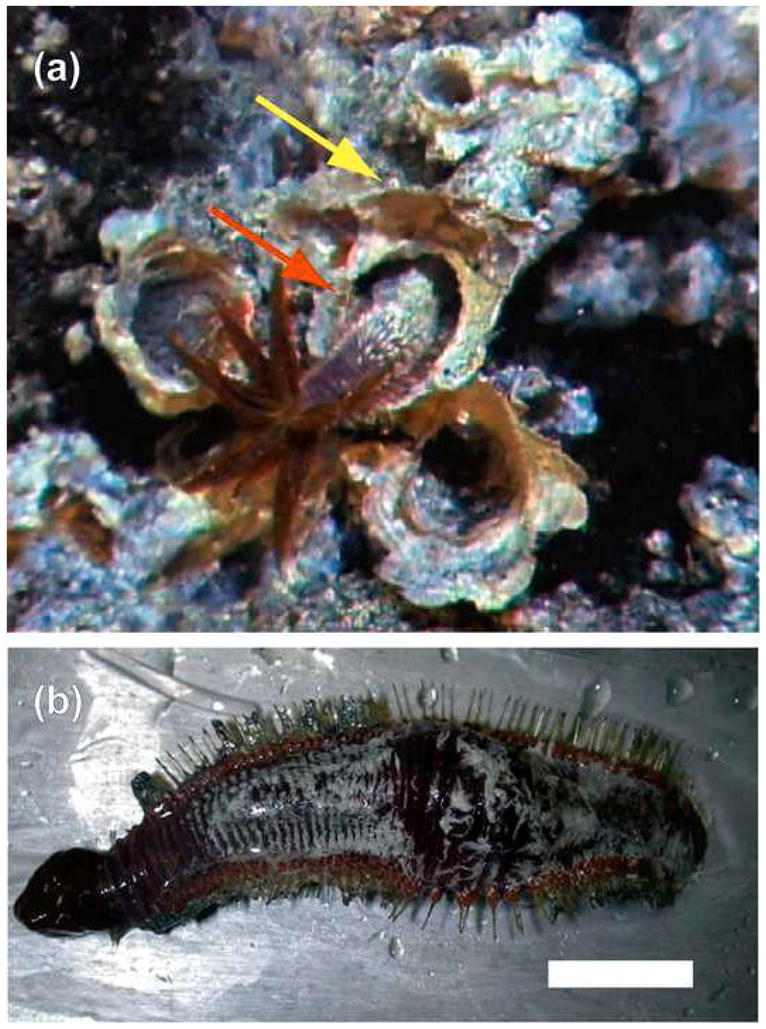
Prokaryotic thermophiles supply stable human protein homologs for structural biology; yet, eukaryotic thermophiles would provide more similar macromolecules plus those missing in microbes. Alvinella pompejana is a deep-sea hydrothermal-vent worm that has been found in temperatures averaging as high as 68 degrees C, with spikes up to 84 degrees C. Here, we used Cu,Zn superoxide dismutase (SOD) to test if this eukaryotic thermophile can provide insights into macromolecular mechanisms and stability by supplying better stable mammalian homologs for structural biology and other biophysical characterizations than those from prokaryotic thermophiles. Identification, cloning, characterization, X-ray scattering (small-angle X-ray scattering, SAXS), and crystal structure determinations show that A. pompejana SOD (ApSOD) is superstable, homologous, and informative. SAXS solution analyses identify the human-like ApSOD dimer. The crystal structure shows the active site at 0.99 A resolution plus anchoring interaction motifs in loops and termini accounting for enhanced stability of ApSOD versus human SOD. Such stabilizing features may reduce movements that promote inappropriate intermolecular interactions, such as amyloid-like filaments found in SOD mutants causing the neurodegenerative disease familial amyotrophic lateral sclerosis or Lou Gehrig's disease. ApSOD further provides the structure of a long-sought SOD product complex at 1.35 A resolution, suggesting a unified inner-sphere mechanism for catalysis involving metal ion movement. Notably, this proposed mechanism resolves apparent paradoxes regarding electron transfer. These results extend knowledge of SOD stability and catalysis and suggest that the eukaryote A. pompejana provides macromolecules highly similar to those from humans, but with enhanced stability more suitable for scientific and medical applications.
原核嗜热菌为结构生物学提供稳定的人类蛋白质同源物;然而,真核嗜热菌会提供更相似的大分子以及微生物中所没有的大分子。庞贝蠕虫是一种深海热液喷口蠕虫,其生存环境的平均温度高达68摄氏度,最高可达84摄氏度。在此,我们利用铜锌超氧化物歧化酶(SOD)来测试这种真核嗜热菌是否能通过为结构生物学和其他生物物理特性提供比原核嗜热菌来源的更稳定的哺乳动物同源物,从而深入了解大分子机制和稳定性。鉴定、克隆、表征、X射线散射(小角X射线散射,SAXS)以及晶体结构测定表明,庞贝蠕虫SOD(ApSOD)具有超稳定性、同源性且信息丰富。SAXS溶液分析确定了类人ApSOD二聚体。晶体结构以0.99埃的分辨率显示了活性位点,以及环和末端的锚定相互作用基序,这些解释了ApSOD相对于人类SOD稳定性增强的原因。这种稳定特征可能会减少促进不适当分子间相互作用的运动,比如在导致神经退行性疾病家族性肌萎缩侧索硬化症(即葛雷克氏症)的SOD突变体中发现的淀粉样细丝。ApSOD还以1.35埃的分辨率提供了长期以来寻求的SOD产物复合物的结构,这表明存在一种涉及金属离子移动的统一内球催化机制。值得注意的是,这一提出的机制解决了有关电子转移的明显矛盾。这些结果扩展了对SOD稳定性和催化作用的认识,并表明真核生物庞贝蠕虫提供了与人类来源的大分子高度相似,但稳定性增强且更适合科学和医学应用的大分子。