Skubitz Keith M, Skubitz Amy P N
The Department of Medicine, University of Minnesota Medical School, Masonic Cancer Center, Minneapolis, MN 55455, USA.
J Transl Med. 2008 Dec 10;6:78. doi: 10.1186/1479-5876-6-78.
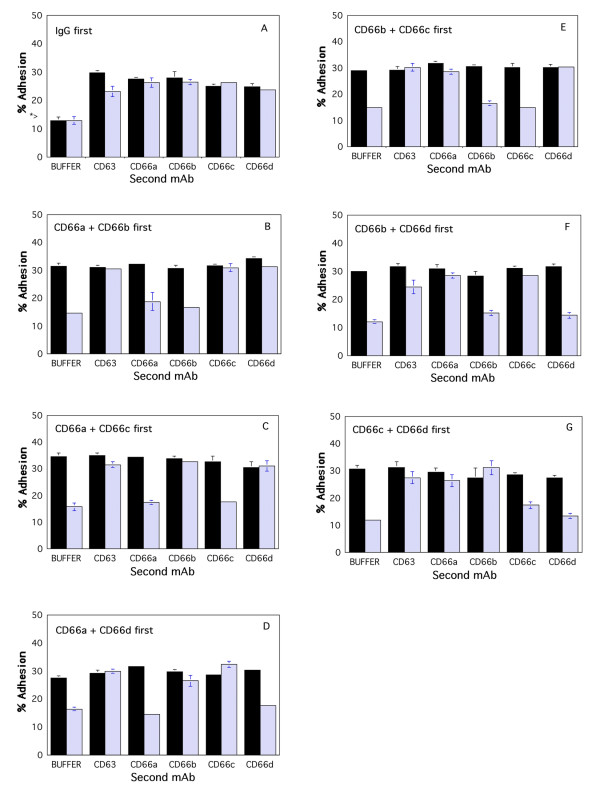
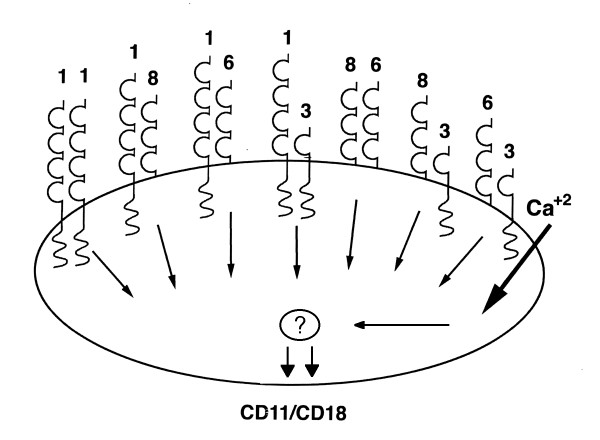
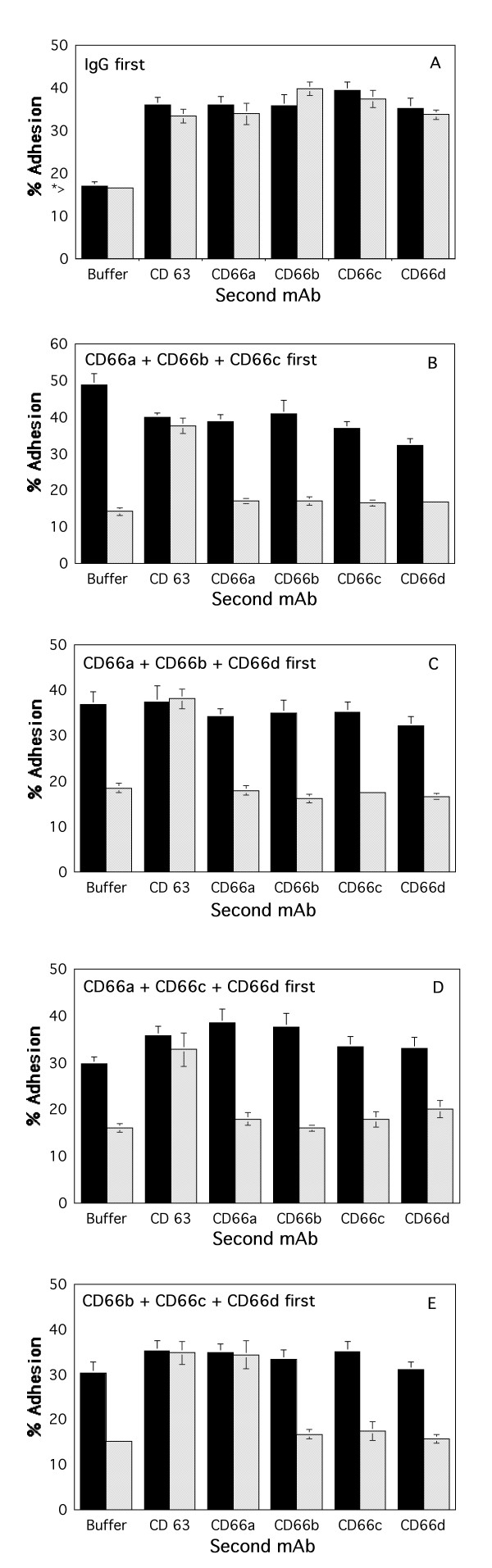
Members of the carcinoembryonic antigen family (CEACAMs) are widely expressed, and, depending on the tissue, capable of regulating diverse functions including tumor promotion, tumor suppression, angiogenesis, and neutrophil activation. Four members of this family, CEACAM1, CEACAM8, CEACAM6, and CEACAM3 (recognized by CD66a, CD66b, CD66c, and CD66d mAbs, respectively), are expressed on human neutrophils. CD66a, CD66b, CD66c, and CD66d antibodies each increase neutrophil adhesion to human umbilical vein endothelial cell monolayers. This increase in neutrophil adhesion caused by CD66 antibodies is blocked by CD18 mAbs and is associated with upregulation of CD11/CD18 on the neutrophil surface. To examine potential interactions of CEACAMs in neutrophil signaling, the effects on neutrophil adhesion to human umbilical vein endothelial cells of a set of CD66 mAbs was tested following desensitization to stimulation by various combinations of these mAbs. Addition of a CD66 mAb in the absence of calcium results in desensitization of neutrophils to stimulation by that CD66 mAb. The current data show that desensitization of neutrophils to any two CEACAMs results in selective desensitization to those two CEACAMs, while the cells remain responsive to the other two neutrophil CEACAMs. In addition, cells desensitized to CEACAM-3, -6, and -8 were still responsive to stimulation of CEACAM1 by CD66a mAbs. In contrast, desensitization of cells to CEACAM1 and any two of the other CEACAMs left the cells unresponsive to all CD66 mAbs. Cells desensitized to any combination of CEACAMs remained responsive to the unrelated control protein CD63. Thus, while there is significant independence of the four neutrophil CEACAMs in signaling, CEACAM1 appears to play a unique role among the neutrophil CEACAMs. A model in which CEACAMs dimerize to form signaling complexes could accommodate the observations. Similar interactions may occur in other cells expressing CEACAMs.
癌胚抗原家族(CEACAMs)成员广泛表达,根据组织不同,能够调节多种功能,包括肿瘤促进、肿瘤抑制、血管生成和中性粒细胞激活。该家族的四个成员,即CEACAM1、CEACAM8、CEACAM6和CEACAM3(分别由CD66a、CD66b、CD66c和CD66d单克隆抗体识别),在人类中性粒细胞上表达。CD66a、CD66b、CD66c和CD66d抗体均可增加中性粒细胞与人脐静脉内皮细胞单层的黏附。CD66抗体引起的中性粒细胞黏附增加可被CD18单克隆抗体阻断,并与中性粒细胞表面CD11/CD18的上调有关。为了研究CEACAMs在中性粒细胞信号传导中的潜在相互作用,在对这些单克隆抗体的各种组合刺激脱敏后,测试了一组CD66单克隆抗体对中性粒细胞与人脐静脉内皮细胞黏附的影响。在无钙情况下添加CD66单克隆抗体可导致中性粒细胞对该CD66单克隆抗体的刺激脱敏。目前的数据表明,中性粒细胞对任何两种CEACAMs脱敏会导致对这两种CEACAMs的选择性脱敏,而细胞对其他两种中性粒细胞CEACAMs仍有反应。此外,对CEACAM - 3、- 6和- 8脱敏的细胞对CD66a单克隆抗体刺激CEACAM1仍有反应。相反,细胞对CEACAM1和其他任何两种CEACAMs脱敏后,对所有CD66单克隆抗体均无反应。对任何CEACAMs组合脱敏的细胞对无关对照蛋白CD63仍有反应。因此,虽然四种中性粒细胞CEACAMs在信号传导中具有显著独立性,但CEACAM1在中性粒细胞CEACAMs中似乎起着独特作用。CEACAMs二聚化形成信号复合物的模型可以解释这些观察结果。类似的相互作用可能发生在表达CEACAMs的其他细胞中。