Sonnenberg Maike, van der Kuip Heiko, Haubeis Silke, Fritz Peter, Schroth Werner, Friedel Godehard, Simon Wolfgang, Mürdter Thomas E, Aulitzky Walter E
Dr Margarete Fischer-Bosch Institute of Clinical Pharmacology and University of Tuebingen, Stuttgart, Germany.
BMC Cancer. 2008 Dec 11;8:364. doi: 10.1186/1471-2407-8-364.
Carcinoma-associated fibroblasts (CAFs) can promote carcinogenesis and tumor progression. Only limited data on the response of CAFs to chemotherapy and their potential impact on therapy outcome are available. This study was undertaken to analyze the influence of chemotherapy on carcinoma-associated fibroblasts (CAFs) in vitro and in vivo.
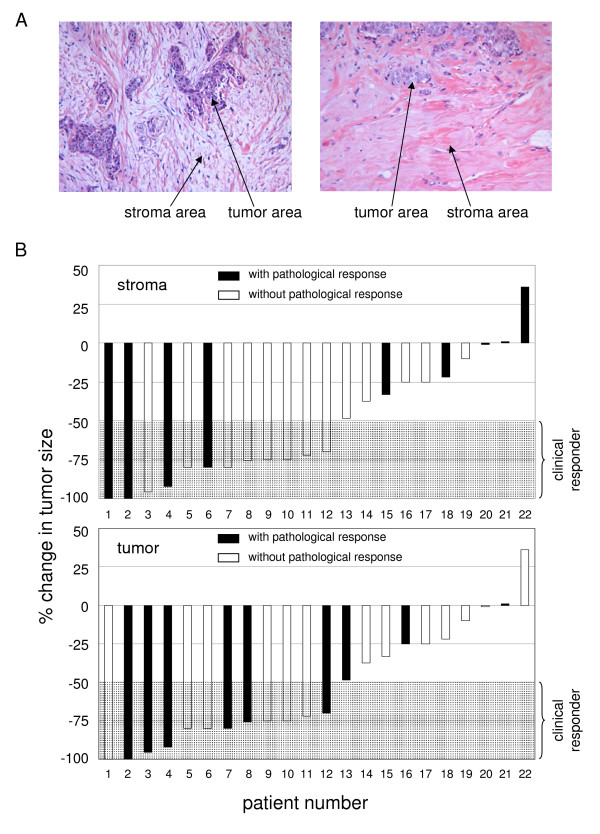
The in vivo response of stromal cells to chemotherapy was investigated in 22 neoadjuvant treated breast tumors on tissue sections before and after chemotherapy. Response to chemotherapy was analyzed in vitro in primary cultures of isolated CAFs from 28 human lung and 9 breast cancer tissues. The response was correlated to Mdm2, ERCC1 and TP53 polymorphisms and TP53 mutation status. Additionally, the cytotoxic effects were evaluated in an ex vivo experiment using cultured tissue slices from 16 lung and 17 breast cancer specimens.
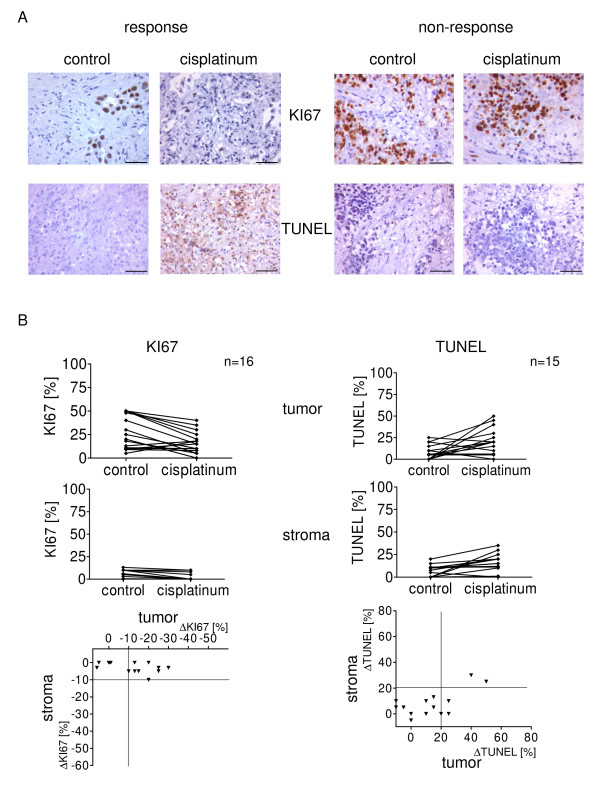
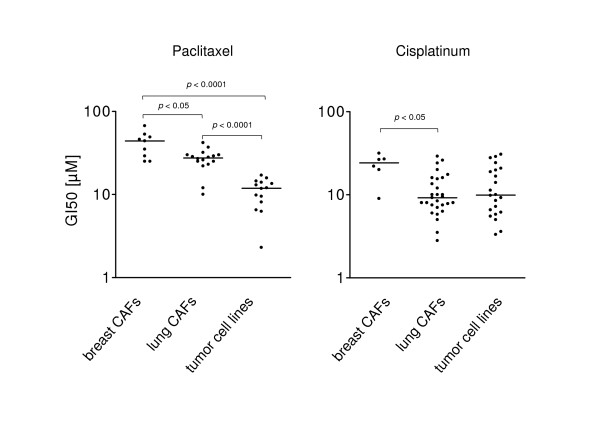
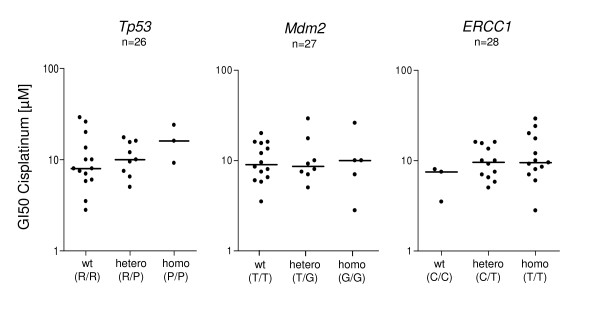
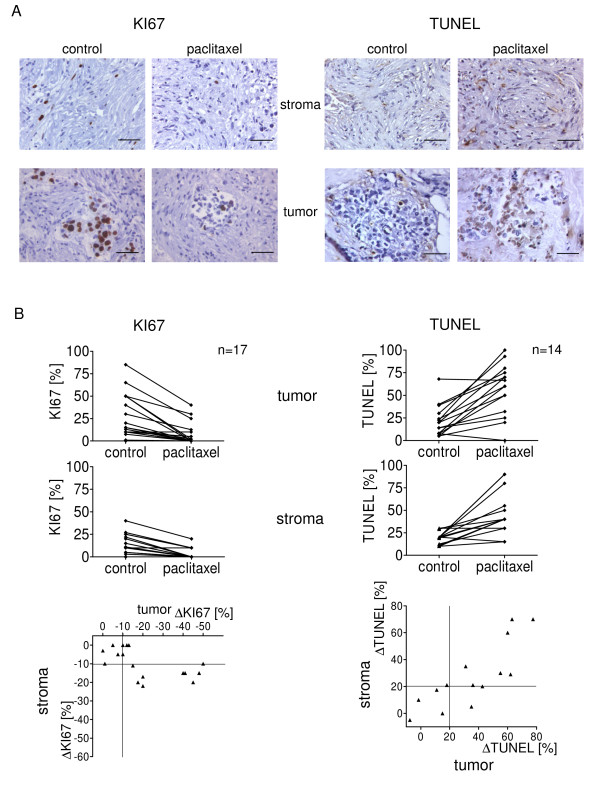
Nine of 22 tumors showed a therapy-dependent reduction of stromal activity. Pathological response of tumor or stroma cells did not correlate with clinical response. Isolated CAFs showed little sensitivity to paclitaxel. In contrast, sensitivity of CAFs to cisplatinum was highly variable with a GI50 ranging from 2.8 to 29.0 microM which is comparable to the range observed in tumor cell lines. No somatic TP53 mutation was detected in any of the 28 CAFs from lung cancer tissue. In addition, response to cisplatinum was not significantly associated with the genotype of TP53 nor Mdm2 and ERCC1 polymorphisms. However, we observed a non-significant trend towards decreased sensitivity in the presence of TP53 variant genotype. In contrast to the results obtained in isolated cell culture, in tissue slice culture breast cancer CAFs responded to paclitaxel within their microenvironment in the majority of cases (9/14). The opposite was observed in lung cancer tissues: only few CAFs were sensitive to cisplatinum within their microenvironment (2/15) whereas a higher proportion responded to cisplatinum in isolated culture.
Similar to cancer cells, CAF response to chemotherapy is highly variable. Beside significant individual/intrinsic differences the sensitivity of CAFs seems to depend also on the cancer type as well as the microenvironment.
癌相关成纤维细胞(CAFs)可促进肿瘤发生和肿瘤进展。关于CAFs对化疗的反应及其对治疗结果潜在影响的数据有限。本研究旨在分析化疗在体外和体内对癌相关成纤维细胞(CAFs)的影响。
在22例接受新辅助治疗的乳腺肿瘤化疗前后的组织切片上,研究基质细胞对化疗的体内反应。从28例人肺癌组织和9例乳腺癌组织中分离出CAFs进行原代培养,体外分析其对化疗的反应。该反应与Mdm2、ERCC1和TP53基因多态性及TP53突变状态相关。此外,使用16例肺癌和17例乳腺癌标本的培养组织切片进行体外实验,评估细胞毒性作用。
22例肿瘤中有9例显示出治疗依赖性的基质活性降低。肿瘤或基质细胞的病理反应与临床反应无关。分离出的CAFs对紫杉醇敏感性较低。相反,CAFs对顺铂的敏感性差异很大,半数抑制浓度(GI50)范围为2.8至29.0微摩尔,这与在肿瘤细胞系中观察到的范围相当。在28例肺癌组织来源的CAFs中均未检测到体细胞TP53突变。此外,对顺铂的反应与TP53基因型、Mdm2和ERCC1基因多态性均无显著相关性。然而,我们观察到在存在TP53变异基因型时敏感性有降低的非显著趋势。与在分离细胞培养中获得的结果相反,在组织切片培养中,大多数情况下(9/14)乳腺癌CAFs在其微环境中对紫杉醇有反应。在肺癌组织中观察到相反的情况:在其微环境中只有少数CAFs对顺铂敏感(2/15),而在分离培养中有较高比例的CAFs对顺铂有反应。
与癌细胞类似,CAFs对化疗的反应高度可变。除了显著的个体/内在差异外,CAFs的敏感性似乎还取决于癌症类型以及微环境。