Fichtner-Feigl S, Strober W, Geissler E K, Schlitt H-J
Mucosal Immunity Section, Laboratory of Host Defenses, National Institute of Allergy and Infectious Diseases, National Institutes of Health, Bethesda, Maryland, USA.
Mucosal Immunol. 2008 Nov;1 Suppl 1(0 1):S24-7. doi: 10.1038/mi.2008.41.
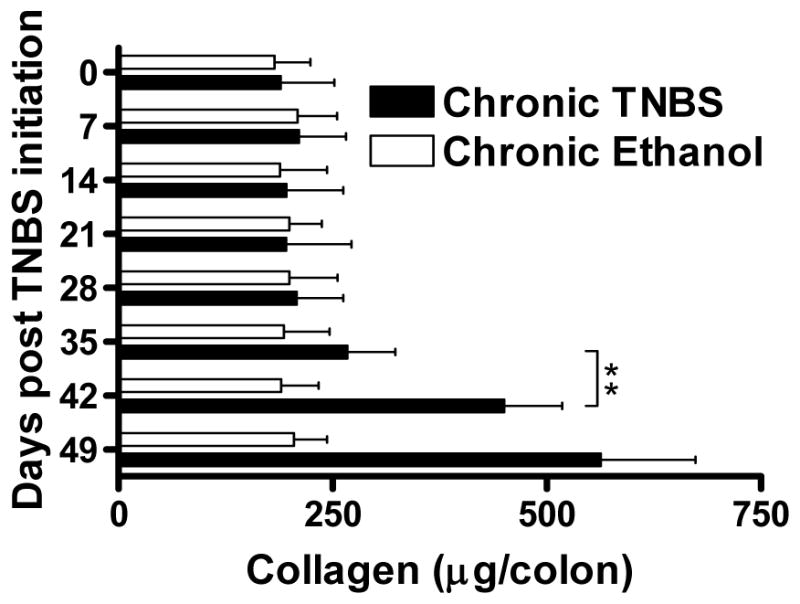
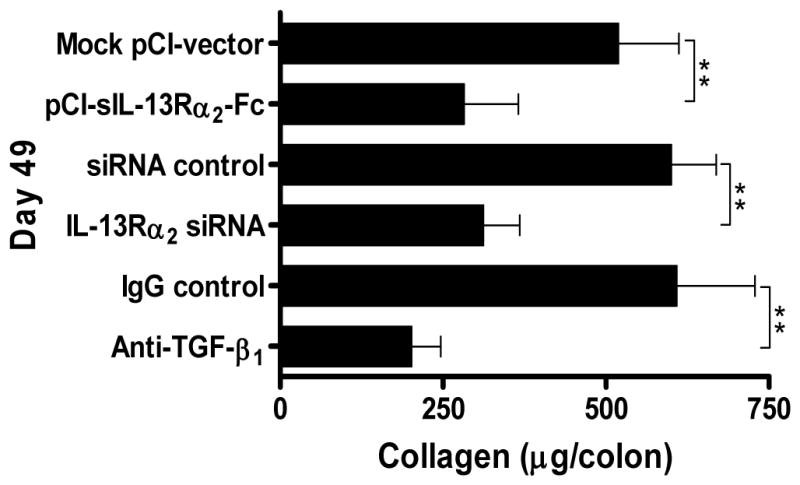
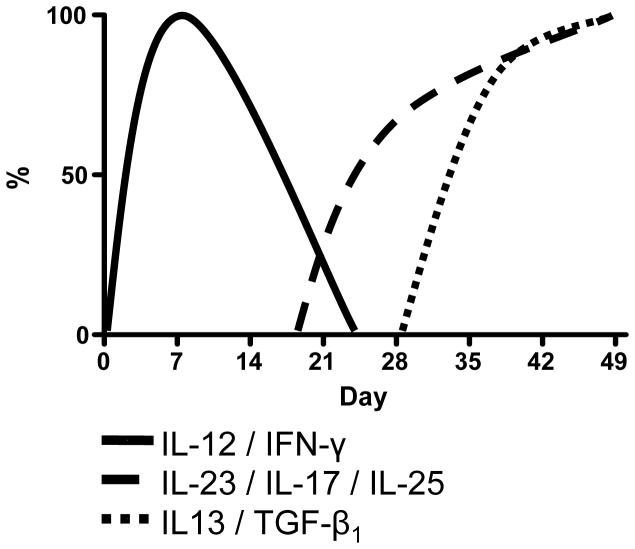
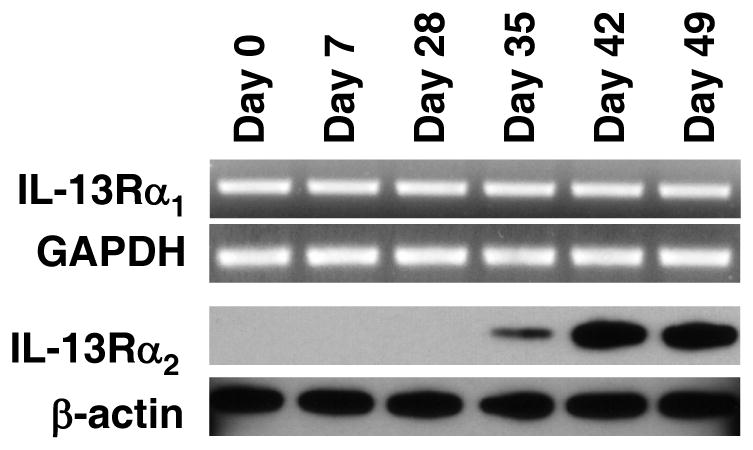
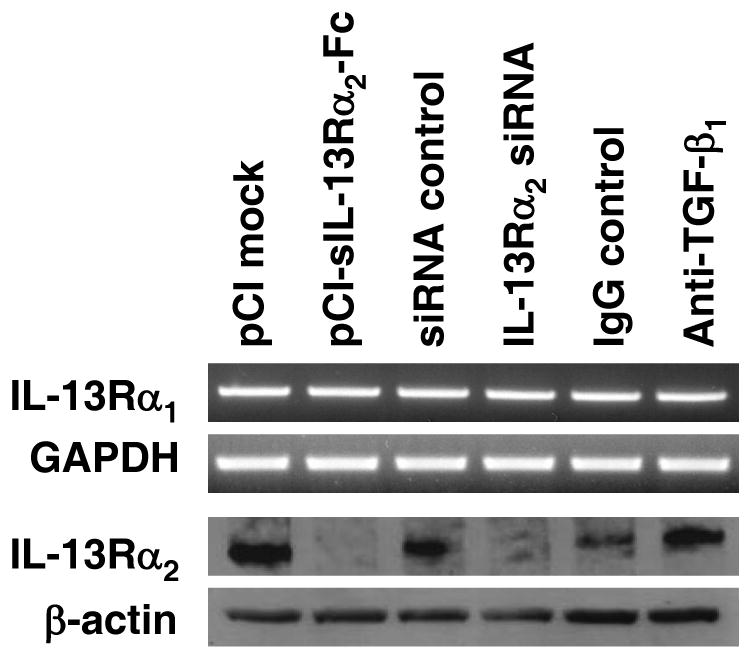
To investigate the immunopathogenesis of inflammation-associated fibrosis we analyzed the chronic colitis and late-developing fibrosis occurring in BALB/c mice administered weekly doses of intrarectal trinitrobenzene sulfonic acid (TNBS). We showed first in this model that an initial T helper type 1 response involving interleukin (IL)-12p70 and interferon-gamma subsides after 3 weeks to be supplanted by an IL-23/IL-25 response beginning after 4-5 weeks. This evolution is followed by gradually increasing production of IL-17 and cytokines ordinarily seen in a T helper type 2 response, particularly IL-13, which reaches a plateau at 8-9 weeks. We then show that IL-13 production results in the induction of an IL-13 receptor formerly thought to function only as a decoy receptor, IL-13Ralpha(2), and this receptor is critical to the production of tumor growth factor (TGF)-beta(1) and the onset of fibrosis. Thus, if IL-13 signaling through this receptor is blocked by administration of soluble IL-13Ralpha(2)-Fc, or by administration of IL-13Ralpha(2)-specific siRNA, TGF-beta(1) is not produced and fibrosis does not occur. These studies show that in chronic TNBS colitis, fibrosis is dependent on the development of an IL-13 response that acts through a novel cell-surface-expressed IL-13 receptor to induce TGF-beta(1).
为了研究炎症相关纤维化的免疫发病机制,我们分析了每周经直肠给予三硝基苯磺酸(TNBS)的BALB/c小鼠发生的慢性结肠炎和后期出现的纤维化。我们首先在该模型中表明,涉及白细胞介素(IL)-12p70和干扰素-γ的初始1型辅助性T细胞反应在3周后消退,随后被4-5周后开始的IL-23/IL-25反应所取代。这种演变之后是IL-17的产生逐渐增加以及通常在2型辅助性T细胞反应中出现的细胞因子,特别是IL-13,其在8-9周达到平台期。然后我们表明,IL-13的产生导致一种以前被认为仅作为诱饵受体发挥作用的IL-13受体即IL-13Rα(2)的诱导,并且该受体对于肿瘤生长因子(TGF)-β(1)的产生和纤维化的发生至关重要。因此,如果通过给予可溶性IL-13Rα(2)-Fc或给予IL-13Rα(2)特异性小干扰RNA来阻断通过该受体的IL-13信号传导,则不会产生TGF-β(1)且不会发生纤维化。这些研究表明,在慢性TNBS结肠炎中,纤维化依赖于通过一种新的细胞表面表达的IL-13受体发挥作用以诱导TGF-β(1)的IL-13反应的发展。