Kadry Mai O
National Research Center, Therapeutic Chemistry Department, Al Bouhooth Street, Dokki, Giza, Egypt.
Heliyon. 2019 Jul 27;5(7):e02162. doi: 10.1016/j.heliyon.2019.e02162. eCollection 2019 Jul.
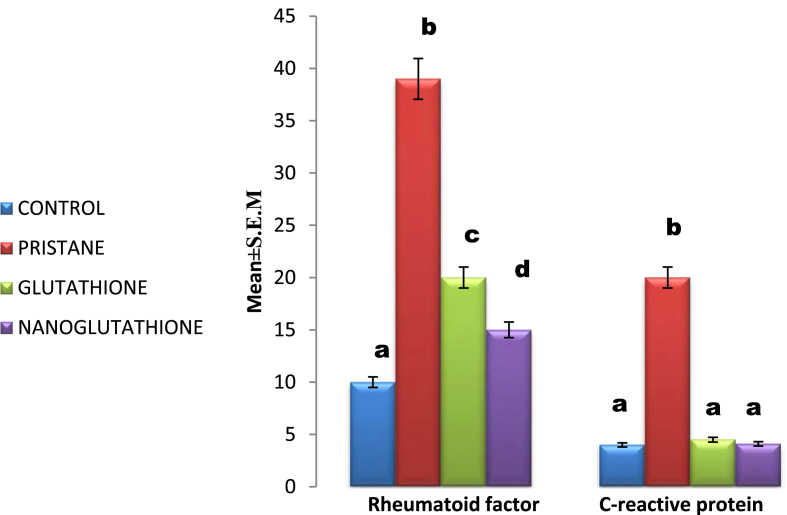
Nano-medicine can passively accumulate in chronic inflammatory tissues via the enhanced permeability and retention phenomenon, or by being conjugated with a ligand that can bind to receptors over expressed by cells inside chronic inflammatory tissues, contributing to reduced systemic side-effects and increased efficacy. This article highlights the utilization of nanomedicine for potential treatment of rheumatoid arthritis. Rheumatoid arthritis was induced in rat model via 2 weeks intradermal injection of pristane at the base of the tail in a daily dose of 150 μl. Susceptible rat strains developed severe arthritis with a sudden onset 3 weeks post pristane injection. Three weeks post pristane administration; rats were treated intravenously with glutathione or liposomal-glutathione in a dose of 5 mg/kg daily for 30 days. Concomitant supplementation with the aforementioned antioxidants effect on proinflammatory marker C-reactive protein (CRP) was assessed. On the other hand, oxidative stress biomarker malondialdehyde (MDA) and rheumatoid factor (RF) compared with pristane treated group was also investigated. The results elucidated that glutathione and liposomal -glutathione significantly reduced rheumatoid factor, malondialdehyde and C-reactive protein levels with the superiority of liposomal -glutathione in this side reflecting its pronounced effect as anti-rheumatoid agent.
纳米医学可以通过增强渗透与滞留效应被动地在慢性炎症组织中蓄积,或者与能够结合慢性炎症组织内细胞过度表达的受体的配体偶联,从而减少全身副作用并提高疗效。本文重点介绍了纳米医学在类风湿性关节炎潜在治疗中的应用。通过在大鼠尾部基部每日皮内注射150 μl pristane,连续注射2周,诱导大鼠类风湿性关节炎模型。易感大鼠品系在注射pristane后3周突然出现严重关节炎。在给予pristane 3周后,大鼠静脉注射谷胱甘肽或脂质体包裹的谷胱甘肽,剂量为5 mg/kg,每日1次,共30天。评估同时补充上述抗氧化剂对促炎标志物C反应蛋白(CRP)的影响。另一方面,还研究了与pristane治疗组相比的氧化应激生物标志物丙二醛(MDA)和类风湿因子(RF)。结果表明,谷胱甘肽和脂质体包裹的谷胱甘肽显著降低了类风湿因子、丙二醛和C反应蛋白水平,脂质体包裹的谷胱甘肽在这方面的优势反映了其作为抗类风湿药物的显著效果。