Schneider Alexandra, Neas Lucas, Herbst Margaret C, Case Martin, Williams Ronald W, Cascio Wayne, Hinderliter Alan, Holguin Fernando, Buse John B, Dungan Kathleen, Styner Maya, Peters Annette, Devlin Robert B
Helmholtz Zentrum München, German Research Center for Environmental Health, Institute of Epidemiology, Ingolstädter Landstrasse 1, Neuherberg, Germany.
Environ Health Perspect. 2008 Dec;116(12):1666-74. doi: 10.1289/ehp.11666. Epub 2008 Jul 31.
Exposure to fine airborne particulate matter [< or =2.5 microm in aerodynamic diameter (PM(2.5))] has been associated with cardiovascular and hematologic effects, especially in older people with cardiovascular disease. Some epidemiologic studies suggest that adults with diabetes also may be a particularly susceptible population.
The purpose of this study was to analyze the short-term effects of ambient PM(2.5) on markers of endothelial function in diabetic volunteers.
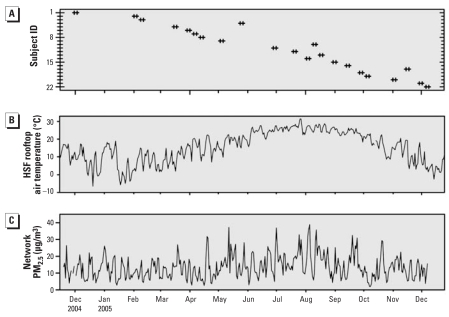
We conducted a prospective panel study in 22 people with type 2 diabetes mellitus in Chapel Hill, North Carolina (USA), from November 2004 to December 2005. We acquired daily measurements of PM(2.5) and meteorologic data at central monitoring sites. On 4 consecutive days, we measured endothelial function by brachial artery ultrasound in all participants and by pulsewave measurements in a subgroup. Data were analyzed using additive mixed models with a random participant effect and adjusted for season, day of the week, and meteorology.
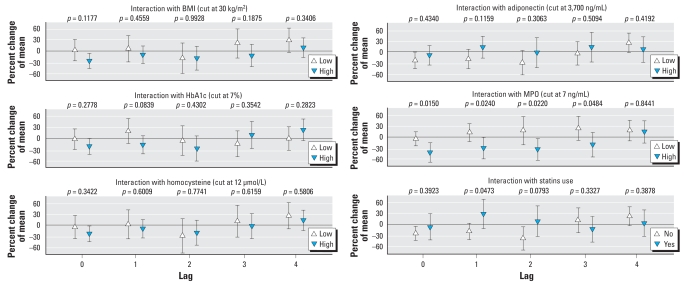
Flow-mediated dilatation decreased in association with PM(2.5) during the first 24 hr, whereas small-artery elasticity index decreased with a delay of 1 and 3 days. These PM(2.5)-associated decrements in endothelial function were greater among participants with a high body mass index, high glycosylated hemoglobin A1c, low adiponectin, or the null polymorphism of glutathione S-transferase M1. However, high levels of myeloperoxidase on the examination day led to strongest effects on endothelial dysfunction.
These data demonstrate that PM(2.5) exposure may cause immediate endothelial dysfunction. Clinical characteristics associated with insulin resistance were associated with enhanced effects of PM on endothelial function. In addition, participants with greater oxidative potential seem to be more susceptible.
暴露于空气中的细颗粒物[空气动力学直径≤2.5微米(PM2.5)]已被证实与心血管和血液学效应有关,尤其是在患有心血管疾病的老年人中。一些流行病学研究表明,糖尿病成年人也可能是特别易感人群。
本研究旨在分析环境PM2.5对糖尿病志愿者内皮功能标志物的短期影响。
2004年11月至2005年12月,我们在美国北卡罗来纳州教堂山对22名2型糖尿病患者进行了一项前瞻性队列研究。我们在中央监测点每日获取PM2.5测量值和气象数据。在连续4天里,我们通过肱动脉超声对所有参与者测量内皮功能,并对一个亚组通过脉搏波测量。使用具有随机参与者效应的加法混合模型分析数据,并对季节、星期几和气象因素进行调整。
在前24小时内,血流介导的血管舒张与PM2.5相关下降,而小动脉弹性指数在延迟1天和3天时下降。这些与PM2.5相关的内皮功能下降在体重指数高、糖化血红蛋白A1c高、脂联素低或谷胱甘肽S-转移酶M1基因多态性缺失的参与者中更大。然而,检查当天高水平的髓过氧化物酶对内皮功能障碍的影响最强。
这些数据表明,暴露于PM2.5可能导致即时内皮功能障碍。与胰岛素抵抗相关临床特征与PM对内皮功能的增强作用相关。此外,氧化潜能较高的参与者似乎更易感。