Luchman H Artee, Benediktsson Hallgrimur, Villemaire Michelle L, Peterson Alan C, Jirik Frank R
Department of Biochemistry and Molecular Biology, and The McCaig Institute for Bone and Joint Health, University of Calgary, Calgary, Alberta, Canada.
PLoS One. 2008;3(12):e3940. doi: 10.1371/journal.pone.0003940. Epub 2008 Dec 15.
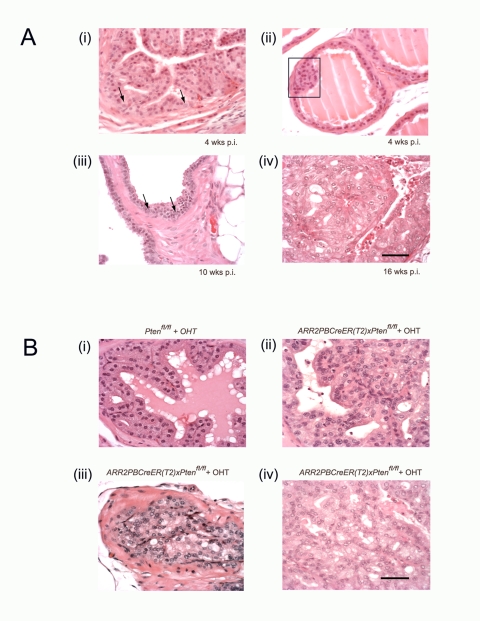
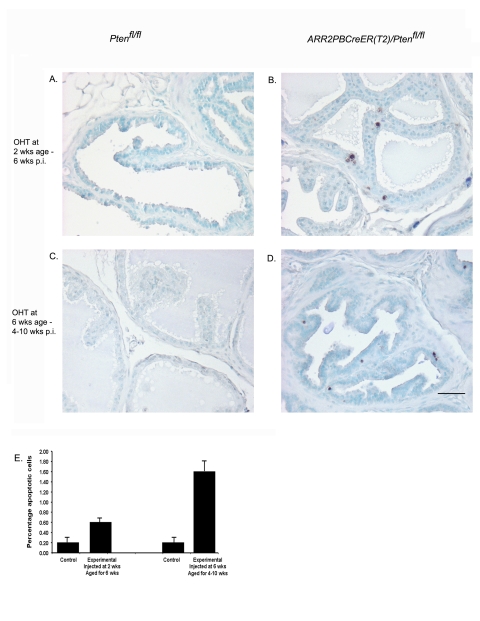
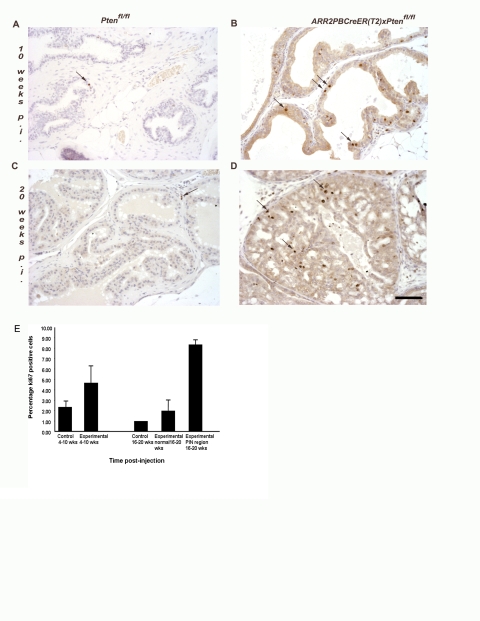
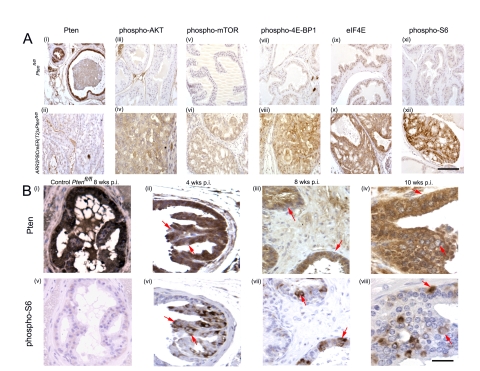
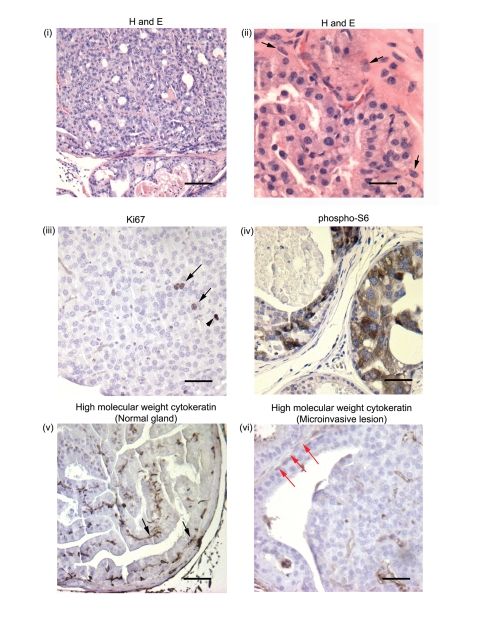
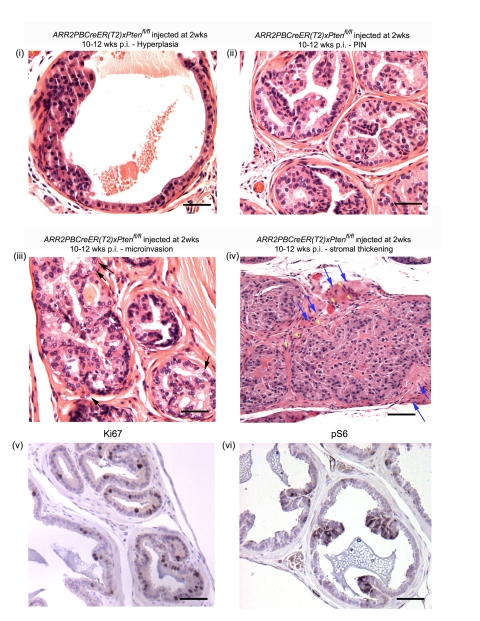
Loss of the PTEN tumor suppressor is a common occurrence in human prostate cancer, particularly in advanced disease. In keeping with its role as a pivotal upstream regulator of the phosphatidylinositol 3-kinase signaling pathway, experimentally-induced deletion of Pten in the murine prostate invariably results in neoplasia. However, and unlike humans where prostate tumorigenesis likely evolves over decades, disease progression in the constitutively Pten deficient mouse prostate is relatively rapid, culminating in invasive cancer within several weeks post-puberty. Given that the prostate undergoes rapid androgen-dependent growth at puberty, and that Pten excisions during this time might be especially tumorigenic, we hypothesized that delaying prostate-specific Pten deletions until immediately after puberty might alter the pace of tumorigenesis. To this end we generated mice with a tamoxifen-inducible Cre recombinase transgene enabling temporal control over prostate-specific gene alterations. This line was then interbred with mice carrying floxed Pten alleles. Despite evidence of increased Akt/mTOR/S6K axis activity at early time points in Pten-deficient epithelial cells, excisions induced in the post-pubertal (6 wk-old) prostate yielded gradual acquisition of a range of lesions. These progressed from pre-malignant changes (nuclear atypia, focal hyperplasia) and low grade prostatic intraepithelial neoplasia (PIN) at 16-20 wks post-tamoxifen exposure, to overtly malignant lesions by approximately 1 yr of age, characterized by high-grade PIN and microinvasive carcinoma. In contrast, when Pten excisions were triggered in the pre-pubertal (2 week-old) prostate, neoplasia evolved over a more abbreviated time-frame, with a spectrum of premalignant lesions, as well as overt PIN and microinvasive carcinoma by 10-12 wks post-tamoxifen exposure. These results indicate that the developmental stage at which Pten deletions are induced dictates the pace of PIN development.
抑癌基因PTEN的缺失在人类前列腺癌中很常见,尤其是在晚期疾病中。与其作为磷脂酰肌醇3激酶信号通路关键上游调节因子的作用一致,实验诱导小鼠前列腺中Pten缺失总是会导致肿瘤形成。然而,与人类前列腺肿瘤发生可能历经数十年不同,组成型Pten缺陷小鼠前列腺中的疾病进展相对较快,在青春期后几周内就会发展为浸润性癌。鉴于前列腺在青春期会经历快速的雄激素依赖性生长,且此时Pten缺失可能具有特别的致瘤性,我们推测将前列腺特异性Pten缺失推迟到青春期刚结束后可能会改变肿瘤发生的速度。为此,我们构建了带有他莫昔芬诱导型Cre重组酶转基因的小鼠,从而能够对前列腺特异性基因改变进行时间控制。然后将该品系与携带floxed Pten等位基因的小鼠杂交。尽管在Pten缺陷的上皮细胞早期时间点有Akt/mTOR/S6K轴活性增加的证据,但在青春期后(6周龄)前列腺中诱导的切除产生了一系列病变的逐渐形成。这些病变从他莫昔芬暴露后16 - 20周的癌前变化(核异型性、局灶性增生)和低级别前列腺上皮内瘤变(PIN),发展到大约1岁时的明显恶性病变,其特征为高级别PIN和微浸润癌。相比之下,当在青春期前(2周龄)前列腺中触发Pten切除时,肿瘤形成在更短的时间内发生,在他莫昔芬暴露后10 - 12周出现一系列癌前病变以及明显的PIN和微浸润癌。这些结果表明,诱导Pten缺失的发育阶段决定了PIN发展的速度。