Scoll Benjamin J, Wong Yu-Ning, Egleston Brian L, Kunkle David A, Saad Ismail R, Uzzo Robert G
Department of Urologic Oncology, Fox Chase Cancer Center, Temple University School of Medicine, Philadelphia, Pennsylvania 19111, USA.
J Urol. 2009 Feb;181(2):506-11. doi: 10.1016/j.juro.2008.10.026. Epub 2008 Dec 13.
Recent data demonstrate that age may be a significant independent prognostic variable following treatment for renal cell carcinoma. We analyzed data from the SEER (Surveillance, Epidemiology and End Results) database to evaluate the relative survival of patients treated surgically for localized renal cell carcinoma as related to tumor size and patient age.
Patients in the SEER database with localized renal cell carcinoma were stratified into cohorts by age and tumor size. Three and 5-year relative survival, the ratio of observed survival in the cancer population to the expected survival of an age, sex and race matched cancer-free population, was calculated with SEER-Stat. Brown's method was used for hypothesis testing.
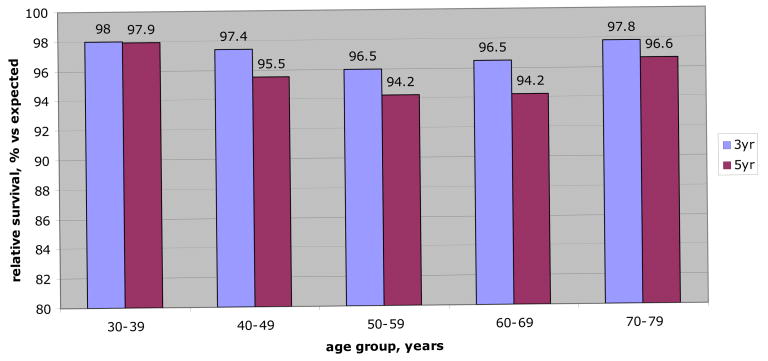
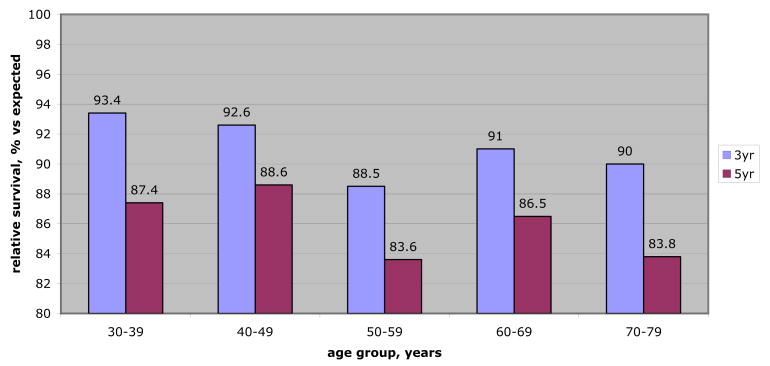
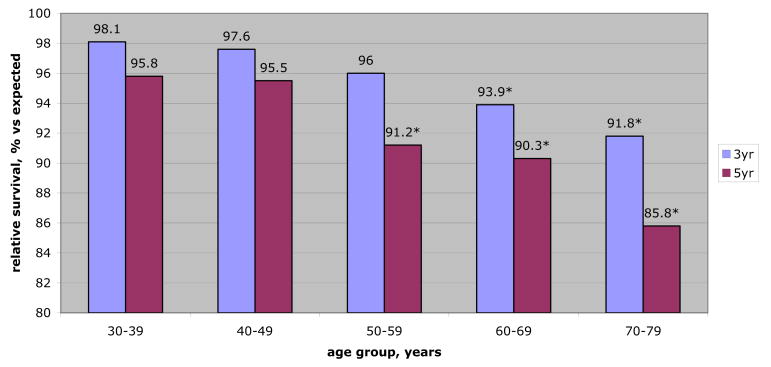
A total of 8,578 patients with surgically treated, localized renal cell carcinoma were identified. While 3 and 5-year survival for patients with small (less than 4 cm) renal cell carcinoma was no different from that of matched cancer-free controls, patients treated for large (greater than 7 cm) localized renal cell carcinoma experienced decreased 5-year relative survival across all age groups. Therefore, age was not a significant predictor of relative survival for patients with small (less than 4 cm) or large (greater than 7 cm) tumors. However, a statistically significant trend toward lower relative survival with increasing age was demonstrated in patients with medium size tumors (4 to 7 cm). Hypothesis testing confirmed these findings.
These data suggest that relative survival is high in patients with tumors less than 4 cm and lower in patients with tumors larger than 7 cm regardless of age. However, increasing age may be related to worse outcomes in patients with tumors 4 to 7 cm. The cause of this observation warrants further investigation.
近期数据表明,年龄可能是肾细胞癌治疗后一个重要的独立预后变量。我们分析了监测、流行病学和最终结果(SEER)数据库中的数据,以评估接受手术治疗的局限性肾细胞癌患者的相对生存率与肿瘤大小和患者年龄的关系。
SEER数据库中患有局限性肾细胞癌的患者按年龄和肿瘤大小分层为队列。使用SEER-Stat计算3年和5年相对生存率,即癌症人群中观察到的生存率与年龄、性别和种族匹配的无癌人群预期生存率的比值。采用布朗方法进行假设检验。
共确定了8578例接受手术治疗的局限性肾细胞癌患者。小(小于4cm)肾细胞癌患者的3年和5年生存率与匹配的无癌对照无差异,而接受大(大于7cm)局限性肾细胞癌治疗的患者在所有年龄组中5年相对生存率均下降。因此,年龄不是小(小于4cm)或大(大于7cm)肿瘤患者相对生存的重要预测因素。然而,中等大小肿瘤(4至7cm)患者中,随着年龄增长相对生存率降低的统计学显著趋势得到了证实。假设检验证实了这些发现。
这些数据表明,无论年龄如何,肿瘤小于4cm的患者相对生存率较高,而肿瘤大于7cm的患者相对生存率较低。然而,年龄增长可能与肿瘤4至7cm患者的预后较差有关。这一观察结果的原因值得进一步研究。