Das Suchismita, Dimopoulos George
W, Harry Feinstone Department of Molecular Microbiology and Immunology, Bloomberg School of Public Health, Johns Hopkins University, 615N Wolfe Street, Baltimore, MD 21205-2179, USA.
BMC Physiol. 2008 Dec 16;8:23. doi: 10.1186/1472-6793-8-23.
Anopheles gambiae mosquitoes exhibit an endophilic, nocturnal blood feeding behavior. Despite the importance of light as a regulator of malaria transmission, our knowledge on the molecular interactions between environmental cues, the circadian oscillators and the host seeking and feeding systems of the Anopheles mosquitoes is limited.
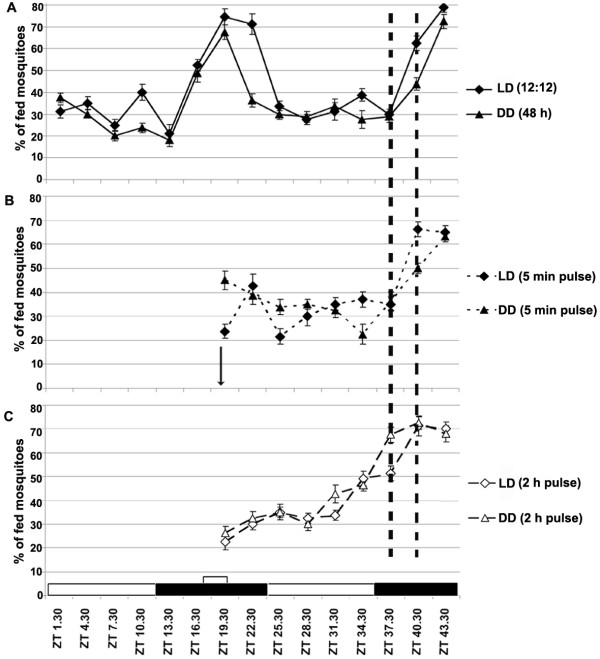
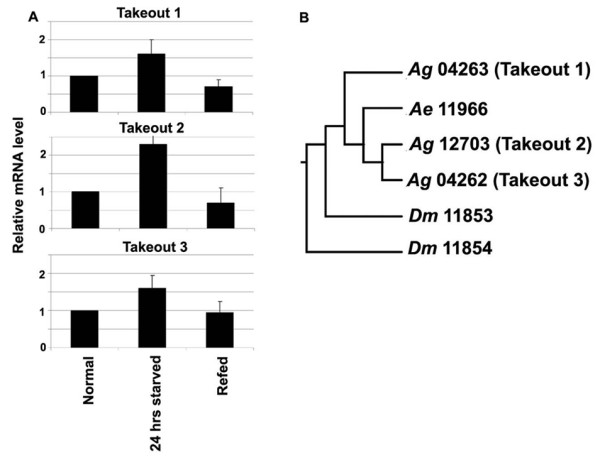
In the present study, we show that the blood feeding behavior of mosquitoes is under circadian control and can be modulated by light pulses, both in a clock dependent and in an independent manner. Short light pulses (approximately 2-5 min) in the dark phase can inhibit the blood-feeding propensity of mosquitoes momentarily in a clock independent manner, while longer durations of light stimulation (approximately 1-2 h) can induce a phase advance in blood-feeding propensity in a clock dependent manner. The temporary feeding inhibition after short light pulses may reflect a masking effect of light, an unknown mechanism which is known to superimpose on the true circadian regulation. Nonetheless, the shorter light pulses resulted in the differential regulation of a variety of genes including those implicated in the circadian control, suggesting that light induced masking effects also involve clock components. Light pulses (both short and long) also regulated genes implicated in feeding as well as different physiological processes like metabolism, transport, immunity and protease digestions. RNAi-mediated gene silencing assays of the light pulse regulated circadian factors timeless, cryptochrome and three takeout homologues significantly up-regulated the mosquito's blood-feeding propensity. In contrast, gene silencing of light pulse regulated olfactory factors down-regulated the mosquito's propensity to feed on blood.
Our study show that the mosquito's feeding behavior is under circadian control. Long and short light pulses can induce inhibition of blood-feeding through circadian and unknown mechanisms, respectively, that involve the chemosensory system.
冈比亚按蚊表现出嗜内性、夜间吸血行为。尽管光作为疟疾传播调节因子很重要,但我们对环境线索、生物钟振荡器与按蚊宿主寻找和进食系统之间分子相互作用的了解有限。
在本研究中,我们表明蚊子的吸血行为受昼夜节律控制,并且可以通过光脉冲以依赖生物钟和不依赖生物钟的方式进行调节。黑暗阶段的短光脉冲(约2 - 5分钟)可以以不依赖生物钟的方式瞬间抑制蚊子的吸血倾向,而较长时间的光刺激(约1 - 2小时)可以以依赖生物钟的方式诱导吸血倾向的相位提前。短光脉冲后的暂时进食抑制可能反映了光的掩盖效应,这是一种已知叠加在真正昼夜节律调节之上的未知机制。尽管如此,较短的光脉冲导致了包括那些与昼夜节律控制有关的多种基因的差异调节,这表明光诱导的掩盖效应也涉及生物钟成分。光脉冲(短脉冲和长脉冲)还调节了与进食以及不同生理过程如代谢、运输、免疫和蛋白酶消化相关的基因。对光脉冲调节的昼夜节律因子timeless、隐花色素和三个外卖同源物进行RNA干扰介导的基因沉默分析,显著上调了蚊子的吸血倾向。相反,光脉冲调节的嗅觉因子的基因沉默下调了蚊子吸食血液的倾向。
我们的研究表明蚊子的进食行为受昼夜节律控制。长光脉冲和短光脉冲分别可以通过涉及化学感应系统的昼夜节律和未知机制诱导吸血抑制。