Björklund Olga, Kahlström Johan, Salmi Peter, Fredholm Bertil B
Department of Physiology and Pharmacology, Karolinska Institutet, Stockholm, Sweden.
PLoS One. 2008;3(12):e3977. doi: 10.1371/journal.pone.0003977. Epub 2008 Dec 18.
There are lingering concerns about caffeine consumption during pregnancy or the early postnatal period, partly because there may be long-lasting behavioral changes after caffeine exposure early in life.
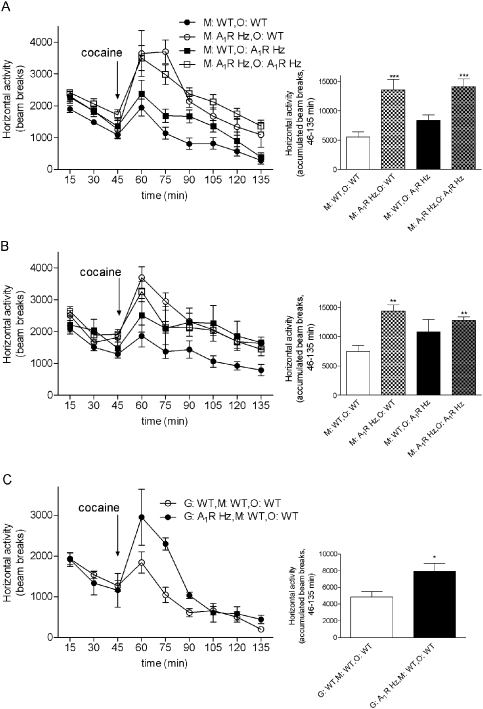
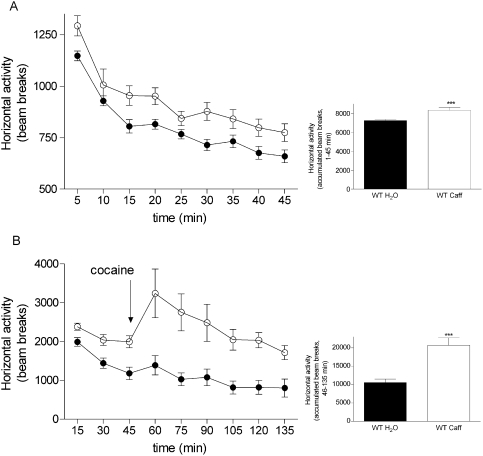
METHODOLOGY/PRINCIPAL FINDINGS: We show that pregnant wild type (WT) mice given modest doses of caffeine (0.3 g/l in drinking water) gave birth to offspring that as adults exhibited increased locomotor activity in an open field. The offspring also responded to cocaine challenge with greater locomotor activity than mice not perinatally exposed to caffeine. We performed the same behavioral experiments on mice heterozygous for adenosine A(1) receptor gene (A(1)RHz). In these mice signaling via adenosine A(1) receptors is reduced to about the same degree as after modest consumption of caffeine. A(1)RHz mice had a behavioral profile similar to WT mice perinatally exposed to caffeine. Furthermore, it appeared that the mother's genotype, not offspring's, was critical for behavioral changes in adult offspring. Thus, if the mother partially lacked A(1) receptors the offspring displayed more hyperactivity and responded more strongly to cocaine stimulation as adults than did mice of a WT mother, regardless of their genotype. This indicates that long-term behavioral alterations in the offspring result from the maternal effect of caffeine, and not a direct effect on fetus. WT offspring from WT mother but having a A(1)R Hz grandmother preserved higher locomotor response to cocaine.
CONCLUSIONS/SIGNIFICANCE: We suggest that perinatal caffeine, by acting on adenosine A(1) receptors in the mother, causes long-lasting behavioral changes in the offspring that even manifest themselves in the second generation.
孕期或产后早期摄入咖啡因一直令人担忧,部分原因是生命早期接触咖啡因后可能会产生持久的行为变化。
方法/主要发现:我们发现,给怀孕的野生型(WT)小鼠喂食适量咖啡因(饮用水中含0.3 g/l),所产的后代成年后在旷场试验中表现出更高的运动活性。这些后代对可卡因刺激的反应也比未在围产期接触咖啡因的小鼠更活跃。我们对腺苷A(1)受体基因杂合子(A(1)RHz)小鼠进行了同样的行为实验。在这些小鼠中,通过腺苷A(1)受体的信号传导减少到与适量摄入咖啡因后的程度大致相同。A(1)RHz小鼠的行为特征与围产期接触咖啡因的WT小鼠相似。此外,似乎是母亲的基因型而非后代的基因型对成年后代的行为变化至关重要。因此,如果母亲部分缺乏A(1)受体,其后代成年后比野生型母亲的小鼠表现出更多的多动,对可卡因刺激的反应也更强烈,无论其自身基因型如何。这表明后代的长期行为改变是由咖啡因的母体效应引起的,而非对胎儿的直接影响。来自野生型母亲但有A(1)R Hz祖母的野生型后代对可卡因仍保持较高的运动反应。
结论/意义:我们认为,围产期咖啡因通过作用于母亲体内的腺苷A(1)受体,会导致后代产生持久的行为变化,甚至在第二代中也会表现出来。