Daniels Ramon, van Rossum Erik, de Witte Luc, Kempen Gertrudis I J M, van den Heuvel Wim
Faculty of Health and Care, Zuyd University of Applied Sciences, Heerlen, the Netherlands.
BMC Health Serv Res. 2008 Dec 30;8:278. doi: 10.1186/1472-6963-8-278.
There is an interest for intervention studies aiming at the prevention of disability in community-dwelling physically frail older persons, though an overview on their content, methodological quality and effectiveness is lacking.
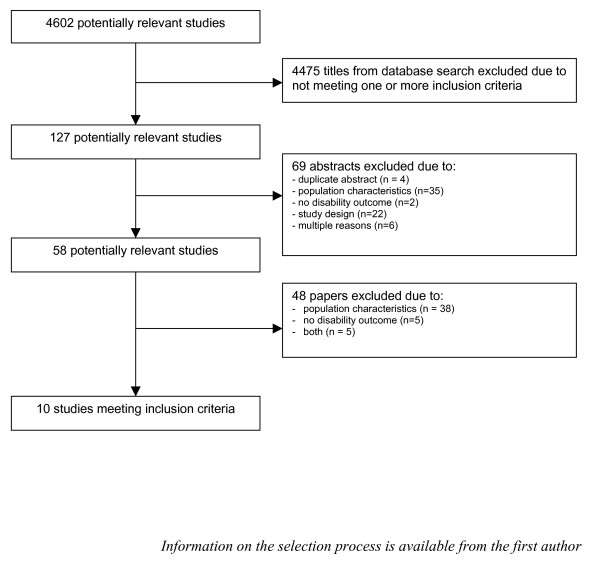
A search for clinical trials involved databases PubMed, CINAHL and Cochrane Central Register of Controlled Trials and manually hand searching. Trials that included community-dwelling frail older persons based on physical frailty indicators and used disability measures for outcome evaluation were included. The selection of papers and data-extraction was performed by two independent reviewers. Out of 4602 titles, 10 papers remained that met the inclusion criteria. Of these, 9 were of sufficient methodological quality and concerned 2 nutritional interventions and 8 physical exercise interventions.
No evidence was found for the effect of nutritional interventions on disability measures. The physical exercise interventions involved 2 single-component programs focusing on lower extremity strength and 6 multi-component programs addressing a variety of physical parameters. Out of 8 physical exercise interventions, three reported positive outcomes for disability. There was no evidence for the effect of single lower extremity strength training on disability. Differences between the multi-component interventions in e.g. individualization, duration, intensity and setting hamper the interpretation of the elements that consistently produced successful outcomes.
There is an indication that relatively long-lasting and high-intensive multicomponent exercise programs have a positive effect on ADL and IADL disability for community-living moderate physically frail older persons. Future research into disability prevention in physical frail older persons could be directed to more individualized and comprehensive programs.
针对社区居住的身体虚弱老年人预防残疾的干预研究受到关注,但其内容、方法学质量和有效性缺乏综述。
检索涉及PubMed、CINAHL和Cochrane对照试验中央注册库的临床试验,并进行手工检索。纳入基于身体虚弱指标纳入社区居住的虚弱老年人并使用残疾测量方法进行结局评估的试验。论文的筛选和数据提取由两名独立的评审员进行。在4602篇标题中,有10篇论文符合纳入标准。其中9篇具有足够的方法学质量,涉及2项营养干预和8项体育锻炼干预。
未发现营养干预对残疾测量有影响的证据。体育锻炼干预包括2个侧重于下肢力量的单组分项目和6个涉及多种身体参数的多组分项目。在8项体育锻炼干预中,有3项报告了残疾方面的积极结果。没有证据表明单纯的下肢力量训练对残疾有影响。多组分干预在个体化、持续时间、强度和环境等方面的差异妨碍了对始终产生成功结果的因素的解释。
有迹象表明,相对持久和高强度的多组分运动项目对社区居住的中度身体虚弱老年人的日常生活活动能力和工具性日常生活活动能力残疾有积极影响。未来针对身体虚弱老年人预防残疾的研究可指向更个体化和全面的项目。