Ng Laura J, Cropley Jennifer E, Pickett Hilda A, Reddel Roger R, Suter Catherine M
Victor Chang Cardiac Research Institute, Darlinghurst 2010, Australia.
Nucleic Acids Res. 2009 Mar;37(4):1152-9. doi: 10.1093/nar/gkn1030. Epub 2009 Jan 7.
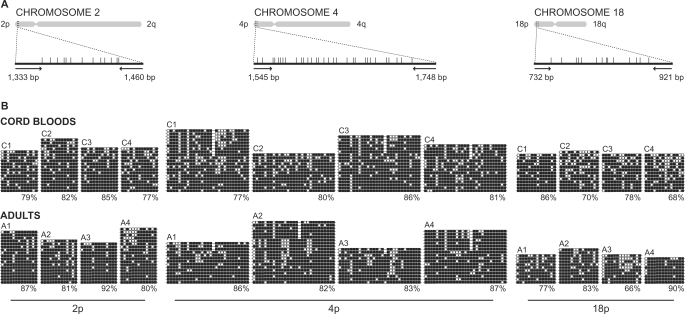
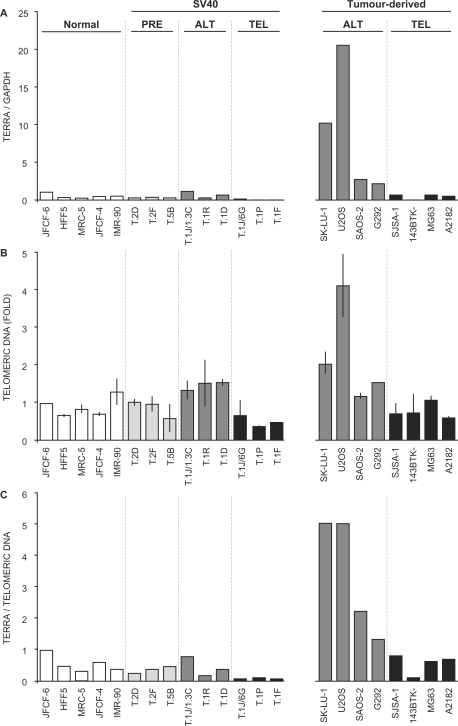
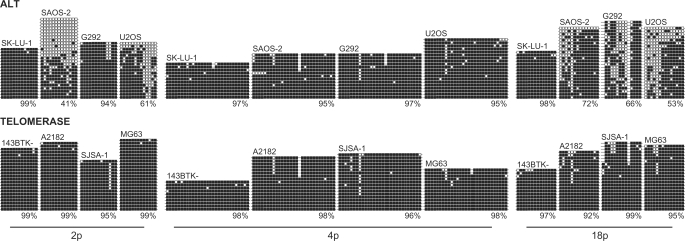
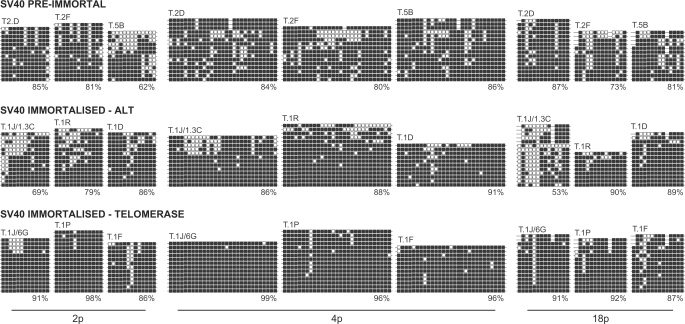
Tumours and immortalized cells avoid telomere attrition by using either the ribonucleoprotein enzyme telomerase or a recombination-based alternative lengthening of telomeres (ALT) mechanism. Available evidence from mice suggests that the epigenetic state of the telomere may influence the mechanism of telomere maintenance, but this has not been directly tested in human cancer. Here we investigated cytosine methylation directly adjacent to the telomere as a marker of the telomere's epigenetic state in a panel of human cell lines. We find that while ALT cells show highly heterogeneous patterns of subtelomeric methylation, subtelomeric regions in telomerase-positive cells invariably show denser methylation than normal cells, being almost completely methylated. When compared to matched normal and ALT cells, telomerase-positive cells also exhibit reduced levels of the telomeric repeat-containing-RNA (TERRA), whose transcription originates in the subtelomere. Our results are consistent with the notion that TERRA may inhibit telomerase: the heavy cytosine methylation we observe in telomerase-positive cells may reflect selection for TERRA silencing in order to facilitate telomerase activity at the telomere. These data suggest that the epigenetic differences between telomerase-positive and ALT cells may underlie the mechanism of telomere maintenance in human tumorigenesis and highlight the broad reaching consequences of epigenetic dysregulation in cancer.
肿瘤细胞和永生化细胞通过使用核糖核蛋白酶端粒酶或基于重组的端粒替代延长(ALT)机制来避免端粒磨损。来自小鼠的现有证据表明,端粒的表观遗传状态可能影响端粒维持机制,但这尚未在人类癌症中得到直接验证。在这里,我们研究了在一组人类细胞系中紧邻端粒的胞嘧啶甲基化,将其作为端粒表观遗传状态的标志物。我们发现,虽然ALT细胞显示出亚端粒甲基化的高度异质性模式,但端粒酶阳性细胞中的亚端粒区域总是比正常细胞显示出更密集的甲基化,几乎完全甲基化。与匹配的正常细胞和ALT细胞相比,端粒酶阳性细胞还表现出端粒重复序列含RNA(TERRA)水平的降低,其转录起始于亚端粒。我们的结果与TERRA可能抑制端粒酶的观点一致:我们在端粒酶阳性细胞中观察到的大量胞嘧啶甲基化可能反映了对TERRA沉默的选择,以便促进端粒处的端粒酶活性。这些数据表明,端粒酶阳性细胞和ALT细胞之间的表观遗传差异可能是人类肿瘤发生中端粒维持机制的基础,并突出了癌症中表观遗传失调的广泛影响。