Wang Min, Hu Youji, Stearns Mark E
Department of Pathology, Drexel University College of Medicine, 15th and Vine Streets, Philadelphia, PA 19102-1192, USA.
J Exp Clin Cancer Res. 2009 Jan 12;28(1):6. doi: 10.1186/1756-9966-28-6.
A number of studies have previously shown that the over expression of different ribosomal proteins might play an important role in cancer (i.e. S3a, L10, L16). We have previously reported that RPS2, a 33 Kda ribosomal protein was over expressed in malignant prostate cancer cell lines and in archived tumor specimens. Thus, RPS2 or other aberrantly over-expressed ribosomal proteins might promote cancer and be excellent therapeutic targets for treatment of the disease.
Western blotting and RT-PCR have been used to measure and compare the levels of expression of RPS2 in a variety of malignant prostate cancer cell lines, plus normal and benign cells lines. We have developed a 'ribozyme-like' DNAZYM-1P '10-23' motif oligonucleotide and examined whether it targets RPS2 in different cell lines by RT-PCR and Western blots. Growth and apoptosis assays were carried out to measure whether DNAZYM-1P 'knock-down' of RPS2 influenced cell proliferation or survival. We have also developed a SCID mouse tumor model with PC-3ML cells to determine whether DNAZYM-1P targeting of RPS2 compromised tumor growth and mouse survival rates in vivo.
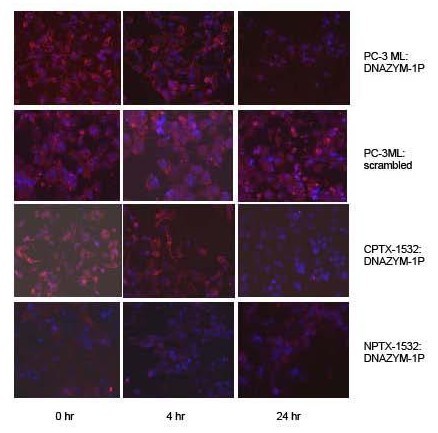
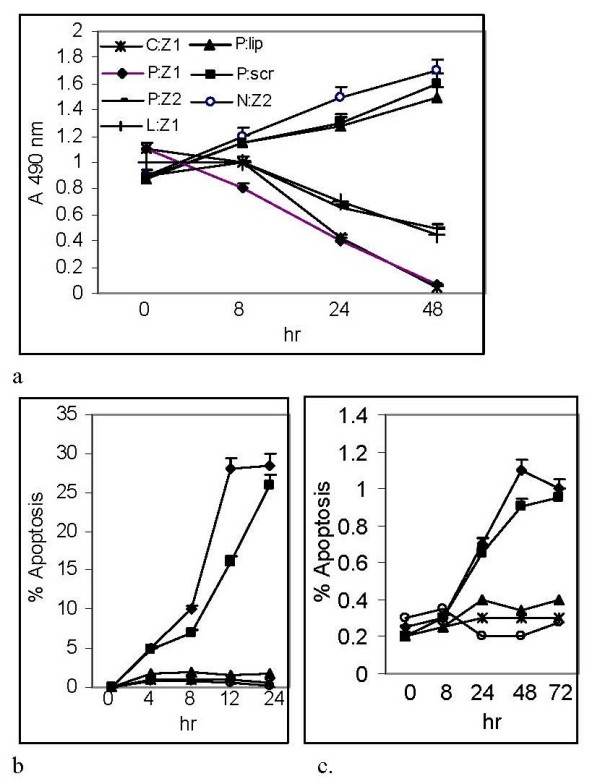
Western blots showed that PC-3ML, LNCaP, CPTX-1532, and pBABE-cmyc stably transfected IBC-10a cells all over-expressed RPS2, whereas IBC-10a parent, NPTX-1532, and BPH-1 cells or mouse NIH-3T3 cells expressed barely detectable levels of RPS2. RT-PCR assays showed that DNAZYM-1P, which targeted RPS2, 'knocked-down' RPS2 expression in the malignant cells (i.e. PC-3ML cells) in vitro. The DNAZYM-1P also inhibited cell growth and induced apoptosis in the malignant prostate cells, but had little effect on the normal IBC-10a or NPTX-1532 cell lines. Finally, SCID mouse tumor modeling studies showed that DNAZYM-1P blocked tumor growth and metastasis by PC-3ML cells and eventually eradicated tumors following localized or systemic i.v. delivery. Mouse survival studies revealed that there was a dosage dependent increase in disease free survival rates in mice treated systemically with DNAZYM-1P (i.e. mouse survival increased from 0% to 100%).
In sum, we have shown for the first time that therapeutic targeting of RPS2 is an excellent approach for the eradication of prostate cancer in preclinical tumor modeling studies.
此前多项研究表明,不同核糖体蛋白的过表达可能在癌症中发挥重要作用(如S3a、L10、L16)。我们之前报道过,一种33千道尔顿的核糖体蛋白RPS2在恶性前列腺癌细胞系和存档的肿瘤标本中过表达。因此,RPS2或其他异常过表达的核糖体蛋白可能促进癌症发展,并且是治疗该疾病的理想靶点。
运用蛋白质免疫印迹法和逆转录聚合酶链反应来测量并比较RPS2在多种恶性前列腺癌细胞系以及正常和良性细胞系中的表达水平。我们研发了一种“类核酶”DNAZYM - 1P“10 - 23”基序寡核苷酸,并通过逆转录聚合酶链反应和蛋白质免疫印迹法检测其是否能在不同细胞系中靶向作用于RPS2。进行生长和凋亡检测以测定DNAZYM - 1P对RPS2的“敲低”是否会影响细胞增殖或存活。我们还构建了一个用PC - 3ML细胞的重症联合免疫缺陷小鼠肿瘤模型,以确定DNAZYM - 1P对RPS2的靶向作用是否会在体内损害肿瘤生长和小鼠存活率。
蛋白质免疫印迹显示,PC - 3ML、LNCaP、CPTX - 1532以及稳定转染pBABE - cmyc的IBC - 10a细胞均过表达RPS2,而IBC - 10a亲本细胞、NPTX - 1532、BPH - 1细胞或小鼠NIH - 3T3细胞中RPS2表达水平几乎检测不到。逆转录聚合酶链反应检测表明,靶向RPS2的DNAZYM - 1P在体外“敲低”了恶性细胞(即PC - 3ML细胞)中RPS2的表达。DNAZYM - 1P还抑制了恶性前列腺细胞的生长并诱导其凋亡,但对正常的IBC - 10a或NPTX - 1532细胞系影响很小。最后,重症联合免疫缺陷小鼠肿瘤建模研究表明,DNAZYM - 1P通过局部或全身静脉注射给药后可阻断PC - 3ML细胞的肿瘤生长和转移,并最终根除肿瘤。小鼠存活研究显示,用DNAZYM - 1P全身治疗的小鼠无病存活率呈剂量依赖性增加(即小鼠存活率从0%提高到100%)。
总之,我们首次表明,在临床前肿瘤建模研究中,对RPS2进行治疗性靶向是根除前列腺癌的一种理想方法。