Pauklin Siim, Sernández Isora V, Bachmann Gudrun, Ramiro Almudena R, Petersen-Mahrt Svend K
DNA Editing Laboratory, Cancer Research UK, Clare Hall Laboratories, South Mimms, EN6 3LD, England, UK.
J Exp Med. 2009 Jan 16;206(1):99-111. doi: 10.1084/jem.20080521. Epub 2009 Jan 12.
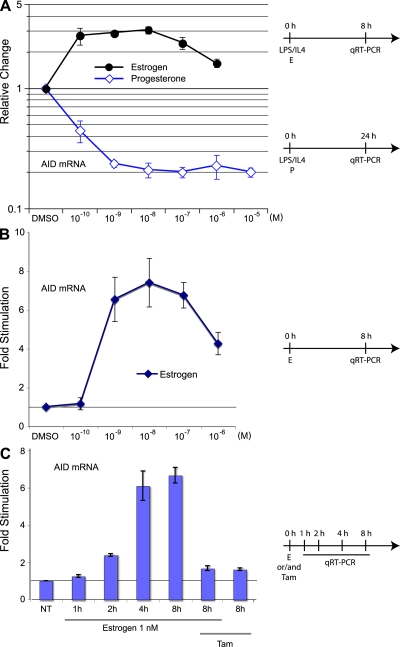
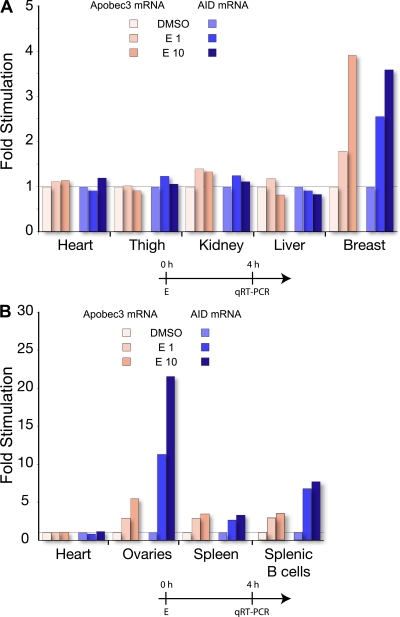
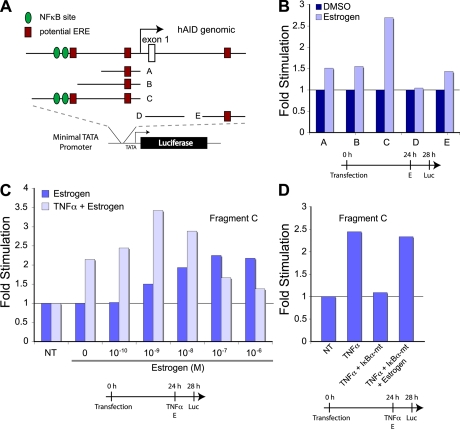
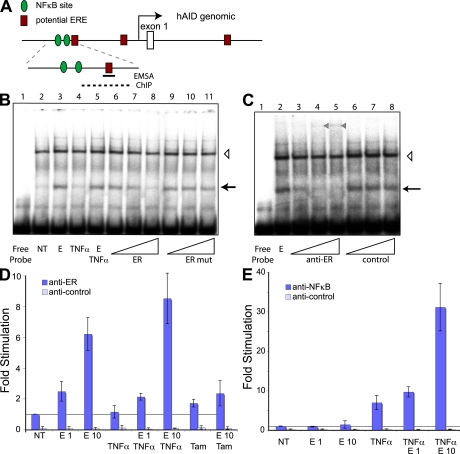
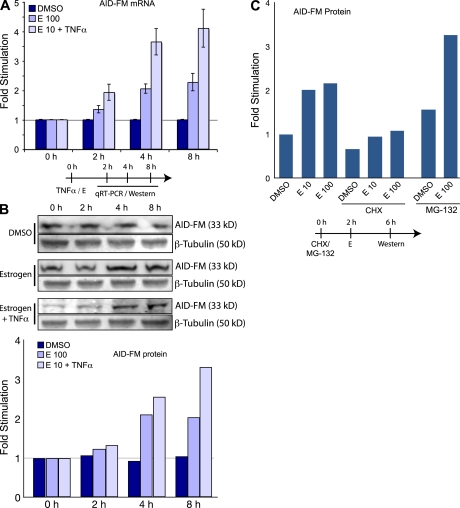
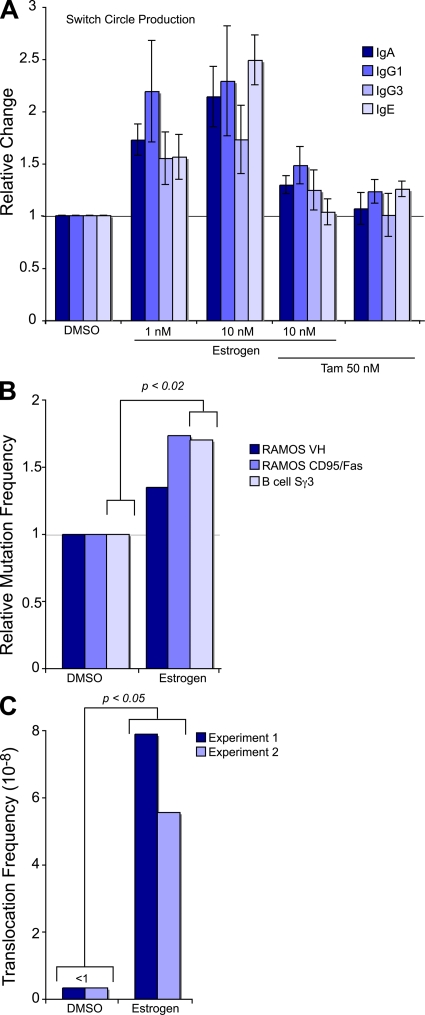
The immunological targets of estrogen at the molecular, humoral, and cellular level have been well documented, as has estrogen's role in establishing a gender bias in autoimmunity and cancer. During a healthy immune response, activation-induced deaminase (AID) deaminates cytosines at immunoglobulin (Ig) loci, initiating somatic hypermutation (SHM) and class switch recombination (CSR). Protein levels of nuclear AID are tightly controlled, as unregulated expression can lead to alterations in the immune response. Furthermore, hyperactivation of AID outside the immune system leads to oncogenesis. Here, we demonstrate that the estrogen-estrogen receptor complex binds to the AID promoter, enhancing AID messenger RNA expression, leading to a direct increase in AID protein production and alterations in SHM and CSR at the Ig locus. Enhanced translocations of the c-myc oncogene showed that the genotoxicity of estrogen via AID production was not limited to the Ig locus. Outside of the immune system (e.g., breast and ovaries), estrogen induced AID expression by >20-fold. The estrogen response was also partially conserved within the DNA deaminase family (APOBEC3B, -3F, and -3G), and could be inhibited by tamoxifen, an estrogen antagonist. We therefore suggest that estrogen-induced autoimmunity and oncogenesis may be derived through AID-dependent DNA instability.
雌激素在分子、体液和细胞水平上的免疫靶点已得到充分证明,雌激素在自身免疫和癌症中建立性别偏向方面的作用也是如此。在健康的免疫反应过程中,激活诱导的脱氨酶(AID)使免疫球蛋白(Ig)基因座上的胞嘧啶脱氨基,启动体细胞超突变(SHM)和类别转换重组(CSR)。核AID的蛋白质水平受到严格控制,因为不受调控的表达会导致免疫反应的改变。此外,AID在免疫系统外的过度激活会导致肿瘤发生。在此,我们证明雌激素 - 雌激素受体复合物与AID启动子结合,增强AID信使RNA的表达,导致AID蛋白产量直接增加,并使Ig基因座处的SHM和CSR发生改变。c - myc癌基因易位增强表明,雌激素通过AID产生的遗传毒性不限于Ig基因座。在免疫系统之外(例如乳腺和卵巢),雌激素诱导AID表达增加20倍以上。雌激素反应在DNA脱氨酶家族(APOBEC3B、-3F和-3G)中也部分保守,并且可被雌激素拮抗剂他莫昔芬抑制。因此,我们认为雌激素诱导的自身免疫和肿瘤发生可能源于AID依赖性DNA不稳定性。