Department of Biological Sciences and Merriam-Powell Center for Environmental Research, PO Box 6077, Flagstaff, AZ 86011, USA.
Carbon Balance Manag. 2009 Jan 16;4:1. doi: 10.1186/1750-0680-4-1.
Forests can sequester carbon dioxide, thereby reducing atmospheric concentrations and slowing global warming. In the U.S., forest carbon stocks have increased as a result of regrowth following land abandonment and in-growth due to fire suppression, and they currently sequester approximately 10% of annual US emissions. This ecosystem service is recognized in greenhouse gas protocols and cap-and-trade mechanisms, yet forest carbon is valued equally regardless of forest type, an approach that fails to account for risk of carbon loss from disturbance.
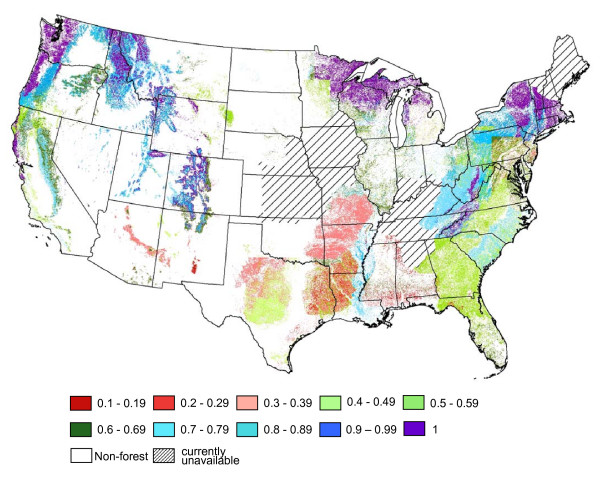
Here we show that incorporating wildfire risk reduces the value of forest carbon depending on the location and condition of the forest. There is a general trend of decreasing risk-scaled forest carbon value moving from the northern toward the southern continental U.S.
Because disturbance is a major ecological factor influencing long-term carbon storage and is often sensitive to human management, carbon trading mechanisms should account for the reduction in value associated with disturbance risk.
森林可以吸收二氧化碳,从而降低大气中的浓度,减缓全球变暖。在美国,由于土地废弃后的重新生长和火灾抑制导致的自然生长,森林碳储量有所增加,目前约占美国年排放量的 10%。这种生态系统服务在温室气体协议和总量管制与排放交易机制中得到了认可,但无论森林类型如何,森林碳都被平等对待,这种方法没有考虑到因干扰而导致碳损失的风险。
在这里,我们表明,考虑野火风险会降低森林碳的价值,具体取决于森林的位置和状况。从美国北部到南部,随着风险尺度的变化,森林碳价值呈下降趋势。
由于干扰是影响长期碳储存的主要生态因素,而且通常对人类管理敏感,碳交易机制应该考虑与干扰风险相关的价值降低。