Zaina Fabio, Negrini Stefano, Atanasio Salvatore
ISICO, Milan, Italy.
Scoliosis. 2009 Jan 20;4:3. doi: 10.1186/1748-7161-4-3.
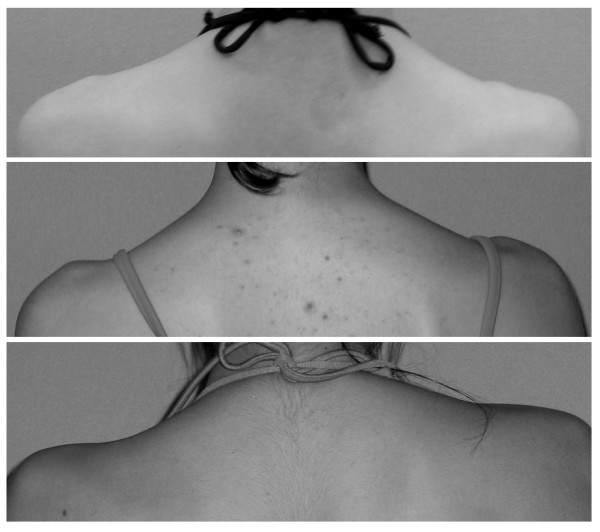
Aesthetic appearance is of primary importance in the treatment of adolescent idiopathic scoliosis (AIS), but to date tools for routine clinical practice have not become available. The aim of the present study is to develop such a tool and to verify its repeatability.
At first we developed the Aesthetic Index (AI), based on a three-point scale for asymmetry of the shoulders, scapulae and waist that we tested for 5 years. From this experience we developed another tool we called TRACE, the acronym of Trunk Aesthetic Clinical Evaluation; TRACE is a 12-point scale based on four sub-scales, shoulders (0-3), scapulae (0-2), hemi-thorax (0-2) and waist (0-4).
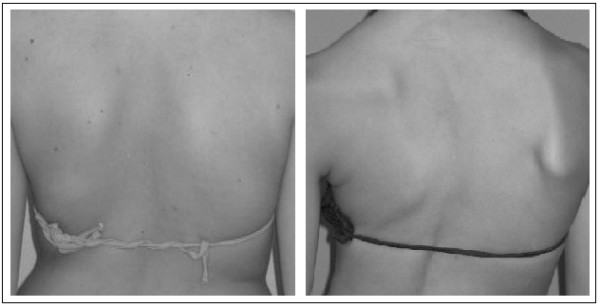
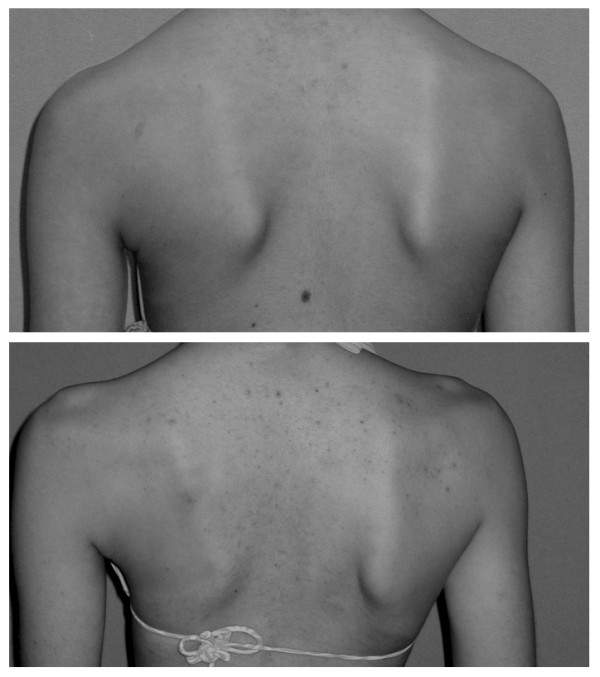
Posterior-anterior (PA) photographs of one hundred-sixty AIS patients.
Each photograph was scored in two independent tests by four observers using AI, and subsequently TRACE.
Kappa statistical analysis and 95% level of agreement were used; we also identified the minimum significant change (95% confidence level).
We found the intra- and inter-raters repeatability of AI to be fair. Three points out of seven was the minimum significant change between two different evaluations. For TRACE, intra-rater repeatability was fair and inter-raters poor; but the minimum significant change was three (intra-rater), or four (inter-raters) out of twelve points.
Widening the scale from 7 (AI) to 12 points (TRACE) increased the clinical sensitivity to changes of the aesthetic scale, even if TRACE has only a fair repeatability. TRACE is a no-cost tool for routine clinical practice in AIS patients. Due to the absence of other comparable validated tools, once the inherent measurement error is known and understood, its routine clinical use by physicians is advised.
美观在青少年特发性脊柱侧凸(AIS)的治疗中至关重要,但迄今为止,常规临床实践中尚未有可用的工具。本研究的目的是开发这样一种工具并验证其可重复性。
首先,我们开发了美学指数(AI),它基于肩部、肩胛骨和腰部不对称的三点量表,我们对其进行了5年的测试。基于此经验,我们开发了另一种工具,我们称之为TRACE,即躯干美学临床评估的首字母缩写;TRACE是一个基于四个子量表的12分制量表,肩部(0 - 3分)、肩胛骨(0 - 2分)、半胸(0 - 2分)和腰部(0 - 4分)。
160例AIS患者的前后位(PA)照片。
四张照片由四名观察者在两次独立测试中使用AI进行评分,随后使用TRACE进行评分。
采用Kappa统计分析和95%一致性水平;我们还确定了最小显著变化(95%置信水平)。
我们发现AI的评分者内和评分者间可重复性一般。两次不同评估之间的最小显著变化为七分中的三分。对于TRACE,评分者内可重复性一般,评分者间较差;但最小显著变化为十二分中的三分(评分者内)或四分(评分者间)。
将量表从7分(AI)扩展到12分(TRACE)提高了美学量表对变化的临床敏感性,即使TRACE的可重复性仅一般。TRACE是一种用于AIS患者常规临床实践的免费工具。由于没有其他经过验证的可比工具,一旦了解并理解了其固有的测量误差,建议医生在常规临床中使用。