Negrini Stefano, Atanasio Salvatore, Negrini Francesco, Zaina Fabio, Marchini Gianfranco
ISICO (Italian Scientific Spine Institute), Via R, Bellarmino 13/1, 20121 Milan, Italy.
Scoliosis. 2008 Oct 31;3:15. doi: 10.1186/1748-7161-3-15.
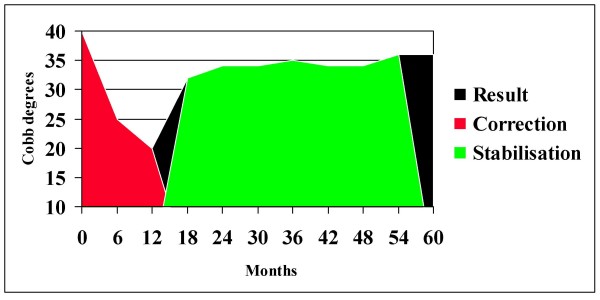
The conservative treatment of adolescent idiopathic scoliosis (AIS) has traditionally been divided into two phases-correction and stabilisation-and casts, even if less used today, can be considered the best standard in the correction phase. Till the present, however, no comparison between cast and brace efficacy has been proposed.
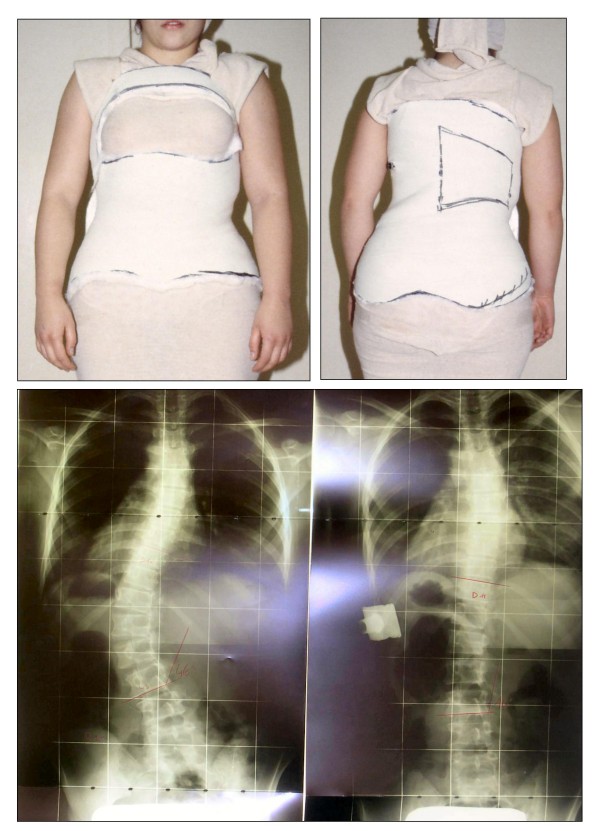
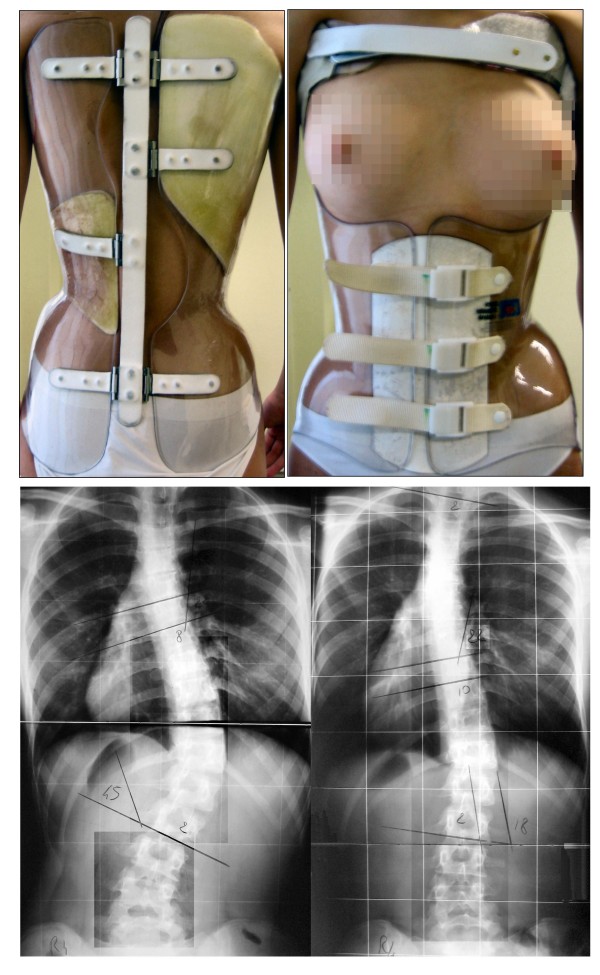
This is a prospective cohort study with a retrospective control group. The aim was to verify if it is possible to obtain with a specifically developed rigid brace results comparable to a cast. We considered fifty AIS patients who had refused surgery, aged 14.1 +/- 1.5 years, with 46.7 +/- 7.8 degrees Cobb scoliosis. Thirty-two consecutive patients (with no drop-outs) were prospectively followed up with the Sforzesco brace (SBG), and compared against a retrospective group of eighteen patients treated with the Risser cast (RCG). The treatment time (the total correction phase) was 19 +/- 3 months. Out-of-brace x-rays were compared, as well as clinical results.
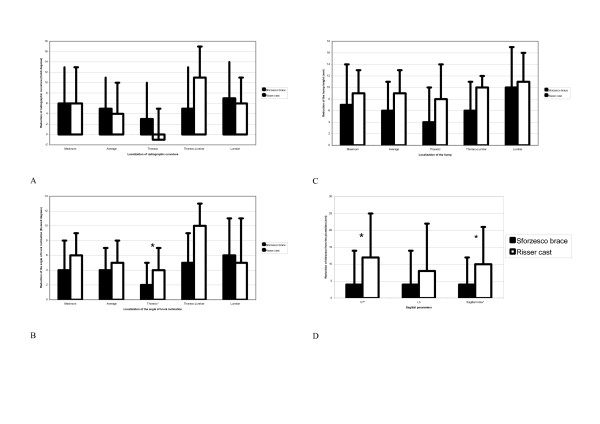
Compliance and hours of treatment were higher in the RCG while all the other parameters were not different. We observed a reduction of 6 degrees Cobb and an important aesthetic gain in both groups (P<0.05). Three patients (6%) worsened, while 56% improved (36% at least 10 degrees , and 14% 15 degrees or more). The SBG did show results comparable to the RCG, with only minor differences in terms of scoliosis correction. On the contrary, straightening of the spine (decrease of the sagittal physiological curves) was much higher in the RCG but was not clinically significant in the SBG.
In the corrective phase of AIS treatment it is possible with a specific rigid brace (Sforzesco - SPoRT concept) to obtain scoliosis correction similar to cast. Due to the human and social costs of casting, and worst sagittal profile results, Sforzesco brace should be the preferred method wherever possible.
青少年特发性脊柱侧凸(AIS)的保守治疗传统上分为两个阶段——矫正和稳定,石膏支具尽管如今较少使用,但仍可被视为矫正阶段的最佳标准。然而,迄今为止,尚未有人对石膏支具和矫形支具的疗效进行比较。
这是一项带有回顾性对照组的前瞻性队列研究。目的是验证使用专门研发的刚性支具是否能够取得与石膏支具相当的效果。我们纳入了50例拒绝手术的AIS患者,年龄为14.1±1.5岁,Cobb角脊柱侧凸为46.7±7.8度。对连续32例患者(无失访)使用斯福尔扎支具(SBG)进行前瞻性随访,并与18例接受里塞尔石膏支具治疗的回顾性组患者(RCG)进行比较。治疗时间(整个矫正阶段)为19±3个月。对支具外X线片以及临床结果进行了比较。
RCG组的依从性和治疗时长更高,而其他所有参数并无差异。我们观察到两组的Cobb角均减小了6度,且在美观方面均有显著改善(P<0.05)。3例患者(6%)病情恶化,而56%的患者病情改善(36%至少改善10度,14%改善15度或更多)。SBG确实显示出与RCG相当的效果,在脊柱侧凸矫正方面仅有微小差异。相反,RCG组脊柱的伸直(矢状面生理曲度减小)程度更高,但在SBG组中这在临床上并不显著。
在AIS治疗的矫正阶段,使用特定的刚性支具(斯福尔扎 - SPoRT概念)能够取得与石膏支具相似的脊柱侧凸矫正效果。鉴于使用石膏支具的人力和社会成本,以及矢状面外形更差的结果,只要有可能,斯福尔扎支具应作为首选方法。