Knipe D, Lodish H F, Baltimore D
J Virol. 1977 Mar;21(3):1140-8. doi: 10.1128/JVI.21.3.1140-1148.1977.
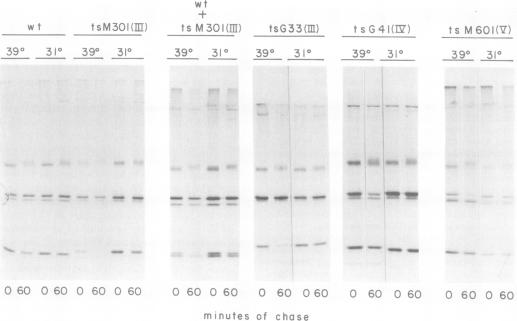
The metabolism of viral RNA and proteins has been studied in cells infected with temperature-sensitive mutant strains of vesicular stomatitis virus. Certain viral proteins encoded by the mutant strains, usually the putative mutant protein for the assigned complementation group, were shown to be degraded more rapidly at the nonpermissive temperature than were the wild-type proteins. Group III mutants (tsG33, tsM301) encode M proteins which are degraded three- to fourfold faster than the wild-type protein. This defect cannot be fully rescued by coinfection with wild-type virus, and thus the defect appears to be in the M protein itself. Mutants tsM601 (VI) and tsG41(IV) encode N proteins which are degraded much faster than the wild-type protein and also share the property of being defective in replication of viral RNA, suggesting a correlation between these phenotypic properties. Furthermore, the L proteins of tsG11(I) and tsG13(I) are more labile than the wild-type protein at the nonpermissive temperature. The G protein of tsM501(V) did not undergo the change in electrophoretic mobility previously shown to be the result of sialylation, suggesting that it is defective in maturation or glycosylation at the nonpermissive temperature. Three of the mutants previously isolated in this laboratory, tsM502(V), tsM601(VI), and tsM602(VI), were shown to be defective in viral RNA synthesis at the nonpermissive temperature. Mutant tsM601(VI) was defective mainly in viral RNA replication, whereas tsM502(V) appeared to be totally defective for viral RNA transcription and replication at the nonpermissive temperature.
已在感染水疱性口炎病毒温度敏感突变株的细胞中研究了病毒RNA和蛋白质的代谢。突变株编码的某些病毒蛋白,通常是指定互补组的推定突变蛋白,在非允许温度下比野生型蛋白降解得更快。III组突变体(tsG33、tsM301)编码的M蛋白比野生型蛋白降解速度快三到四倍。这种缺陷不能通过与野生型病毒共感染完全挽救,因此缺陷似乎存在于M蛋白本身。突变体tsM601(VI)和tsG41(IV)编码的N蛋白比野生型蛋白降解快得多,并且还具有病毒RNA复制缺陷的特性,表明这些表型特性之间存在相关性。此外,tsG11(I)和tsG13(I)的L蛋白在非允许温度下比野生型蛋白更不稳定。tsM501(V)的G蛋白未发生先前显示为唾液酸化结果的电泳迁移率变化,表明它在非允许温度下成熟或糖基化存在缺陷。先前在本实验室分离的三个突变体,tsM502(V)、tsM601(VI)和tsM602(VI),在非允许温度下病毒RNA合成存在缺陷。突变体tsM601(VI)主要在病毒RNA复制方面存在缺陷,而tsM502(V)在非允许温度下似乎对病毒RNA转录和复制完全缺陷。