Hoddinott Pat, Britten Jane, Prescott Gordon J, Tappin David, Ludbrook Anne, Godden David J
Centre for Rural Health, University of Aberdeen, Centre for Health Science, Inverness IV2 3JH.
BMJ. 2009 Jan 30;338:a3026. doi: 10.1136/bmj.a3026.
To assess the clinical effectiveness and cost effectiveness of a policy to provide breastfeeding groups for pregnant and breastfeeding women.
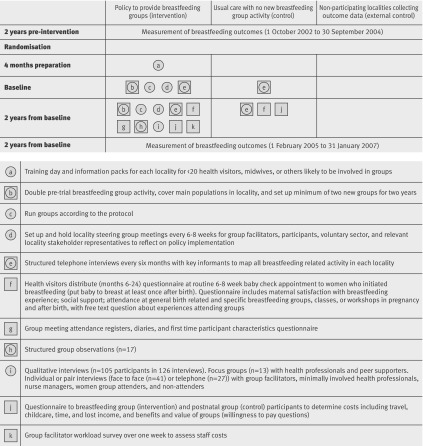
Cluster randomised controlled trial with prospective mixed method embedded case studies to evaluate implementation processes.
Primary care in Scotland.
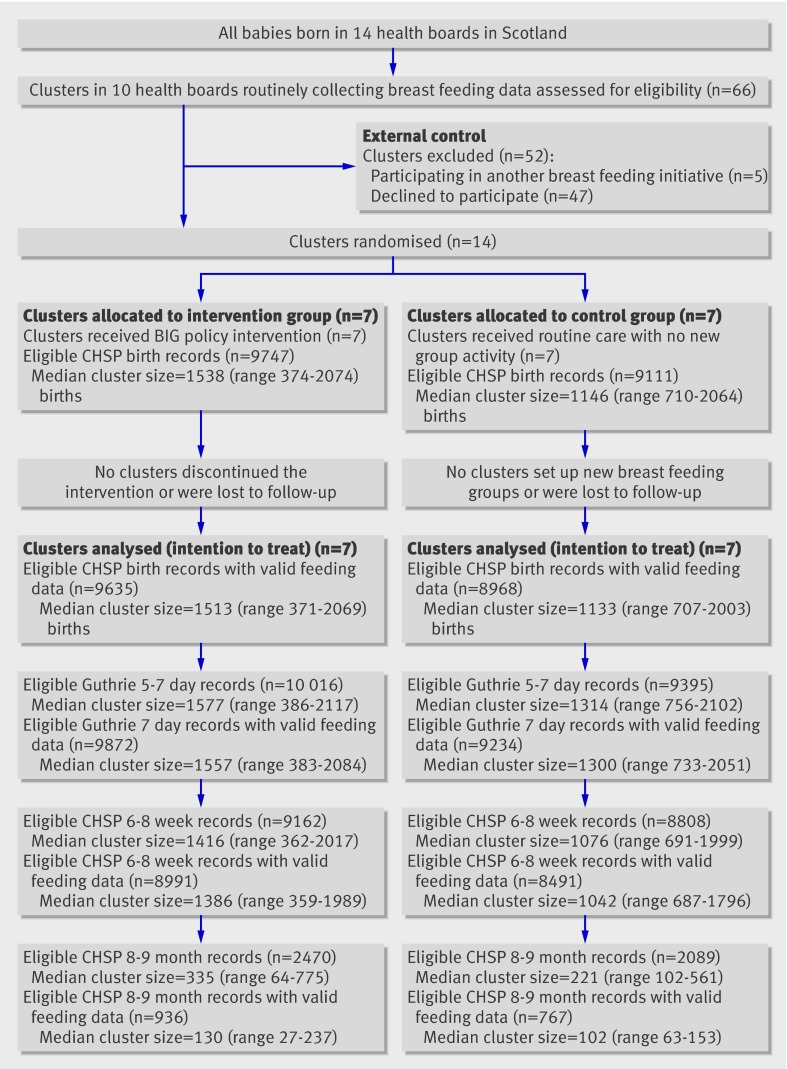
Pregnant women, breastfeeding mothers, and babies registered with 14 of 66 eligible clusters of general practices (localities) in Scotland that routinely collect breastfeeding outcome data.
Localities set up new breastfeeding groups to provide population coverage; control localities did not change group activity.
any breast feeding at 6-8 weeks from routinely collected data for two pre-trial years and two trial years.
any breast feeding at birth, 5-7 days, and 8-9 months; maternal satisfaction.
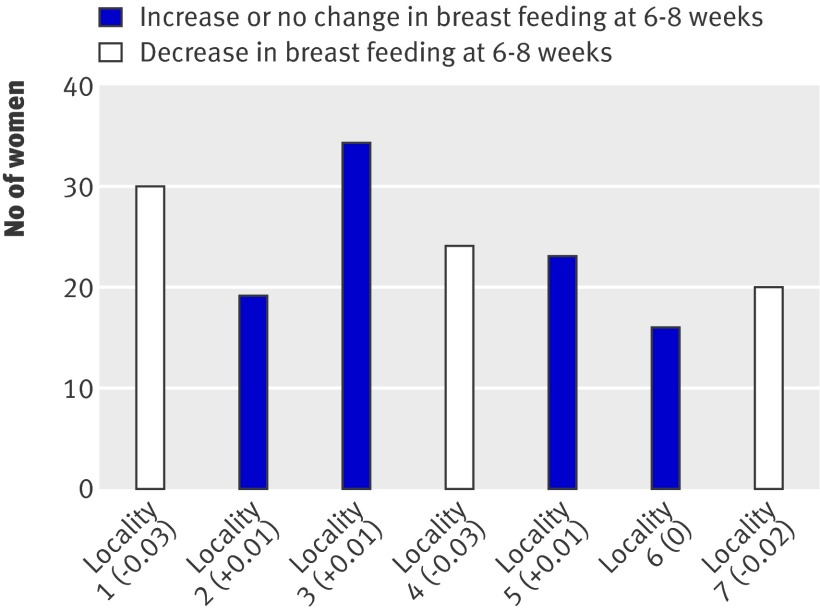
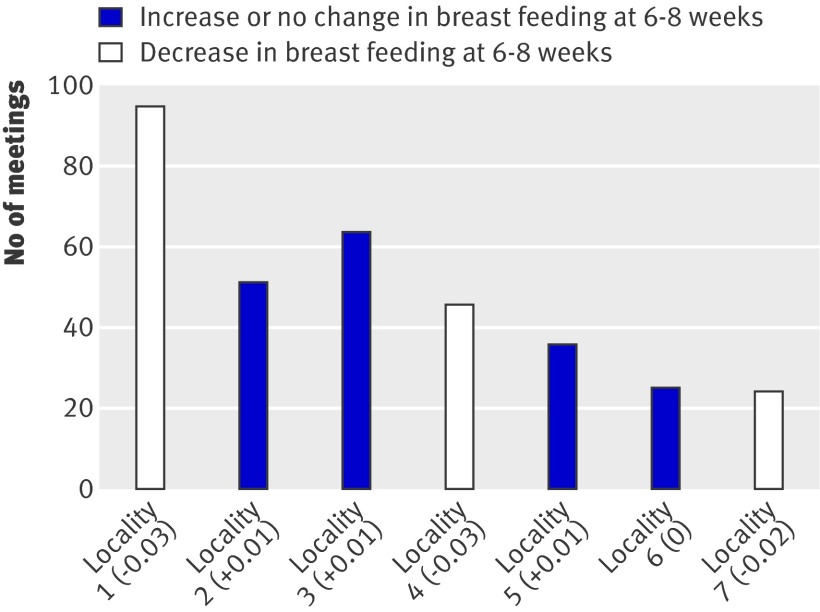
Between 1 February 2005 and 31 January 2007, 9747 birth records existed for intervention localities and 9111 for control localities. The number of breastfeeding groups increased from 10 to 27 in intervention localities, where 1310 women attended, and remained at 10 groups in control localities. No significant differences in breastfeeding outcomes were found. Any breast feeding at 6-8 weeks declined from 27% to 26% in intervention localities and increased from 29% to 30% in control localities (P=0.08, adjusted for pre-trial rate). Any breast feeding at 6-8 weeks increased from 38% to 39% in localities not participating in the trial. Women who attended breastfeeding groups were older (P<0.001) than women initiating breast feeding who did not attend and had higher income (P=0.02) than women in the control localities who attended postnatal groups. The locality cost was pound13 400 (euro14 410; $20 144) a year.
A policy for providing breastfeeding groups in relatively deprived areas of Scotland did not improve breastfeeding rates at 6-8 weeks. The costs of running groups would be similar to the costs of visiting women at home.
Current Controlled Trials ISRCTN44857041.
评估一项为孕妇和哺乳期妇女提供母乳喂养小组的政策的临床效果和成本效益。
采用整群随机对照试验,并结合前瞻性混合方法嵌入案例研究来评估实施过程。
苏格兰的初级医疗保健机构。
在苏格兰66个符合条件的全科医疗群组(地区)中的14个进行登记的孕妇、哺乳期母亲和婴儿,这些群组常规收集母乳喂养结果数据。
各地区设立新的母乳喂养小组以实现人群覆盖;对照地区不改变小组活动。
根据两个试验前年份和两个试验年份的常规收集数据,在6 - 8周时的任何母乳喂养情况。
出生时、5 - 7天以及8 - 9个月时的任何母乳喂养情况;母亲满意度。
在2005年2月1日至2007年1月31日期间,干预地区有9747份出生记录,对照地区有9111份。干预地区的母乳喂养小组数量从10个增加到27个,有1310名妇女参加,对照地区仍为10个小组。未发现母乳喂养结局有显著差异。干预地区6 - 8周时的任何母乳喂养率从27%降至26%,对照地区从29%升至30%(经试验前率调整后P = 0.08)。未参与试验的地区6 - 8周时的任何母乳喂养率从38%升至39%。参加母乳喂养小组的妇女比未参加的开始母乳喂养的妇女年龄更大(P < 0.001),且收入高于对照地区参加产后小组的妇女(P = 0.02)。每个地区每年的成本为13400英镑(14410欧元;20144美元)。
在苏格兰相对贫困地区提供母乳喂养小组的政策并未提高6 - 8周时的母乳喂养率。开展小组活动的成本与上门探访妇女的成本相近。
当前受控试验ISRCTN44857041。