Ficociello Linda H, Perkins Bruce A, Roshan Bijan, Weinberg Janice M, Aschengrau Ann, Warram James H, Krolewski Andrzej S
Research Division, Joslin Diabetes Center, Boston, Massachusetts, USA.
Diabetes Care. 2009 May;32(5):889-93. doi: 10.2337/dc08-1560. Epub 2009 Feb 5.
The purpose of this study was to examine prospectively whether renal hyperfiltration is associated with the development of microalbuminuria in patients with type 1 diabetes, after taking into account known risk factors.
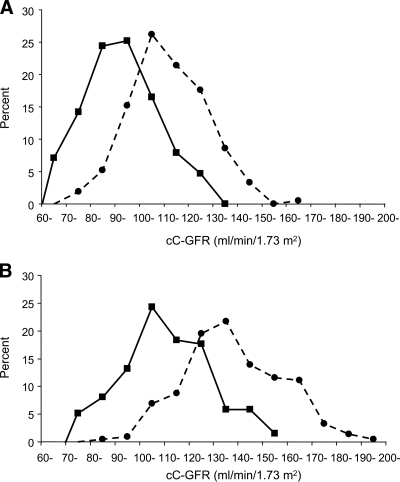
The study group comprised 426 participants with normoalbuminuria from the First Joslin Kidney Study, followed for 15 years. Glomerular filtration rate was estimated by serum cystatin C, and hyperfiltration was defined as exceeding the 97.5th percentile of the sex-specific distribution of a similarly aged, nondiabetic population (134 and 149 ml/min per 1.73 m(2) for men and women, respectively). The outcome was time to microalbuminuria development (multiple albumin excretion rate >30 microg/min). Hazard ratios (HRs) for microalbuminuria were calculated at 5, 10, and 15 years.
Renal hyperfiltration was present in 24% of the study group and did not increase the risk of developing microalbuminuria. The unadjusted HR for microalbuminuria comparing those with and without hyperfiltration at baseline was 0.8 (95% CI 0.4-1.7) during the first 5 years, 1.0 (0.6-1.7) during the first 10 years, and 0.8 (0.5-1.4) during 15 years of follow-up. The model adjusted for baseline known risk factors including A1C, age at diagnosis of diabetes, diabetes duration, and cigarette smoking resulted in similar HRs. In addition, incorporating changes in hyperfiltration status during follow-up had minimal impact on the HRs for microalbuminuria.
Renal hyperfiltration does not have an impact on the development of microalbuminuria in type 1 diabetes during 5, 10, or 15 years of follow-up.
本研究的目的是在考虑已知危险因素后,前瞻性地研究1型糖尿病患者的肾脏高滤过是否与微量白蛋白尿的发生有关。
研究组包括来自乔斯林肾脏研究一期的426名正常白蛋白尿参与者,随访15年。通过血清胱抑素C估算肾小球滤过率,高滤过定义为超过年龄、性别匹配的非糖尿病人群特定性别分布的第97.5百分位数(男性和女性分别为每1.73 m² 134和149 ml/min)。观察终点为微量白蛋白尿发生时间(多次白蛋白排泄率>30μg/min)。计算5年、10年和15年时微量白蛋白尿的风险比(HR)。
研究组中24%存在肾脏高滤过,且未增加微量白蛋白尿发生风险。基线时高滤过组与非高滤过组相比,微量白蛋白尿的未调整HR在随访的前5年为0.8(95%CI 0.4 - 1.7),前10年为1.0(0.6 - 1.7),15年时为0.8(0.5 - 1.4)。对包括糖化血红蛋白、糖尿病诊断年龄、糖尿病病程和吸烟等基线已知危险因素进行校正的模型得出相似的HR。此外,纳入随访期间高滤过状态的变化对微量白蛋白尿的HR影响极小。
在随访的5年、10年或15年期间,肾脏高滤过对1型糖尿病患者微量白蛋白尿的发生无影响。