Gupta Pawan, Ho Ping-Chih, Ha Sung Gil, Lin Yi-Wei, Wei Li-Na
Institute of Microbial Technology, Chandigarh, India.
PLoS One. 2009;4(2):e4363. doi: 10.1371/journal.pone.0004363. Epub 2009 Feb 10.
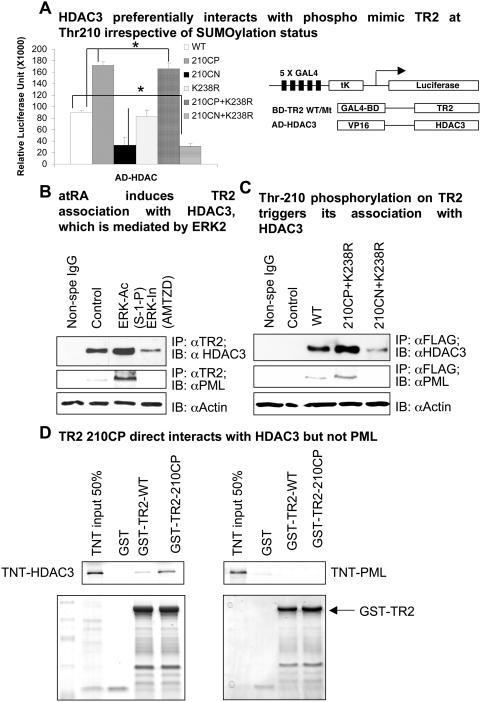
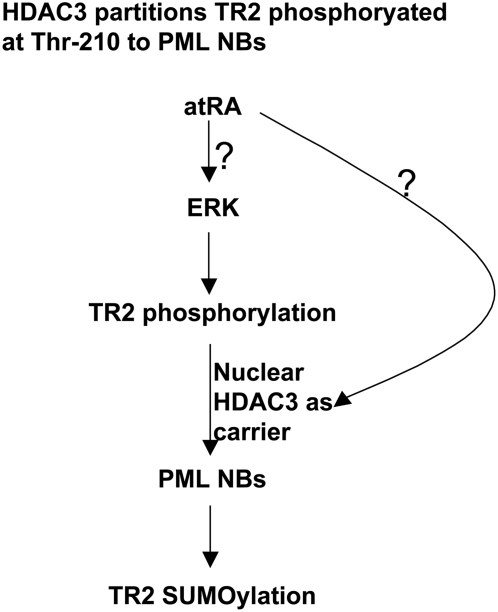
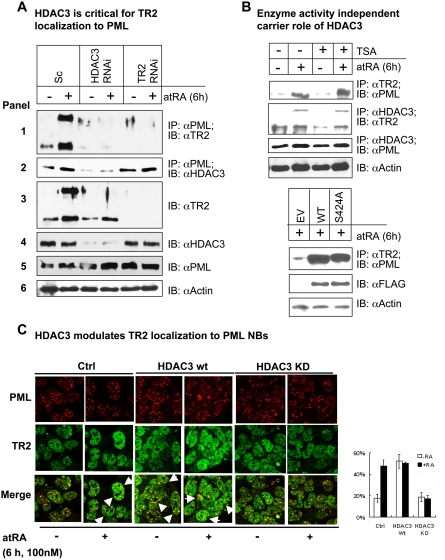
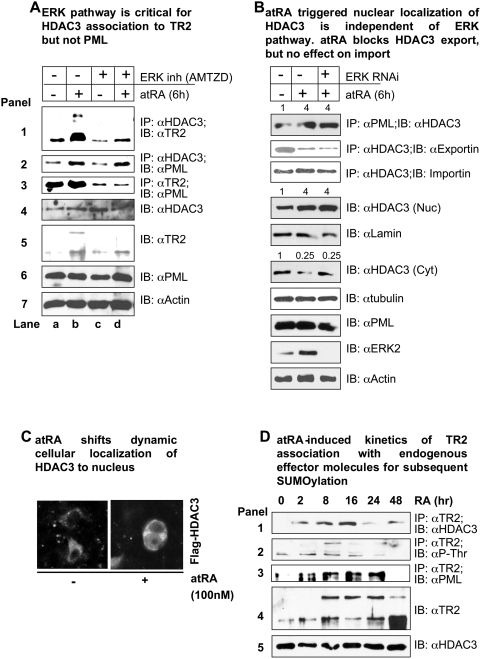
TR2 is an orphan nuclear receptor specifically expressed in early embryos (Wei and Hsu, 1994), and a transcription factor for transcriptional regulation of important genes in stem cells including the gate keeper Oct4 (Park et al. 2007). TR2 is known to function as an activator (Wei et al. 2000), or a repressor (Chinpaisal et al., 1998, Gupta et al. 2007). Due to the lack of specific ligands, mechanisms triggering its activator or repressor function have remained puzzling for decades. Recently, we found that all-trans retinoic acid (atRA) triggers the activation of extracellular-signal-regulated kinase 2 (ERK2), which phosphorylates TR2 and stimulates its partitioning to promyelocytic leukemia (PML) nuclear bodies, thereby converting the activator function of TR2 into repression (Gupta et al. 2008; Park et al. 2007). Recruitment of TR2 to PML is a crucial step in the conversion of TR2 from an activator to a repressor. However, it is unclear how phosphorylated TR2 is recruited to PML, an essential step in converting TR2 from an activator to a repressor. In the present study, we use both in vitro and in vivo systems to address the problem of recruiting TR2 to PML nuclear bodies. First, we identify histone deacetylase 3 (HDAC3) as an effector molecule. HDAC3 is known to interact with TR2 (Franco et al. 2001) and this interaction is enhanced by the atRA-stimulated phosphorylation of TR2 at Thr-210 (Gupta et al. 2008). Secondly, in this study, we also find that the carrier function of HDAC3 is independent of its deacetylase activity. Thirdly, we find another novel activity of atRA that stimulates nuclear enrichment of HDAC3 to form nuclear complex with PML, which is ERK2 independent. This is the first report identifying a deacetylase-independent function for HDAC3, which serves as a specific carrier molecule that targets a specifically phosphorylated protein to PML NBs. This is also the first study delineating how protein recruitment to PML nuclear bodies occurs, which can be stimulated by atRA in an ERK2-independent manner. These findings could provide new insights into the development of potential therapeutics and in understanding how orphan nuclear receptor activities can be regulated without ligands.
TR2是一种孤儿核受体,在早期胚胎中特异性表达(Wei和Hsu,1994年),并且是干细胞中包括关键因子Oct4在内的重要基因转录调控的转录因子(Park等人,2007年)。已知TR2可作为激活剂发挥作用(Wei等人,2000年),或作为抑制剂(Chinpaisal等人,1998年;Gupta等人,2007年)。由于缺乏特异性配体,触发其激活剂或抑制剂功能的机制数十年来一直令人困惑。最近,我们发现全反式维甲酸(atRA)触发细胞外信号调节激酶2(ERK2)的激活,ERK2使TR2磷酸化并刺激其向早幼粒细胞白血病(PML)核体的分配,从而将TR2的激活剂功能转化为抑制功能(Gupta等人,2008年;Park等人,2007年)。TR2募集到PML是TR2从激活剂转变为抑制剂的关键步骤。然而,尚不清楚磷酸化的TR2如何被募集到PML,这是TR2从激活剂转变为抑制剂的关键步骤。在本研究中,我们使用体外和体内系统来解决将TR2募集到PML核体的问题。首先,我们确定组蛋白脱乙酰酶3(HDAC3)为效应分子。已知HDAC3与TR2相互作用(Franco等人,2001年),并且这种相互作用在Thr-210处被atRA刺激的TR2磷酸化增强(Gupta等人,2008年)。其次,在本研究中,我们还发现HDAC3的载体功能与其脱乙酰酶活性无关。第三,我们发现atRA的另一种新活性,即刺激HDAC3在核内富集以与PML形成核复合物,这与ERK2无关。这是首次报道确定HDAC3的脱乙酰酶非依赖性功能,其作为一种特异性载体分子,将特异性磷酸化的蛋白质靶向PML核体。这也是首次描述蛋白质如何募集到PML核体,atRA可以以ERK2非依赖性方式刺激这一过程。这些发现可能为潜在治疗方法的开发以及理解孤儿核受体活性如何在无配体情况下受到调控提供新的见解。