Stall Ron, Duran Luis, Wisniewski Stephen R, Friedman Mark S, Marshal Michael P, McFarland Willi, Guadamuz Thomas E, Mills Thomas C
Department of Behavioral and Community Health Sciences, University of Pittsburgh Graduate School of Public Health, 208 Parran Hall 130 DeSoto Street, Pittsburgh, PA 15261, USA.
AIDS Behav. 2009 Aug;13(4):615-29. doi: 10.1007/s10461-008-9509-7. Epub 2009 Feb 10.
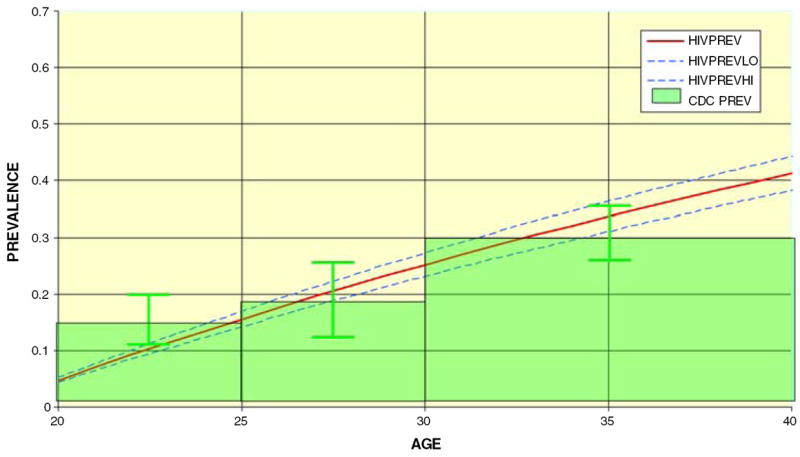
Attempts to document changing HIV incidence rates among MSM are compromised by issues of generalizability and statistical power. To address these issues, this paper reports annualized mean HIV incidence rates from the entire published incidence literature on MSM from Europe, North America and Australia for the period 1995-2005. Publications that met the entry criteria were coded for region of the world, sampling method and year of study. From these reports, we calculated a mean incidence rate with confidence intervals for these variables. Although no differences in mean incidence rates were found for MSM from 1995 to 2005, HIV incidence rates are lower in Australia than either North America or Europe. We calculated a mean incidence rate of 2.39% for MSM in the United States, which if sustained within a cohort of MSM, would yield HIV prevalence rate of approximately 40% at age 40. These extrapolations overlap published HIV prevalence rates for MSM younger than age 40 in the United States. HIV incidence rates in the 2-3% range will adversely affect the health of gay male communities for decades to come. This analysis suggests that greater attention should be devoted to the question of how best to design prevention interventions that will lower HIV incidence rates among gay men.
由于普遍性和统计效力问题,记录男男性行为者中不断变化的艾滋病毒发病率的尝试受到了影响。为解决这些问题,本文报告了1995年至2005年期间欧洲、北美和澳大利亚已发表的关于男男性行为者发病率文献中的年化平均艾滋病毒发病率。符合纳入标准的出版物按世界区域、抽样方法和研究年份进行编码。根据这些报告,我们计算了这些变量的平均发病率及其置信区间。尽管1995年至2005年期间男男性行为者的平均发病率没有差异,但澳大利亚的艾滋病毒发病率低于北美或欧洲。我们计算出美国男男性行为者的平均发病率为2.39%,如果在男男性行为者队列中持续保持这一发病率,那么在40岁时艾滋病毒患病率将达到约40%。这些推断与美国40岁以下男男性行为者已公布的艾滋病毒患病率重叠。2%至3%范围内的艾滋病毒发病率将在未来几十年对男同性恋群体的健康产生不利影响。该分析表明,应更加关注如何最好地设计预防干预措施以降低男同性恋者中艾滋病毒发病率这一问题。