Shi Chanjuan, Hong Seung-Mo, Lim Phillip, Kamiyama Hirohiko, Khan Mehtab, Anders Robert A, Goggins Michael, Hruban Ralph H, Eshleman James R
The Sol Goldman Pancreatic Cancer Research Center, Department of Pathology, The Johns Hopkins Medical Institutions, Baltimore, MD 212312, USA.
Mol Cancer Res. 2009 Feb;7(2):230-6. doi: 10.1158/1541-7786.MCR-08-0206. Epub 2009 Feb 10.
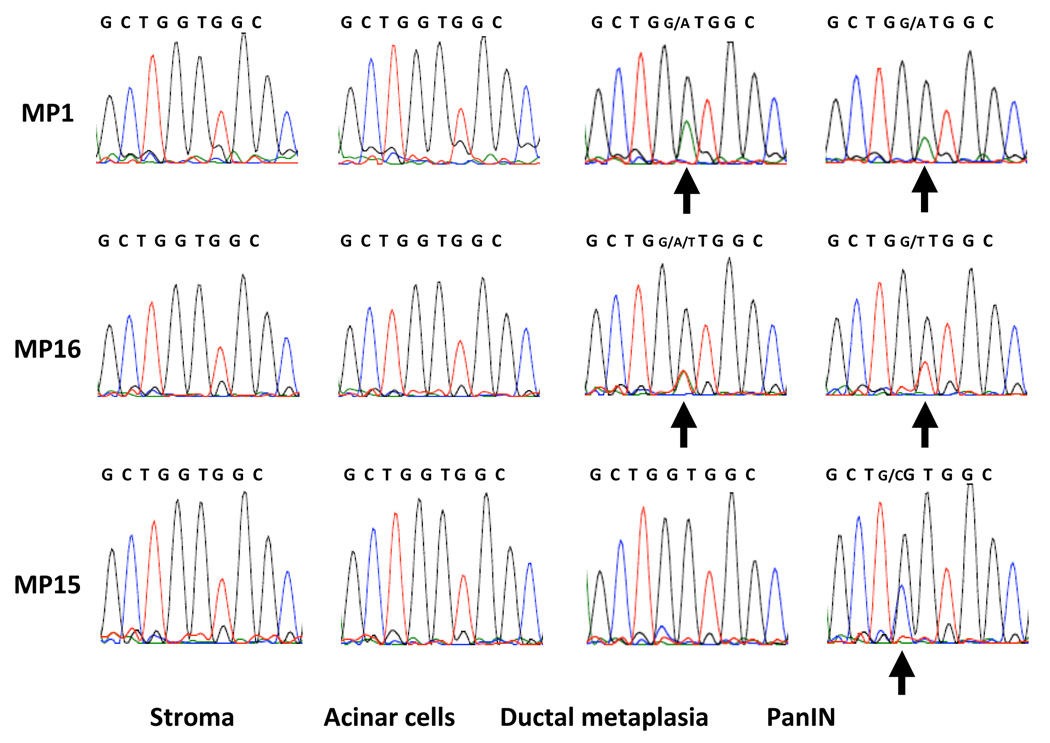
Pancreatic intraepithelial neoplasia (PanIN) is a precursor to invasive ductal adenocarcinoma of the pancreas. Observations made in genetically engineered mouse models suggest that the acinar/centroacinar compartment can give rise to ductal neoplasia. To integrate findings in mice and men, we examined human acinar cells, acinar-ductal metaplasia (ADM) lesions, and PanINs for KRAS2 gene mutations. Surgically resected pancreata were screened for foci of ADM with or without an associated PanIN lesion. Stromal cells, acinar cells, ADMs, and PanINs were separately isolated using laser capture microdissection. KRAS2 status was analyzed using genomic DNA isolated from the microdissected tissue. Twelve of these 31 foci of ADM occurred in isolation, whereas 19 were in the same lobules as a PanIN lesion. All 31 microdissected foci of acinar cells were KRAS2 gene wild-type, as were all 12 isolated ADM lesions lacking an associated PanIN. KRAS2 gene mutations were present in 14 of 19 (74%) PanIN lesions and in 12 of the 19 (63%) foci of ADM associated with these PanINs. All ADM lesions with a KRAS2 gene mutation harbored the identical KRAS2 gene mutation found in their associated PanIN lesions. Ductal neoplasms of the human pancreas, as defined by KRAS2 gene mutations, do not appear to arise from acinar cells. Isolated AMD lesions are genetically distinct from those associated with PanINs, and the latter may represent retrograde extension of the neoplastic PanIN cells or less likely are precursors to PanIN.
胰腺上皮内瘤变(PanIN)是胰腺浸润性导管腺癌的前体。在基因工程小鼠模型中的观察结果表明,腺泡/腺泡中心区可引发导管瘤变。为整合小鼠和人类的研究结果,我们检测了人类腺泡细胞、腺泡-导管化生(ADM)病变及PanIN中的KRAS2基因突变。对手术切除的胰腺进行筛查,寻找伴有或不伴有相关PanIN病变的ADM病灶。使用激光捕获显微切割技术分别分离基质细胞、腺泡细胞、ADM和PanIN。使用从显微切割组织中分离的基因组DNA分析KRAS2状态。这31个ADM病灶中有12个单独出现,而19个与PanIN病变位于同一小叶。所有31个显微切割的腺泡细胞病灶均为KRAS2基因野生型,所有12个未伴有相关PanIN的孤立ADM病灶也是如此。19个PanIN病变中有14个(74%)存在KRAS2基因突变,与这些PanIN相关的19个ADM病灶中有12个(63%)存在该突变。所有发生KRAS2基因突变的ADM病灶均携带与其相关的PanIN病变中相同的KRAS2基因突变。由KRAS2基因突变定义的人类胰腺导管肿瘤似乎并非起源于腺泡细胞。孤立的AMD病灶在基因上与那些与PanIN相关的病灶不同,后者可能代表肿瘤性PanIN细胞的逆行延伸,或者不太可能是PanIN的前体。