Nansel Tonja R, Iannotti Ronald J, Simons-Morton Bruce G, Plotnick Leslie P, Clark Loretta M, Zeitzoff Linda
Division of Epidemiology, Statistics and Prevention Research, Eunice Kennedy Shriver National Institute of Child Health and Human Development, National Institutes of Health, Bethesda, Maryland, USA.
Diabetes Care. 2009 May;32(5):807-9. doi: 10.2337/dc08-1968. Epub 2009 Feb 10.
To describe a 2-year follow-up of A1C outcomes of a self-regulation intervention for youth with type 1 diabetes.
A total of 81 youths with type 1 diabetes ages 11-16 years were randomized to usual care versus a diabetes personal trainer intervention consisting of six self-monitoring, goal-setting, and problem-solving sessions with trained nonprofessionals. A1C data were obtained from medical records 2 years postintervention, and ANCOVA adjusting for age and baseline A1C was conducted.
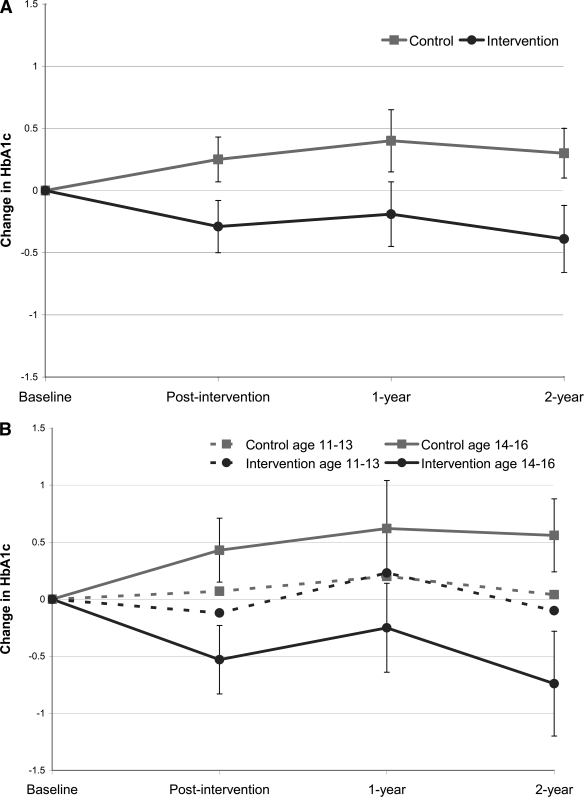
An overall intervention effect on A1C (8.93% control vs. 8.43% intervention; F = 8.24, P = 0.05) and a significant intervention-by-age interaction (F = 9.88; P = 0.002) were observed, indicating a greater effect among older than younger youths. Subgroup analyses demonstrated no treatment group differences among pre-/early adolescents but a significant difference in A1C among middle adolescents (9.61% control vs. 8.46% intervention; F = 7.20, P = 0.011).
Findings indicate maintenance of intervention effects on A1C observed at 1-year follow-up.
描述一项针对1型糖尿病青少年的自我调节干预措施的糖化血红蛋白(A1C)结果的2年随访情况。
总共81名年龄在11至16岁之间的1型糖尿病青少年被随机分为常规护理组和糖尿病私人教练干预组,后者由与经过培训的非专业人员进行的六次自我监测、目标设定和问题解决课程组成。在干预后2年从医疗记录中获取A1C数据,并进行了调整年龄和基线A1C的协方差分析。
观察到对A1C的总体干预效果(对照组为8.93%,干预组为8.43%;F = 8.24,P = 0.05)以及显著的干预与年龄交互作用(F = 9.88;P = 0.002),表明年龄较大的青少年比年龄较小的青少年效果更明显。亚组分析显示,在小学/初中早期青少年中治疗组之间没有差异,但在初中中期青少年中A1C有显著差异(对照组为9.61%,干预组为8.46%;F = 7.20,P = 0.011)。
研究结果表明在1年随访中观察到的对A1C的干预效果得以维持。