Wu Jiangxue, Xiao Xia, Jia Hongyun, Chen Jiemin, Zhu Yinghui, Zhao Peng, Lin Huanxin, Huang Wenlin
State Key Laboratory of Oncology in South China, Cancer Center, Sun Yat-Sen University, Guangzhou, PR China.
BMC Cancer. 2009 Feb 16;9:55. doi: 10.1186/1471-2407-9-55.
We previously found that r-hu-IFNgamma exerts a potent anti-tumor effect on human nasopharyngeal carcinoma xenografts in vivo. Considering the fact that the clinical use of recombinant IFNgamma is limited by its short half-life and systemic side effects, we developed a recombinant adenovirus, Ad-IFNgamma.
Dynamic distribution of the adenovirus vector and expression of IFNgamma were evaluated by Q-PCR and ELISA after intratumoral administration of Ad-IFNgamma into CNE-2 xenografts.
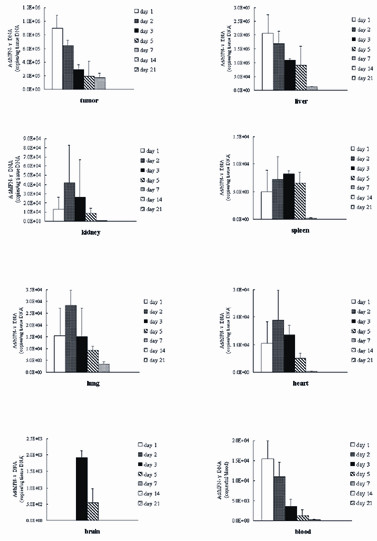
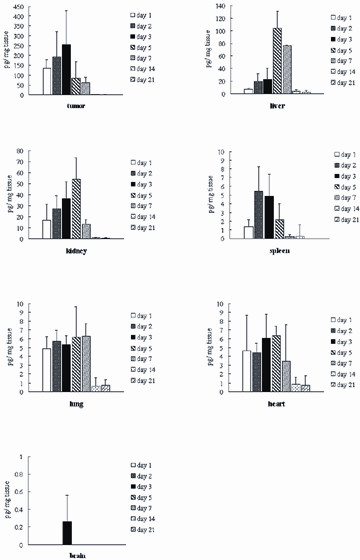
Ad-IFNgamma DNA was mainly enriched in tumors where the Ad-IFNgamma DNA was injected (P < 0.05, compared to blood or parenchymal organs), as well as in livers (P < 0.05). Concentrations of Ad-IFNgamma DNA in other organs and blood were very low. Intratumoral Ad-IFNgamma DNA decreased sharply at high concentrations (9 x 10(5) copies/microg tissue DNA), and slowly at lower concentrations (1.7-2.9 x 10(5) copies/microg tissue DNA). IFNgamma was detected in the tumors and parenchymal organs. The concentration of IFNgamma was highest in the tumor (P < 0.05), followed by the liver and kidney (P < 0.05). High-level intratumoral expression of IFNgamma was maintained for at least 7 days, rapidly peaking on day 3 after injection of Ad-IFNgamma DNA.
An IFNgamma gene delivered by an adenoviral vector achieved high and consistent intratumoral expression. Disseminated Ad-IFNgamma DNA and the transgene product were mainly enriched in the liver.
我们之前发现重组人干扰素γ(r-hu-IFNγ)对人鼻咽癌异种移植瘤在体内具有强大的抗肿瘤作用。鉴于重组干扰素γ的临床应用受其半衰期短和全身副作用的限制,我们构建了一种重组腺病毒Ad-IFNγ。
将Ad-IFNγ瘤内注射到CNE-2异种移植瘤后,通过定量聚合酶链反应(Q-PCR)和酶联免疫吸附测定(ELISA)评估腺病毒载体的动态分布及干扰素γ的表达。
Ad-IFNγ DNA主要富集于注射Ad-IFNγ DNA的肿瘤部位(与血液或实质器官相比,P < 0.05),以及肝脏(P < 0.05)。其他器官和血液中Ad-IFNγ DNA的浓度非常低。瘤内Ad-IFNγ DNA在高浓度(9×10⁵拷贝/μg组织DNA)时急剧下降,在低浓度(1.7 - 2.9×10⁵拷贝/μg组织DNA)时下降缓慢。在肿瘤和实质器官中检测到了干扰素γ。干扰素γ浓度在肿瘤中最高(P < 0.05),其次是肝脏和肾脏(P < 0.05)。瘤内干扰素γ的高水平表达至少维持7天,在注射Ad-IFNγ DNA后第3天迅速达到峰值。
腺病毒载体递送干扰素γ基因在瘤内实现了高效且持续的表达。扩散的Ad-IFNγ DNA和转基因产物主要富集于肝脏。