State Key Laboratory of Oncology in South China, Cancer Center, Sun Yat-Sen University, Guangzhou, People's Republic of China.
PLoS One. 2011 May 5;6(5):e19407. doi: 10.1371/journal.pone.0019407.
Nonviral vectors are attractively used for gene therapy owing to their distinctive advantages. Our previous study has demonstrated that transfer of human IFNγ gene into nasopharyngeal carcinoma (NPC) by using a novel nonviral vector, minicircle (mc), under the control of cytomegalovirus (CMV) promoter was effective to inhibit tumor growth. However, therapies based on CMV promoter cannot express the targeted genes in cancer tissues. Previous studies indicated that the development of human NPC was closely associated with Epstein-Barr virus (EBV) and demonstrated the transcriptional enhancer function of oriP when bound by EBV protein. Therefore, the present study is to explore the targeted gene expression and the anti-tumor effect of a novel tumor-specific gene therapeutic system (mc-oriP-IFNγ) in which the transgene expression was under the transcriptional regulation of oriP promoter.
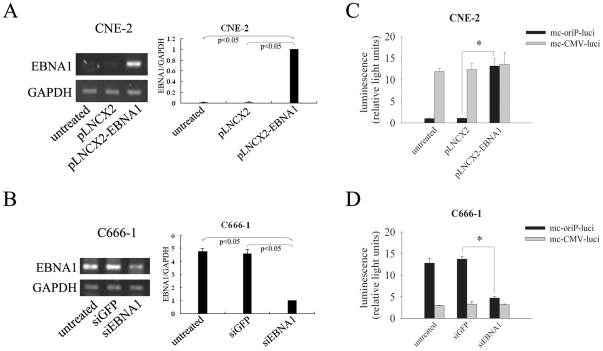
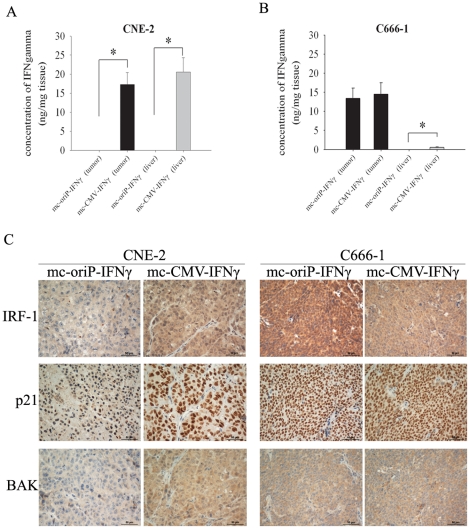
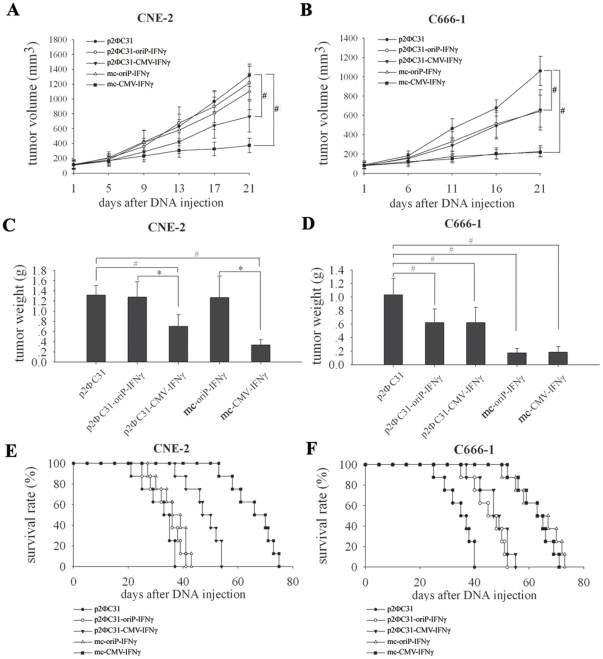
METHODOLOGY/PRINCIPAL FINDINGS: Dual-luciferase reporter assay and ELISA were used to assess the expression of luciferase and IFNγ. WST assay was used to assess the cell proliferation. RT-PCR was used to detect the mRNA level of EBNA1. RNAi was used to knockdown the expression of EBNA1. NPC xenograft models in nude mice were used to investigate the targeted antitumor efficacy of mc-oriP-IFNγ. Immunohistochemistry was used to detect the expression and the activity of the IFNγ in tumor sections. Our results demonstrated that mc-oriP vectors mediated comparable gene expression and anti-proliferative effect in the EBV-positive NPC cell line C666-1 compared to mc-CMV vectors. Furthermore, mc-oriP vectors exhibited much lower killing effects on EBV-negative cell lines compared to mc-CMV vectors. The targeted expression of mc-oriP vectors was inhibited by EBNA1-siRNA in C666-1. This selective expression was corroborated in EBV-positive and -negative tumor models.
CONCLUSIONS/SIGNIFICANCE: This study demonstrates the feasibility of mc-oriP-IFNγ as a safe and highly effective targeted gene therapeutic system for the treatment of EBV positive NPC.
非病毒载体因其独特的优势而被广泛用于基因治疗。我们之前的研究表明,利用新型非病毒载体微环(mc)在巨细胞病毒(CMV)启动子的控制下转染人 IFNγ 基因到鼻咽癌(NPC)中,有效地抑制肿瘤生长。然而,基于 CMV 启动子的治疗方法不能在癌组织中表达靶向基因。先前的研究表明,人类 NPC 的发展与 Epstein-Barr 病毒(EBV)密切相关,并证明 oriP 在 EBV 蛋白结合时具有转录增强子功能。因此,本研究旨在探索新型肿瘤特异性基因治疗系统(mc-oriP-IFNγ)的靶向基因表达和抗肿瘤作用,其中转基因的表达受 oriP 启动子的转录调控。
方法/主要发现:双荧光素酶报告基因检测和 ELISA 用于评估荧光素酶和 IFNγ 的表达。WST 法用于评估细胞增殖。RT-PCR 用于检测 EBNA1 的 mRNA 水平。RNAi 用于敲低 EBNA1 的表达。裸鼠 NPC 异种移植模型用于研究 mc-oriP-IFNγ 的靶向抗肿瘤疗效。免疫组织化学用于检测肿瘤组织中 IFNγ 的表达和活性。我们的结果表明,与 mc-CMV 载体相比,mc-oriP 载体在 EBV 阳性 NPC 细胞系 C666-1 中介导相当的基因表达和抗增殖作用。此外,与 mc-CMV 载体相比,mc-oriP 载体对 EBV 阴性细胞系的杀伤作用要低得多。EBNA1-siRNA 抑制了 C666-1 中 mc-oriP 载体的靶向表达。这种选择性表达在 EBV 阳性和阴性肿瘤模型中得到了证实。
结论/意义:本研究证明了 mc-oriP-IFNγ 作为治疗 EBV 阳性 NPC 的安全高效的靶向基因治疗系统的可行性。