Merkin Sharon Stein, Basurto-Dávila Ricardo, Karlamangla Arun, Bird Chloe E, Lurie Nicole, Escarce Jose, Seeman Teresa
Division of Geriatrics, UCLA Geffen School of Medicine, Los Angeles, CA 90095, USA.
Ann Epidemiol. 2009 Mar;19(3):194-201. doi: 10.1016/j.annepidem.2008.12.006.
To examine race/ethnic-specific patterns of association between neighborhood socioeconomic status (NSES) and a cumulative biological risk index in a nationally representative population.
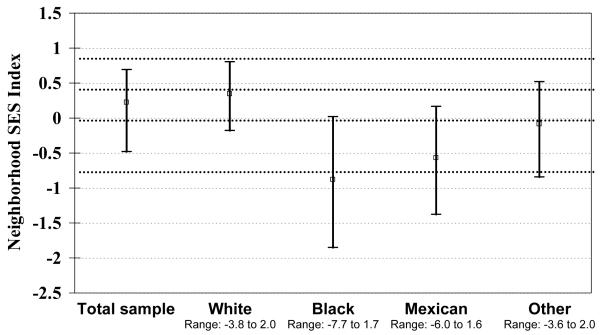
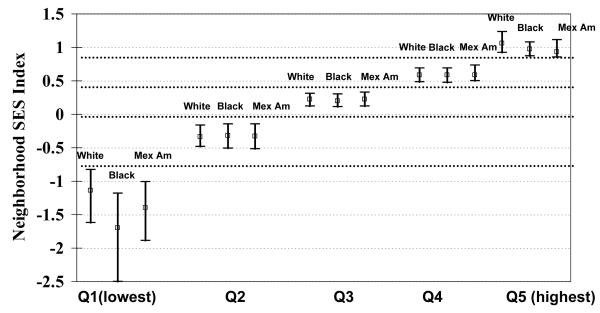
The study sample included 13,199 white, black, and Mexican-American men and women, ages 20 and older, who attended the National Health and Examination Survey examination (1988-1994). Neighborhoods were defined as census tracts and linked to U.S. Census measures from 1990 and 2000, interpolated to the survey year; the NSES score included measures of income, education, poverty, and unemployment and was categorized into quintiles, with the highest indicating greater NSES. A summary biological risk score, allostatic load (AL; range 0-9), was created from 9 biological indicators of elevated risk: serum levels of C-reactive protein, albumin, glycated hemoglobin, total and high-density lipoprotein cholesterol, waist-to-hip ratio, systolic and diastolic blood pressure, and resting heart rate. Regression models stratified by race/ethnicity examined AL as a continuous and dichotomous (>or=3 vs. <3) outcome.
We found strong inverse associations between NSES and AL for black subjects, after adjusting for age, sex, U.S. birth, urban location, and individual SES. These associations were weaker and less consistent for Mexican Americans and whites.
Our results indicate that living in low NSES neighborhoods is most strongly associated with greater cumulative biological risk profiles in the black U.S. population.
在全国代表性人群中,研究邻里社会经济地位(NSES)与累积生物风险指数之间的种族/族裔特异性关联模式。
研究样本包括13199名年龄在20岁及以上的白人、黑人及墨西哥裔美国男性和女性,他们参加了国家健康和检查调查(1988 - 1994年)。邻里被定义为普查区,并与1990年和2000年的美国人口普查数据相关联,并插值到调查年份;NSES得分包括收入、教育、贫困和失业指标,并分为五分位数,得分越高表明NSES越高。从9个风险升高的生物指标创建了一个综合生物风险评分,即应激负荷(AL;范围0 - 9):血清C反应蛋白、白蛋白、糖化血红蛋白、总胆固醇和高密度脂蛋白胆固醇水平、腰臀比、收缩压和舒张压以及静息心率。按种族/族裔分层的回归模型将AL作为连续和二分(≥3与<3)结果进行检验。
在调整年龄、性别、在美国出生、城市位置和个人社会经济地位后,我们发现黑人受试者的NSES与AL之间存在强烈的负相关。墨西哥裔美国人和白人的这些关联较弱且不太一致。
我们的结果表明,在美国黑人人群中,生活在低NSES社区与更高的累积生物风险特征密切相关。