West Steven, Proudfoot Nicholas J
Sir William Dunn School of Pathology, University of Oxford, South Parks Road, Oxford OX13RE, UK.
Mol Cell. 2009 Feb 13;33(3):354-64. doi: 10.1016/j.molcel.2009.01.008.
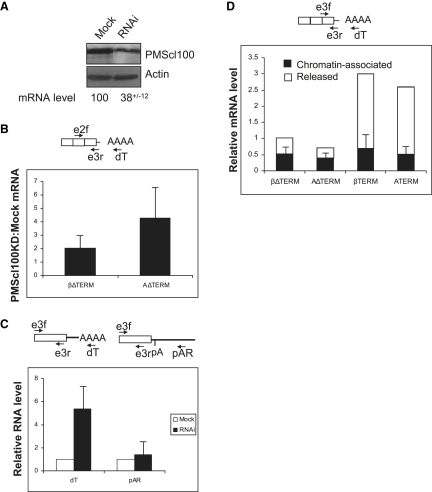
Transcriptional termination of mammalian RNA polymerase II (Pol II) requires a poly(A) (pA) signal and, often, a downstream terminator sequence. Termination is triggered following recognition of the pA signal by Pol II and subsequent pre-mRNA cleavage, which occurs either at the pA site or in transcripts from terminator elements. Although this process has been extensively studied, it is generally considered inconsequential to the level of gene expression. However, our results demonstrate that termination acts as a driving force for optimal gene expression. We show that this effect is general but most dramatic where weak or noncanonical pA signals are present. We establish that termination of Pol II increases the efficiency of pre-mRNA processing that is completed posttranscriptionally. As such, transcripts escape from nuclear surveillance.
哺乳动物RNA聚合酶II(Pol II)的转录终止需要一个聚腺苷酸(pA)信号,并且通常还需要一个下游终止子序列。Pol II识别pA信号并随后进行前体mRNA切割后触发终止,切割发生在pA位点或终止子元件的转录本中。尽管这一过程已得到广泛研究,但一般认为它对基因表达水平无关紧要。然而,我们的结果表明,终止是最佳基因表达的驱动力。我们表明这种效应是普遍存在的,但在存在弱或非典型pA信号的情况下最为显著。我们确定Pol II的终止提高了转录后完成的前体mRNA加工的效率。因此,转录本逃离了核监测。