van der Walt Eric, Rybicki Edward P, Varsani Arvind, Polston J E, Billharz Rosalind, Donaldson Lara, Monjane Adérito L, Martin Darren P
Department of Molecular and Cell Biology, University of Cape Town, Cape Town, South Africa.
Institute of Infectious Disease and Molecular Medicine, University of Cape Town, Cape Town, South Africa.
J Gen Virol. 2009 Mar;90(Pt 3):734-746. doi: 10.1099/vir.0.007724-0.
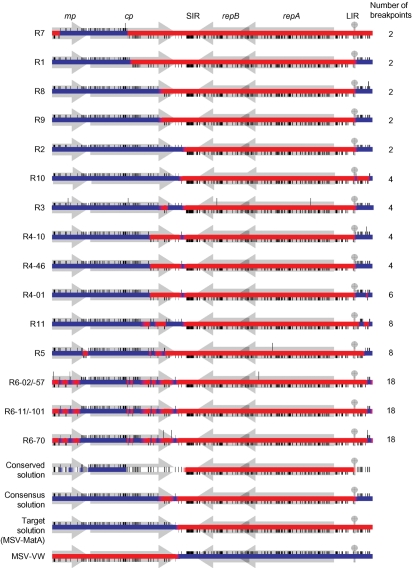
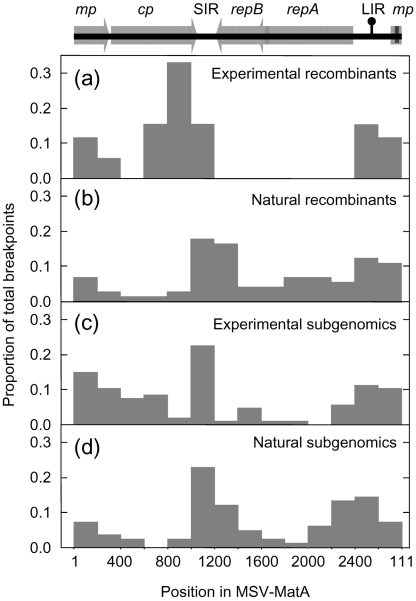
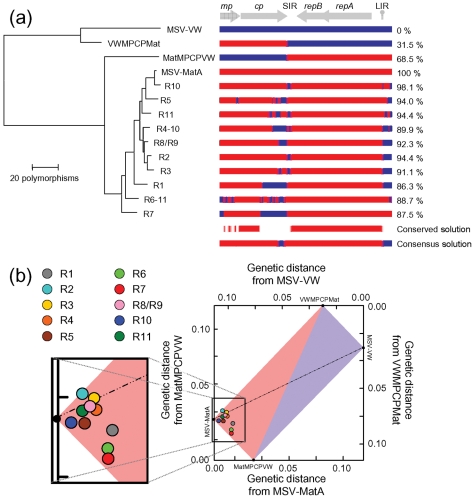
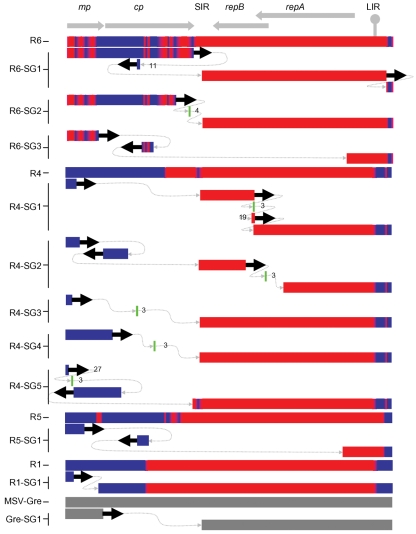
Experimental investigations into virus recombination can provide valuable insights into the biochemical mechanisms and the evolutionary value of this fundamental biological process. Here, we describe an experimental scheme for studying recombination that should be applicable to any recombinogenic viruses amenable to the production of synthetic infectious genomes. Our approach is based on differences in fitness that generally exist between synthetic chimaeric genomes and the wild-type viruses from which they are constructed. In mixed infections of defective reciprocal chimaeras, selection strongly favours recombinant progeny genomes that recover a portion of wild-type fitness. Characterizing these evolved progeny viruses can highlight both important genetic fitness determinants and the contribution that recombination makes to the evolution of their natural relatives. Moreover, these experiments supply precise information about the frequency and distribution of recombination breakpoints, which can shed light on the mechanistic processes underlying recombination. We demonstrate the value of this approach using the small single-stranded DNA geminivirus, maize streak virus (MSV). Our results show that adaptive recombination in this virus is extremely efficient and can yield complex progeny genomes comprising up to 18 recombination breakpoints. The patterns of recombination that we observe strongly imply that the mechanistic processes underlying rolling circle replication are the prime determinants of recombination breakpoint distributions found in MSV genomes sampled from nature.
对病毒重组的实验研究能够为这一基本生物学过程的生化机制及进化价值提供宝贵的见解。在此,我们描述了一种研究重组的实验方案,该方案应适用于任何能够产生合成感染性基因组的重组病毒。我们的方法基于合成嵌合基因组与其构建所源自的野生型病毒之间通常存在的适应性差异。在缺陷型相互嵌合体的混合感染中,选择强烈倾向于恢复部分野生型适应性的重组后代基因组。对这些进化后的后代病毒进行表征,既可以突出重要的遗传适应性决定因素,也能体现重组对其天然亲缘病毒进化的贡献。此外,这些实验提供了有关重组断点频率和分布的精确信息,这有助于揭示重组背后的机制过程。我们利用小型单链DNA双生病毒——玉米条纹病毒(MSV)证明了这种方法的价值。我们的结果表明,该病毒中的适应性重组极其高效,能够产生包含多达18个重组断点的复杂后代基因组。我们观察到的重组模式强烈暗示,滚环复制背后的机制过程是从自然界采样的MSV基因组中发现的重组断点分布的主要决定因素。