Polli Frida E, Wright Christopher I, Milad Mohammed R, Dickerson Bradford C, Vangel Mark, Barton Jason J S, Rauch Scott L, Manoach Dara S
Department of Psychiatry, Massachusetts General Hospital, Harvard Medical School, Boston, MA, USA.
Neuroreport. 2009 Mar 4;20(4):398-402. doi: 10.1097/WNR.0b013e328324edb8.
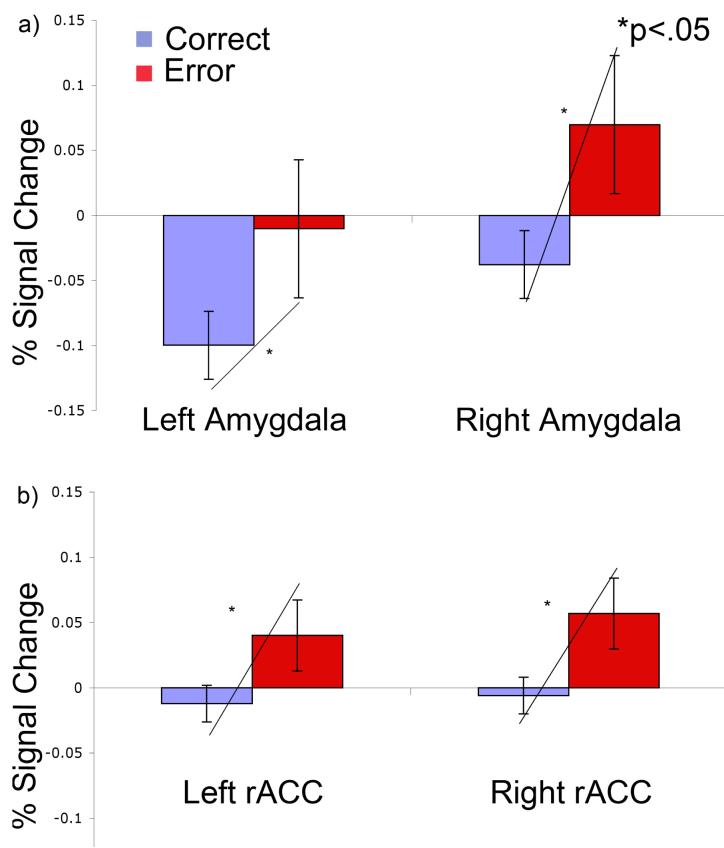
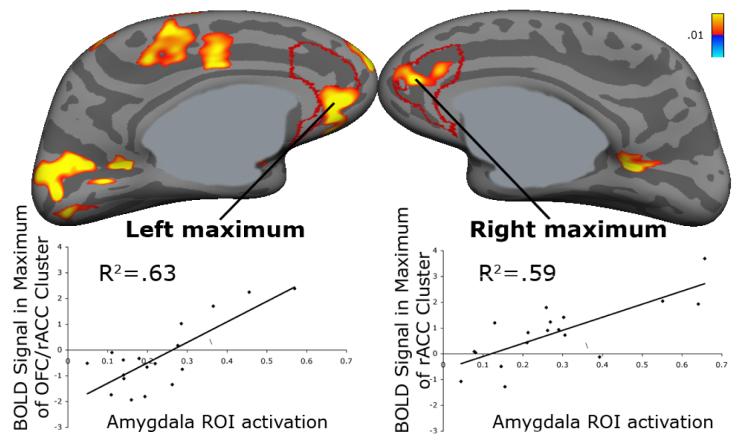
The amygdala detects aversive events and coordinates with the rostral anterior cingulate cortex to adapt behavior. We assessed error-related activation in these regions and its relation to task performance using functional MRI and a saccadic paradigm. Both amygdalae showed increased activation during error versus correct antisaccade trials that was correlated with error-related activation in the corresponding rostral anterior cingulate cortex. Together, activation in the right amygdala and right rostral anterior cingulate cortex predicted greater accuracy. In contrast, the left amygdala activation predicted a higher error rate. These findings support a role for the amygdala in response monitoring. Consistent with proposed specializations of the right and left amygdala in aversive conditioning, we hypothesize that right amygdala-rostral anterior cingulate cortex interactions mediate learning to avoid errors, whereas left error-related amygdala activation underpins detrimental negative affect.
杏仁核可检测厌恶事件,并与喙前扣带回皮质协同作用以调整行为。我们使用功能磁共振成像和扫视范式评估了这些区域中与错误相关的激活及其与任务表现的关系。在错误试验与正确的反扫视试验中,双侧杏仁核均表现出激活增加,且与相应喙前扣带回皮质中与错误相关的激活相关。右侧杏仁核和右侧喙前扣带回皮质的激活共同预示着更高的准确性。相比之下,左侧杏仁核的激活预示着更高的错误率。这些发现支持了杏仁核在反应监测中的作用。与左右杏仁核在厌恶条件反射中所提出的特化作用一致,我们假设右侧杏仁核 - 喙前扣带回皮质的相互作用介导了避免错误的学习,而左侧与错误相关的杏仁核激活则是有害负面影响的基础。