Hajcak G, Castille C, Olvet D M, Dunning J P, Roohi J, Hatchwell E
Department of Psychology, Stony Brook University, Stony Brook, NY 11794-2500, USA.
Genes Brain Behav. 2009 Feb;8(1):80-5. doi: 10.1111/j.1601-183X.2008.00447.x.
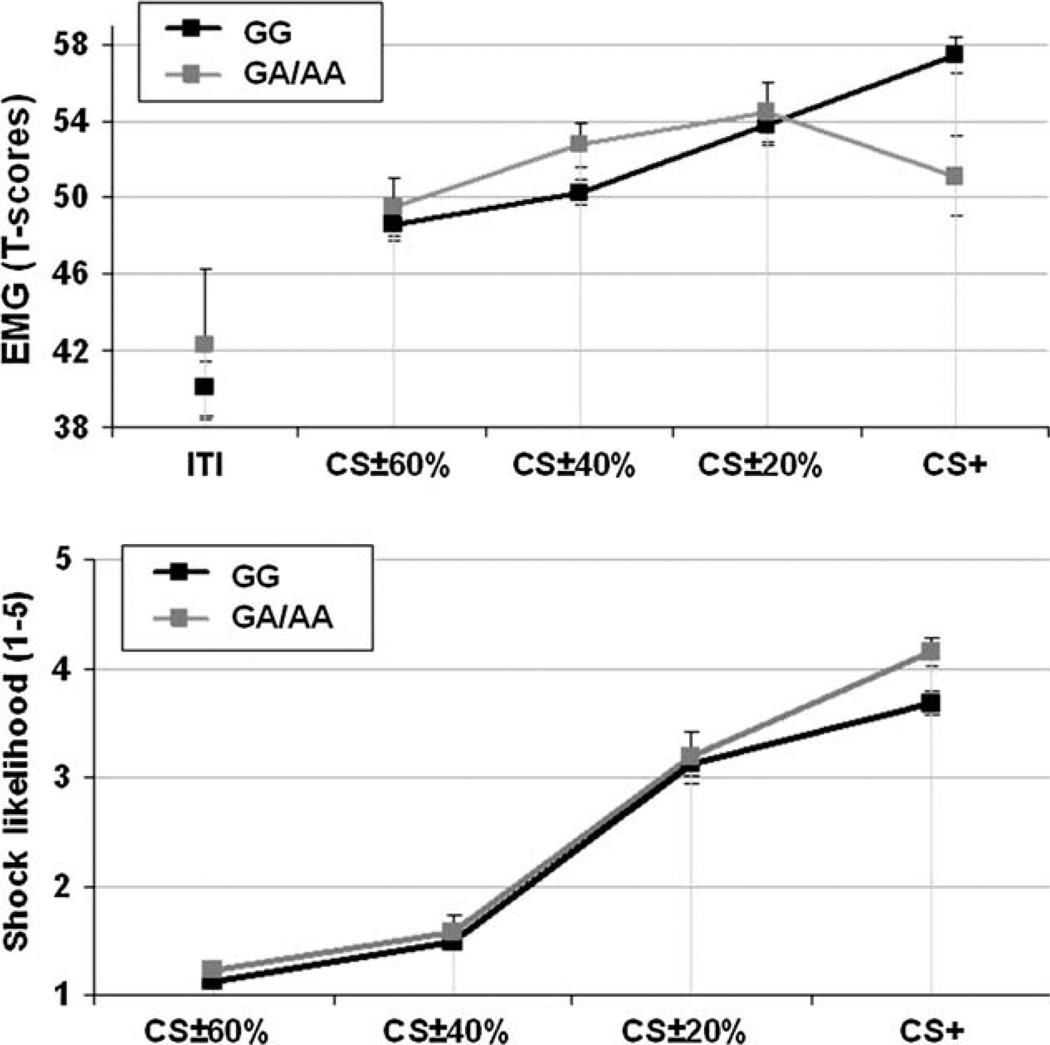
Brain-derived neurotrophic factor (BDNF) has been implicated in hippocampal-dependent learning processes, and carriers of the Met allele of the Val66Met BDNF genotype are characterized by reduced hippocampal structure and function. Recent nonhuman animal work suggests that BDNF is also crucial for amygdala-dependent associative learning. The present study sought to examine fear conditioning as a function of the BDNF polymorphism. Fifty-seven participants were genotyped for the BDNF polymorphism and took part in a differential-conditioning paradigm. Participants were shocked following a particular conditioned stimulus (CS+) and were also presented with stimuli that ranged in perceptual similarity to the CS+ (20, 40 or 60% smaller or larger than the CS+). The eye blink component of the startle response was measured to quantify fear conditioning; post-task shock likelihood ratings for each stimulus were also obtained. All participants reported that shock likelihood varied with perceptual similarity to the CS+ and showed potentiated startle in response to CS +/- 20% stimuli. However, only the Val/Val group had potentiated startle responses to the CS+. Met allele carrying individuals were characterized by deficient fear conditioning--evidenced by an attenuated startle response to CS+ stimuli. Variation in the BDNF genotype appears related to abnormal fear conditioning, consistent with nonhuman animal work on the importance of BDNF in amygdala-dependent associative learning. The relation between genetic variation in BDNF and amygdala-dependent associative learning deficits is discussed in terms of potential mechanisms of risk for psychopathology.
脑源性神经营养因子(BDNF)与海马体依赖的学习过程有关,而携带BDNF基因Val66Met多态性中Met等位基因的个体,其海马体结构和功能有所减退。近期的非人类动物研究表明,BDNF对杏仁核依赖的联想学习也至关重要。本研究旨在考察恐惧条件反射作为BDNF多态性的一项功能。57名参与者接受了BDNF多态性基因分型,并参与了一项差异条件反射范式实验。在特定条件刺激(CS+)出现后,参与者会受到电击,同时还会呈现与CS+在感知相似性上有所不同的刺激(比CS+小或大20%、40%或60%)。测量惊吓反应中的眨眼成分以量化恐惧条件反射;同时还获取了每个刺激在任务后电击可能性评分。所有参与者均报告称,电击可能性随与CS+的感知相似性而变化,并且对CS+/- 20%的刺激表现出惊吓增强。然而,只有Val/Val组对CS+有惊吓增强反应。携带Met等位基因的个体表现出恐惧条件反射缺陷——表现为对CS+刺激的惊吓反应减弱。BDNF基因分型的差异似乎与异常的恐惧条件反射有关,这与非人类动物研究中BDNF在杏仁核依赖的联想学习中的重要性一致。本文从精神病理学潜在风险机制的角度讨论了BDNF基因变异与杏仁核依赖的联想学习缺陷之间的关系。