Grady Sue C, Enander Helen
Department of Geography, Michigan State University, East Lansing, Michigan 48824, USA.
Int J Health Geogr. 2009 Feb 18;8:10. doi: 10.1186/1476-072X-8-10.
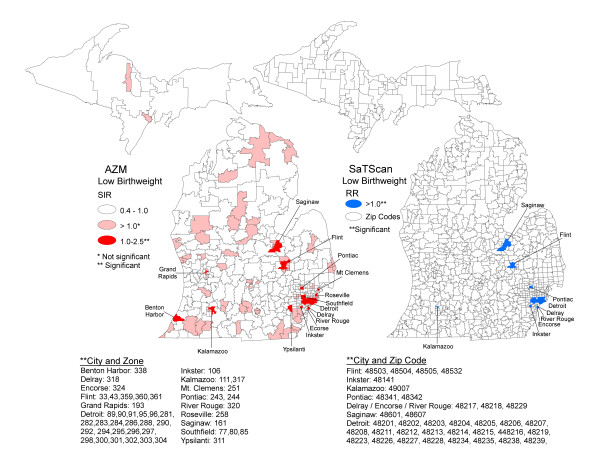
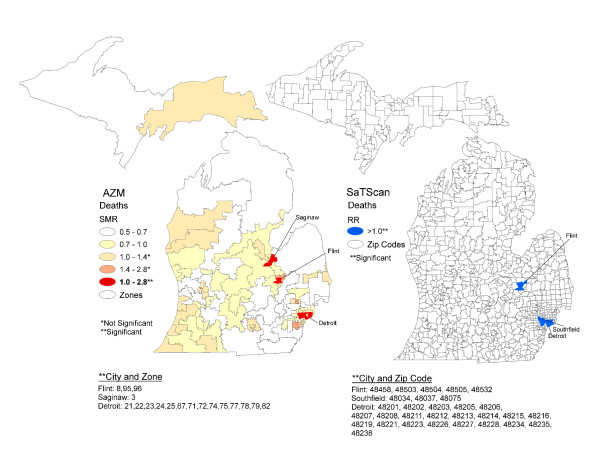
Infant mortality is a major public health problem in the State of Michigan and the United States. The primary adverse reproductive outcome underlying infant mortality is low birthweight. Visualizing and exploring the spatial patterns of low birthweight and infant mortality rates and standardized incidence and mortality ratios is important for generating mechanistic hypotheses, targeting high-risk neighborhoods for monitoring and implementing maternal and child health intervention and prevention programs and evaluating the need for health care services. This study investigates the spatial patterns of low birthweight and infant mortality in the State of Michigan using automated zone matching (AZM) methodology and minimum case and population threshold recommendations provided by the National Center for Health Statistics and the US Census Bureau to calculate stable rates and standardized incidence and mortality ratios at the Zip Code (n = 896) level. The results from this analysis are validated using SaTScan. Vital statistics birth (n = 370,587) and linked infant death (n = 2,972) records obtained from the Michigan Department of Community Health and aggregated for the years 2004 to 2006 are utilized.
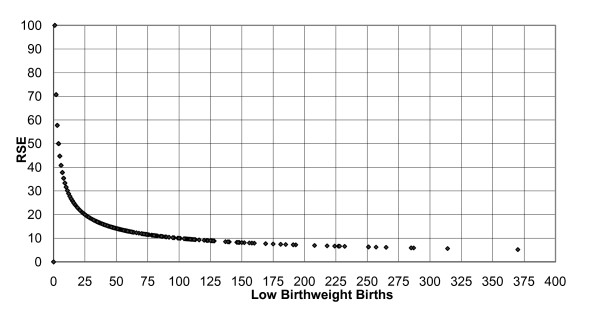
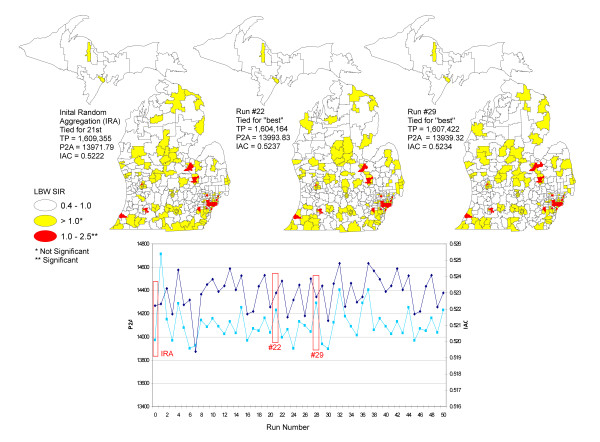
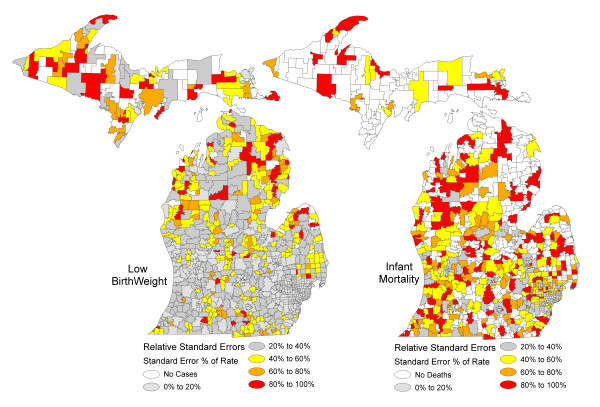
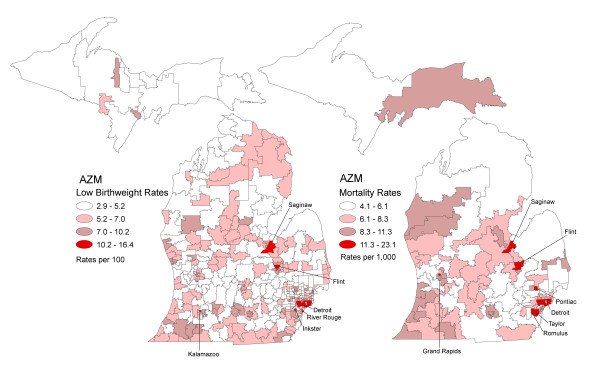
For a majority of Zip Codes the relative standard errors (RSEs) of rates calculated prior to AZM were greater than 20%. Spurious results were the result of too few case and birth counts. Applying AZM with a target population of 25 cases and minimum threshold of 20 cases resulted in the reconstruction of zones with at least 50 births and RSEs of rates 20-22% and below respectively, demonstrating the stability reliability of these new estimates. Other AZM parameters included homogeneity constraints on maternal race and maximum shape compactness of zones to minimize potential confounding. AZM identified areas with elevated low birthweight and infant mortality rates and standardized incidence and mortality ratios. Most but not all of these areas were also detected by SaTScan.
Understanding the spatial patterns of low birthweight and infant deaths in Michigan was an important first step in conducting a geographic evaluation of the State's reported high infant mortality rates. AZM proved to be a useful tool for visualizing and exploring the spatial patterns of low birthweight and infant deaths for public health surveillance. Future research should also consider AZM as a tool for health services research.
婴儿死亡率是密歇根州乃至美国的一个主要公共卫生问题。导致婴儿死亡的主要不良生殖结局是低出生体重。可视化并探究低出生体重和婴儿死亡率以及标准化发病率和死亡率的空间模式,对于生成机制假设、针对高风险社区进行监测并实施母婴健康干预和预防计划以及评估医疗服务需求而言至关重要。本研究采用自动区域匹配(AZM)方法以及美国国家卫生统计中心和美国人口普查局提供的最小病例数和人口阈值建议,对密歇根州低出生体重和婴儿死亡率的空间模式进行调查,以计算邮政编码(n = 896)层面的稳定率以及标准化发病率和死亡率。使用SaTScan对该分析结果进行验证。利用从密歇根州社区卫生部获取的2004年至2006年的生命统计出生记录(n = 370,587)以及关联的婴儿死亡记录(n = 2,972)并进行汇总。
对于大多数邮政编码区域,在进行自动区域匹配之前计算的比率的相对标准误差(RSE)大于20%。虚假结果是由于病例数和出生数过少所致。将目标人群设定为25例病例且最小阈值设定为20例病例来应用自动区域匹配,结果重建了至少有50例出生的区域,且比率的相对标准误差分别为20 - 22%及以下,证明了这些新估计值的稳定性和可靠性。其他自动区域匹配参数包括对母亲种族的同质性约束以及区域的最大形状紧凑度,以尽量减少潜在的混杂因素。自动区域匹配确定了低出生体重、婴儿死亡率以及标准化发病率和死亡率较高的区域。这些区域中的大多数但并非全部也被空间扫描统计(SaTScan)检测到。
了解密歇根州低出生体重和婴儿死亡的空间模式是对该州报告的高婴儿死亡率进行地理评估的重要第一步。自动区域匹配被证明是一种用于可视化和探究低出生体重和婴儿死亡的空间模式以进行公共卫生监测的有用工具。未来研究也应将自动区域匹配视为卫生服务研究的一种工具。