Ozdenerol Esra, Williams Bryan L, Kang Su Young, Magsumbol Melina S
Department of Earth Sciences, University of Memphis, Tennessee 38152, USA.
Int J Health Geogr. 2005 Aug 2;4:19. doi: 10.1186/1476-072X-4-19.
The purpose of this study is to examine the spatial and population (e.g., socio-economic) characteristics of low birthweight using two different cluster estimation techniques. We compared the results of Kulldorff's Spatial Scan Statistic with the results of Rushton's Spatial filtering technique across increasing sizes of spatial filters (circle). We were able to demonstrate that varying approaches exist to explore spatial variation in patterns of low birth weight.
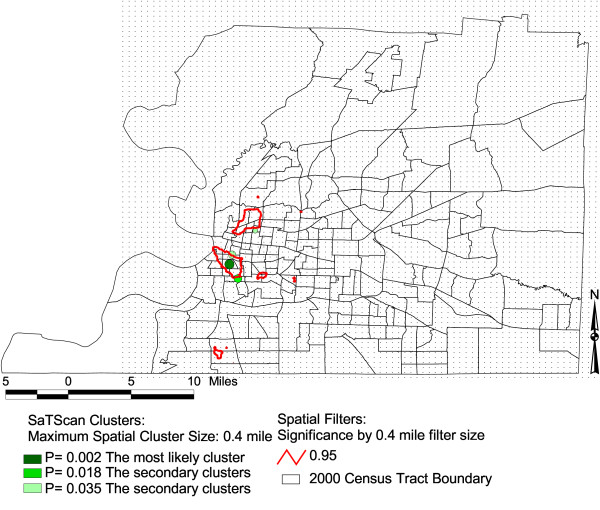
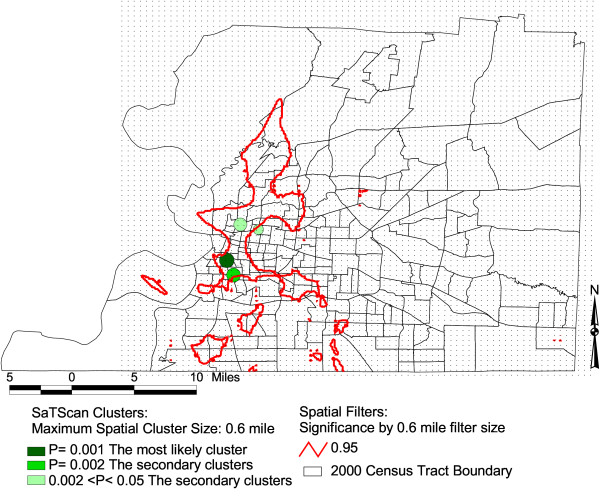
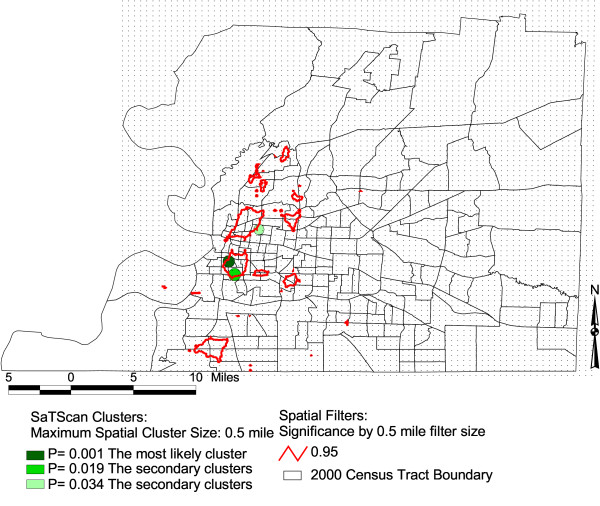
Spatial filtering results did not show any particular area that was not statistically significant based on SaTScan. The high rates, which remain as the filter size increases to 0.4, 0.5 to 0.6 miles, respectively, indicate that these differences are less likely due to chance. The maternal characteristics of births within clusters differed considerably between the two methods. Progressively larger Spatial filters removed local spatial variability, which eventually produced an approximate uniform pattern of low birth weight.
SaTScan and Spatial filtering cluster estimation methods produced noticeably different results from the same individual level birth data. SaTScan clusters are likely to differ from Spatial filtering clusters in terms of population characteristics and geographic area within clusters. Using the two methods in conjunction could provide more detail about the population and spatial features contained with each type of cluster.
本研究的目的是使用两种不同的聚类估计技术来研究低出生体重的空间和人口(如社会经济)特征。我们将库尔朵夫空间扫描统计法的结果与鲁什顿空间滤波技术在不同大小空间滤波器(圆形)下的结果进行了比较。我们能够证明,存在多种方法来探索低出生体重模式中的空间变异。
空间滤波结果未显示出基于SaTScan法无统计学意义的任何特定区域。随着滤波器大小分别增加到0.4、0.5至0.6英里,高发生率表明这些差异不太可能是偶然造成的。两种方法中聚类内出生的产妇特征差异很大。逐渐增大的空间滤波器消除了局部空间变异性,最终产生了低出生体重的近似均匀模式。
SaTScan法和空间滤波聚类估计方法对相同个体水平的出生数据得出了明显不同的结果。SaTScan聚类在人口特征和聚类内地理区域方面可能与空间滤波聚类不同。结合使用这两种方法可以提供有关每种聚类类型所包含的人口和空间特征的更多细节。