Awah Paschal K, Unwin Nigel C, Phillimore Peter R
HoPiT Research Group, PO Box 8046, Yaounde, Cameroon.
BMC Endocr Disord. 2009 Feb 19;9:5. doi: 10.1186/1472-6823-9-5.
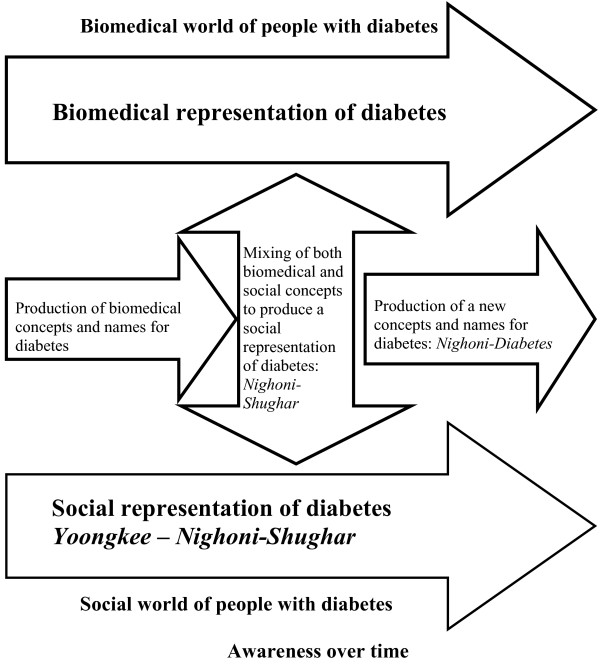
The objective was to examine how the indigenous naming, indigenous self-diagnosis and management of diabetes evolved with awareness in order to develop a socially oriented theoretical model for its care.
The data was collected through a one-year extended participant observation in Bafut, a rural health district of Cameroon. The sample consisted of 72 participants in a rural health district of Cameroon (men and women) with type 2 diabetes. We used participant observation to collect data through focus group discussions, in depth interviews and fieldwork conversations. The method of analysis entailed a thick description, thematic analysis entailing constant comparison within and across FGD and across individual participants and content analysis.
The core concepts identified were the evolution of names for diabetes and the indigenous diagnostic and self-management procedures. Participants fell into one of two naming typologies: (a) Naming excluding any signs and symptoms of diabetes; (b) naming including signs and symptoms of diabetes. Participants fell into two typologies of diagnostic procedures: (a) those that use indigenous diagnostic procedures for monitoring and controlling diabetes outcomes and b) those that had initially used it only for diagnosis and continued to use them for self management. These typologies varied according to how participants' awareness evolved and the impact on self-diagnosis and management.
The evolution of names for diabetes was an important factor that influenced the subsequent self-diagnosis and management of diabetes in both traditional and modern biomedical settings.
目的是研究糖尿病的本土命名、本土自我诊断及管理如何随着认知的提高而演变,以便为其护理建立一个以社会为导向的理论模型。
通过在喀麦隆一个农村健康区巴富特进行为期一年的扩展参与观察来收集数据。样本包括喀麦隆一个农村健康区的72名患有2型糖尿病的参与者(男性和女性)。我们通过焦点小组讨论、深入访谈和实地工作对话,利用参与观察来收集数据。分析方法包括详细描述、主题分析(在焦点小组讨论内部和之间、跨个体参与者进行持续比较)以及内容分析。
确定的核心概念是糖尿病名称的演变以及本土诊断和自我管理程序。参与者分为两种命名类型之一:(a)不包括糖尿病任何体征和症状的命名;(b)包括糖尿病体征和症状的命名。参与者分为两种诊断程序类型:(a)那些使用本土诊断程序来监测和控制糖尿病结果的人,以及(b)那些最初仅将其用于诊断并继续将其用于自我管理的人。这些类型根据参与者认知的演变方式以及对自我诊断和管理的影响而有所不同。
糖尿病名称的演变是一个重要因素,在传统和现代生物医学环境中都会影响随后的糖尿病自我诊断和管理。