Harrison Stephenie A, Tong Frank
Psychology Department and Vanderbilt Vision Research Center, Vanderbilt University, Nashville, Tennessee 37240, USA.
Nature. 2009 Apr 2;458(7238):632-5. doi: 10.1038/nature07832. Epub 2009 Feb 18.
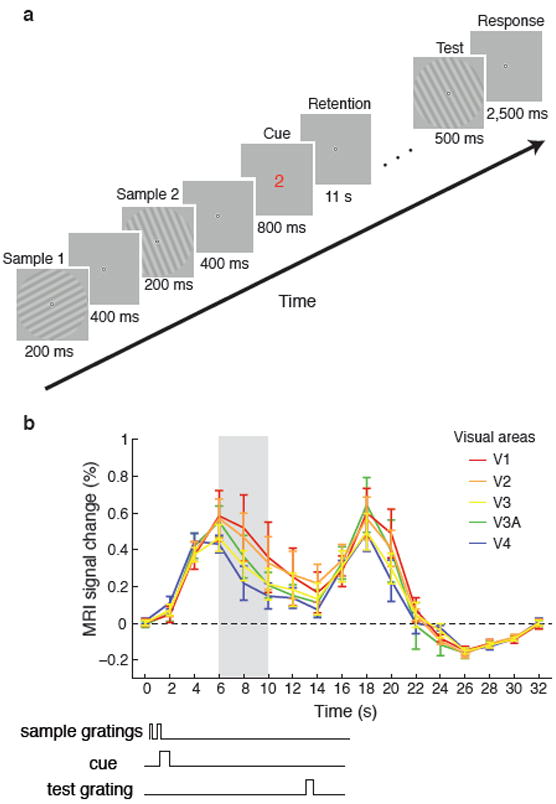
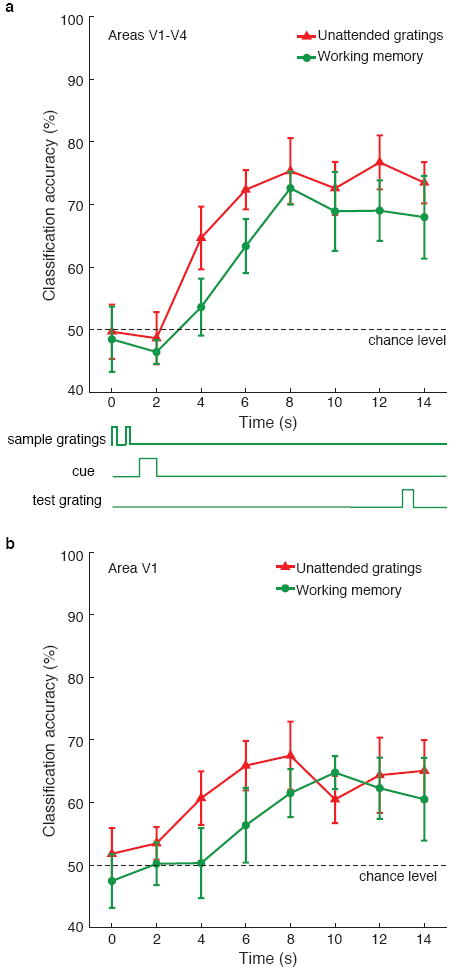
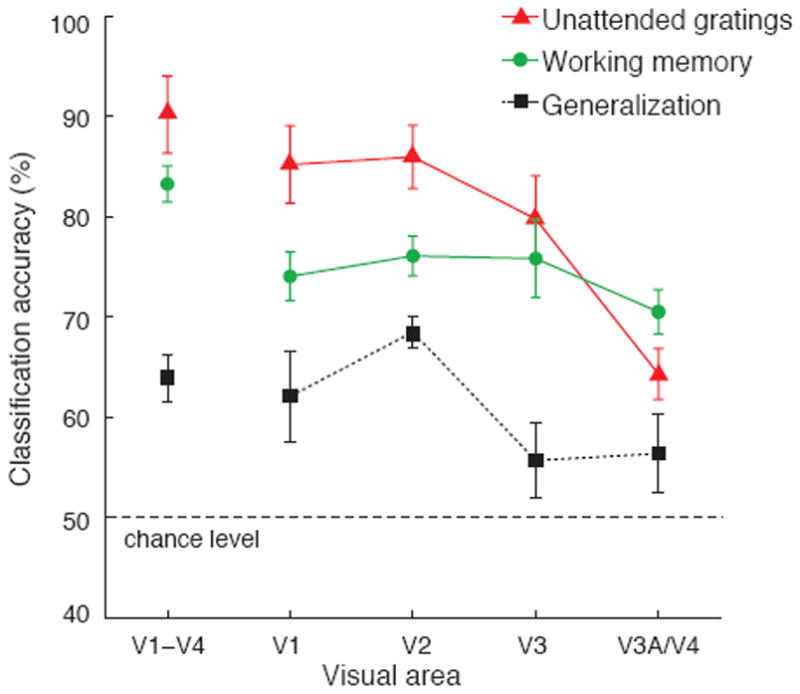
Visual working memory provides an essential link between perception and higher cognitive functions, allowing for the active maintenance of information about stimuli no longer in view. Research suggests that sustained activity in higher-order prefrontal, parietal, inferotemporal and lateral occipital areas supports visual maintenance, and may account for the limited capacity of working memory to hold up to 3-4 items. Because higher-order areas lack the visual selectivity of early sensory areas, it has remained unclear how observers can remember specific visual features, such as the precise orientation of a grating, with minimal decay in performance over delays of many seconds. One proposal is that sensory areas serve to maintain fine-tuned feature information, but early visual areas show little to no sustained activity over prolonged delays. Here we show that orientations held in working memory can be decoded from activity patterns in the human visual cortex, even when overall levels of activity are low. Using functional magnetic resonance imaging and pattern classification methods, we found that activity patterns in visual areas V1-V4 could predict which of two oriented gratings was held in memory with mean accuracy levels upwards of 80%, even in participants whose activity fell to baseline levels after a prolonged delay. These orientation-selective activity patterns were sustained throughout the delay period, evident in individual visual areas, and similar to the responses evoked by unattended, task-irrelevant gratings. Our results demonstrate that early visual areas can retain specific information about visual features held in working memory, over periods of many seconds when no physical stimulus is present.
视觉工作记忆在感知与更高层次的认知功能之间提供了至关重要的联系,使不再呈现在视野中的刺激信息得以主动维持。研究表明,前额叶、顶叶、颞下回和枕叶外侧等高级区域的持续活动支持视觉维持,这可能解释了工作记忆只能容纳3 - 4个项目的有限容量。由于高级区域缺乏早期感觉区域的视觉选择性,观察者如何能够记住特定的视觉特征,比如光栅的精确方向,并且在数秒的延迟过程中表现几乎没有衰减,这一点仍不清楚。一种观点认为感觉区域用于维持经过微调的特征信息,但早期视觉区域在长时间延迟中几乎没有持续活动。在此我们表明,即使在总体活动水平较低时,工作记忆中保持的方向也可以从人类视觉皮层的活动模式中解码出来。使用功能磁共振成像和模式分类方法,我们发现视觉区域V1 - V4的活动模式能够预测记忆中两个定向光栅中的哪一个,平均准确率超过80%,即使是在经过长时间延迟后活动降至基线水平的参与者中也是如此。这些方向选择性的活动模式在整个延迟期持续存在,在各个视觉区域都很明显,并且与由未被注意的、与任务无关的光栅所引发的反应相似。我们的结果表明,在没有物理刺激的情况下,早期视觉区域能够在数秒的时间内保留工作记忆中视觉特征的特定信息。