Berens Philipp, Keliris Georgios A, Ecker Alexander S, Logothetis Nikos K, Tolias Andreas S
Max Planck Institute for Biological Cybernetics Tübingen, Germany.
Front Neurosci. 2008 Dec 15;2(2):199-207. doi: 10.3389/neuro.01.037.2008. eCollection 2008 Dec.
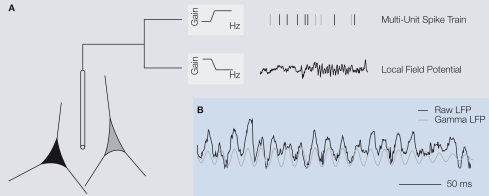
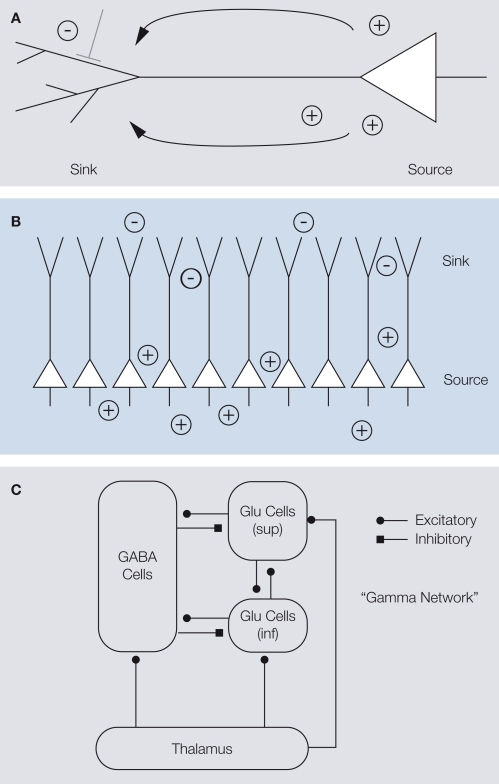
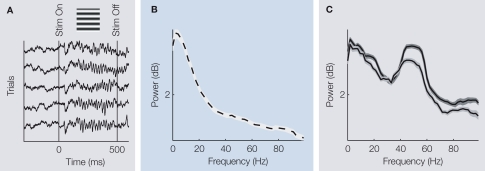
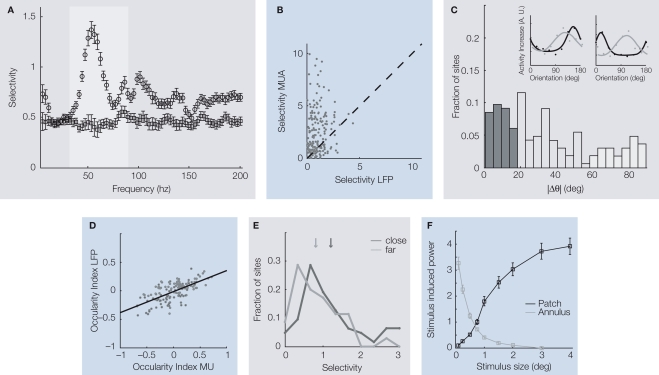
Extracellular voltage fluctuations (local field potentials, LFPs) reflecting neural mass action are ubiquitous across species and brain regions. Numerous studies have characterized the properties of LFP signals in the cortex to study sensory and motor computations as well as cognitive processes like attention, perception and memory. In addition, its extracranial counterpart - the electroencephalogram - is widely used in clinical applications. However, the link between LFP signals and the underlying activity of local populations of neurons remains largely elusive. Here, we review recent work elucidating the relationship between spiking activity of local neural populations and LFP signals. We focus on oscillations in the gamma-band (30-90 Hz) of the LFP in the primary visual cortex (V1) of the macaque that dominate during visual stimulation. Given that in area V1 much is known about the properties of single neurons and the cortical architecture, it provides an excellent opportunity to study the mechanisms underlying the generation of the LFP.
反映神经群体活动的细胞外电压波动(局部场电位,LFP)在所有物种和脑区中普遍存在。众多研究已对皮质中LFP信号的特性进行了表征,以研究感觉和运动计算以及诸如注意力、感知和记忆等认知过程。此外,其颅外对应物——脑电图——在临床应用中被广泛使用。然而,LFP信号与局部神经元群体的潜在活动之间的联系在很大程度上仍然难以捉摸。在这里,我们回顾了最近阐明局部神经群体的放电活动与LFP信号之间关系的工作。我们聚焦于猕猴初级视觉皮层(V1)中LFP的γ波段(30 - 90赫兹)振荡,这种振荡在视觉刺激期间占主导地位。鉴于在V1区,关于单个神经元的特性和皮质结构已有很多了解,它为研究LFP产生的潜在机制提供了绝佳机会。