Seberg Ole, Petersen Gitte
Laboratory of Molecular Systematics, Natural History Museum of Denmark, Copenhagen, Denmark.
PLoS One. 2009;4(2):e4598. doi: 10.1371/journal.pone.0004598. Epub 2009 Feb 25.
DNA barcoding promises to revolutionize the way taxonomists work, facilitating species identification by using small, standardized portions of the genome as substitutes for morphology. The concept has gained considerable momentum in many animal groups, but the higher plant world has been largely recalcitrant to the effort. In plants, efforts are concentrated on various regions of the plastid genome, but no agreement exists as to what kinds of regions are ideal, though most researchers agree that more than one region is necessary. One reason for this discrepancy is differences in the tests that are used to evaluate the performance of the proposed regions. Most tests have been made in a floristic setting, where the genetic distance and therefore the level of variation of the regions between taxa is large, or in a limited set of congeneric species.
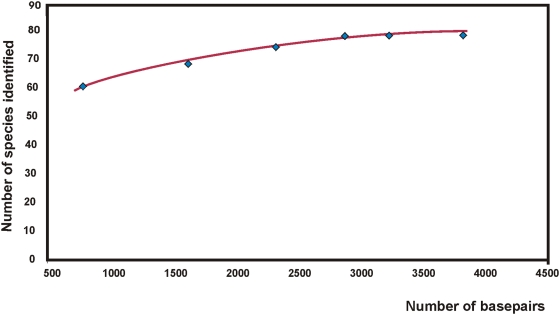
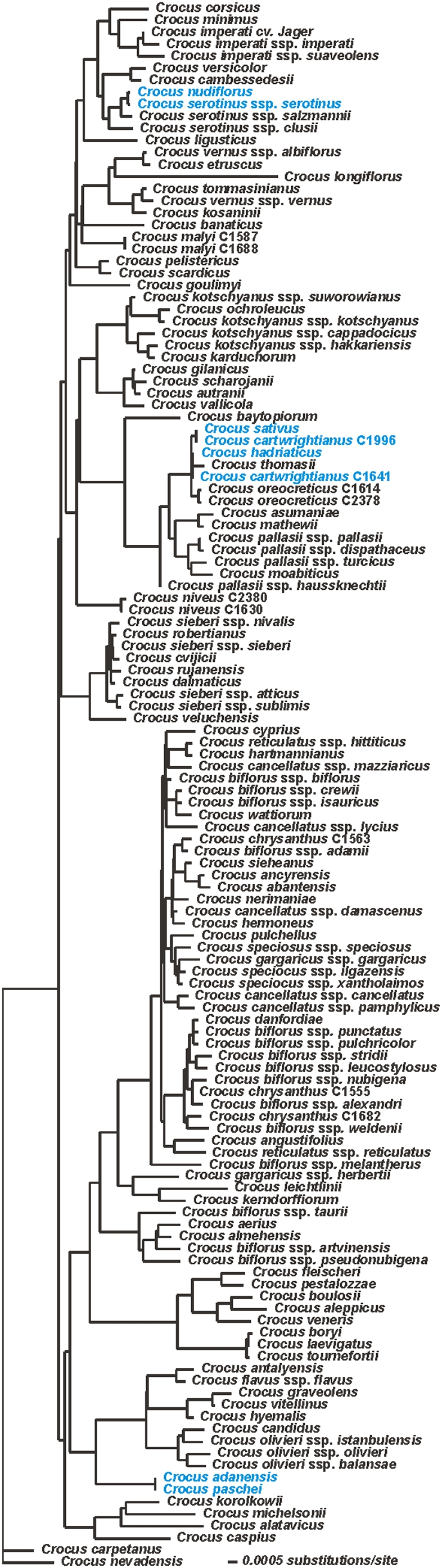
Here we present the first in-depth coverage of a large taxonomic group, all 86 known species (except two doubtful ones) of crocus. Even six average-sized barcode regions do not identify all crocus species. This is currently an unrealistic burden in a barcode context. Whereas most proposed regions work well in a floristic context, the majority will--as is the case in crocus--undoubtedly be less efficient in a taxonomic setting. However, a reasonable but less than perfect level of identification may be reached--even in a taxonomic context.
CONCLUSIONS/SIGNIFICANCE: The time is ripe for selecting barcode regions in plants, and for prudent examination of their utility. Thus, there is no reason for the plant community to hold back the barcoding effort by continued search for the Holy Grail. We must acknowledge that an emerging system will be far from perfect, fraught with problems and work best in a floristic setting.
DNA条形码技术有望彻底改变分类学家的工作方式,通过使用基因组中短小、标准化的片段替代形态学特征来促进物种鉴定。这一概念在许多动物类群中已获得相当大的发展动力,但在高等植物领域,这一努力在很大程度上遭到了抵制。在植物中,研究工作主要集中在质体基因组的各个区域,但对于哪些区域是理想的尚无定论,不过大多数研究人员都认为需要不止一个区域。这种差异的一个原因是用于评估所提议区域性能的测试存在差异。大多数测试是在植物区系环境中进行的,在这种环境中,分类单元之间区域的遗传距离以及因此的变异水平较大,或者是在一组有限的同属物种中进行的。
在此,我们首次对一个大型分类群——番红花属的所有86个已知物种(除了两个存疑物种)进行了深入研究。即便六个中等大小的条形码区域也无法鉴定出所有番红花物种。在条形码的背景下,这目前是一个不切实际的负担。尽管大多数提议的区域在植物区系环境中效果良好,但正如番红花属的情况一样,在分类学背景下,大多数区域无疑效率会更低。然而,即使在分类学背景下,也可能达到一个合理但并非完美的鉴定水平。
结论/意义:现在是选择植物条形码区域并审慎考察其效用的时候了。因此,植物学界没有理由因继续寻找完美方案而阻碍条形码技术的发展。我们必须承认,一个新兴的系统远非完美,充满问题,且在植物区系环境中效果最佳。