Singh Hemant Kumar, Parveen Iffat, Raghuvanshi Saurabh, Babbar Shashi B
Department of Botany, University of Delhi, Delhi, India.
BMC Res Notes. 2012 Jan 19;5:42. doi: 10.1186/1756-0500-5-42.
Based on the testing of several loci, predominantly against floristic backgrounds, individual or different combinations of loci have been suggested as possible universal DNA barcodes for plants. The present investigation was undertaken to check the applicability of the recommended locus/loci for congeneric species with Dendrobium species as an illustrative example.
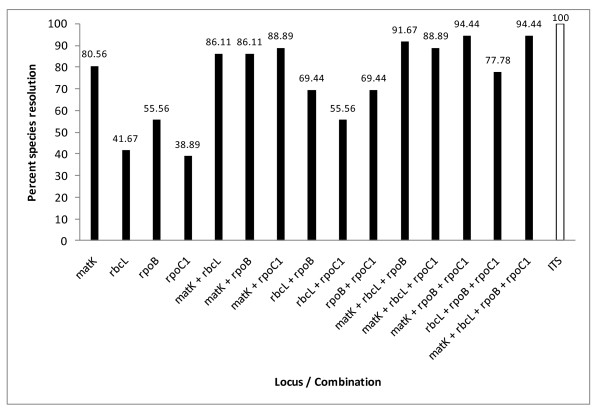
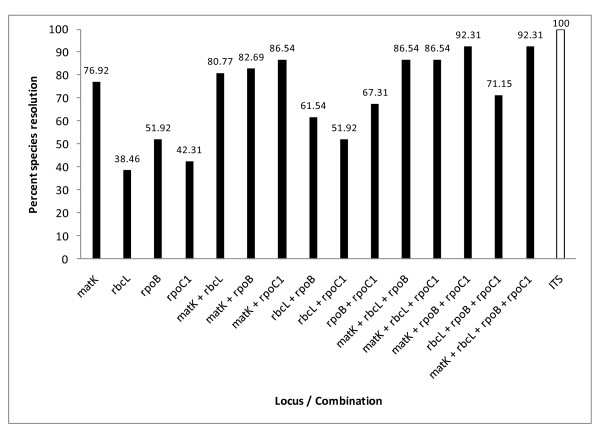
Six loci, matK, rbcL, rpoB, rpoC1, trnH-psbA spacer from the chloroplast genome and ITS, from the nuclear genome, were compared for their amplification, sequencing and species discrimination success rates among multiple accessions of 36 Dendrobium species. The trnH-psbA spacer could not be considered for analysis as good quality sequences were not obtained with its forward primer. Among the tested loci, ITS, recommended by some as a possible barcode for plants, provided 100% species identification. Another locus, matK, also recommended as a universal barcode for plants, resolved 80.56% species. ITS remained the best even when sequences of investigated loci of additional Dendrobium species available on the NCBI GenBank (93, 33, 20, 18 and 17 of ITS, matK, rbcL, rpoB and rpoC1, respectively) were also considered for calculating the percent species resolution capabilities. The species discrimination of various combinations of the loci was also compared based on the 36 investigated species and additional 16 for which sequences of all the five loci were available on GenBank. Two-locus combination of matK+rbcL recommended by the Plant Working Group of Consortium for Barcoding of Life (CBOL) could discriminate 86.11% of 36 species. The species discriminating ability of this barcode was reduced to 80.77% when additional sequences available on NCBI were included in the analysis. Among the recommended combinations, the barcode based on three loci - matK, rpoB and rpoC1- resolved maximum number of species.
Any recommended barcode based on the loci tested so far, is not likely to provide 100% species identification across the plant kingdom and thus is not likely to act as a universal barcode. It appears that barcodes, if based on single or limited locus(i), would be taxa specific as is exemplified by the success of ITS among Dendrobium species, though it may not be suitable for other plants because of the problems that are discussed.
基于对多个位点的测试,主要是针对植物区系背景,单个位点或不同位点组合已被提议作为植物可能的通用DNA条形码。本研究以石斛属植物为例,对推荐的一个或多个位点在同属物种中的适用性进行了检验。
比较了叶绿体基因组中的6个位点,即matK、rbcL、rpoB、rpoC1、trnH-psbA间隔区以及核基因组中的ITS,在36种石斛属植物多个样本中的扩增、测序和物种鉴别成功率。由于trnH-psbA间隔区的正向引物未能获得高质量序列,因此未将其纳入分析。在测试的位点中,一些人推荐的可能作为植物条形码的ITS,物种鉴别成功率为100%。另一个同样被推荐作为植物通用条形码的位点matK,物种鉴别成功率为80.56%。即使在计算物种鉴别成功率百分比时,将NCBI GenBank上可获得的其他石斛属植物的研究位点序列(分别为ITS、matK、rbcL、rpoB和rpoC1的93、33、20、18和17条)也考虑在内,ITS仍然是最佳位点。还基于36种被研究物种以及另外16种在GenBank上可获得所有5个位点序列的物种,比较了不同位点组合的物种鉴别能力。生命条形码联盟(CBOL)植物工作组推荐的matK+rbcL双位点组合,能够鉴别36种中的86.11%。当分析中纳入NCBI上的其他序列时,该条形码的物种鉴别能力降至80.77%。在推荐的组合中,基于matK、rpoB和rpoC1三个位点的条形码鉴别出的物种数量最多。
基于目前所测试位点的任何推荐条形码,都不太可能在整个植物界提供100%的物种鉴别,因此不太可能作为通用条形码。似乎基于单个或有限位点的条形码具有分类群特异性,如石斛属植物中ITS的成功所示,不过由于文中讨论的问题,它可能不适用于其他植物。