Pavuluri Mani N, Passarotti Alessandra M, Harral Erin M, Sweeney John A
All of the authors are with the Center for Cognitive Medicine, University of Illinois at Chicago. Drs. Pavuluri and Passarotti are also with the Institute for Juvenile Research.
All of the authors are with the Center for Cognitive Medicine, University of Illinois at Chicago. Drs. Pavuluri and Passarotti are also with the Institute for Juvenile Research.
J Am Acad Child Adolesc Psychiatry. 2009 Mar;48(3):308-319. doi: 10.1097/CHI.0b013e3181948fc7.
To use functional neuroimaging to probe the affective circuitry dysfunctions underlying disturbances in emotion processing and emotional reactivity in pediatric bipolar disorder (PBD).
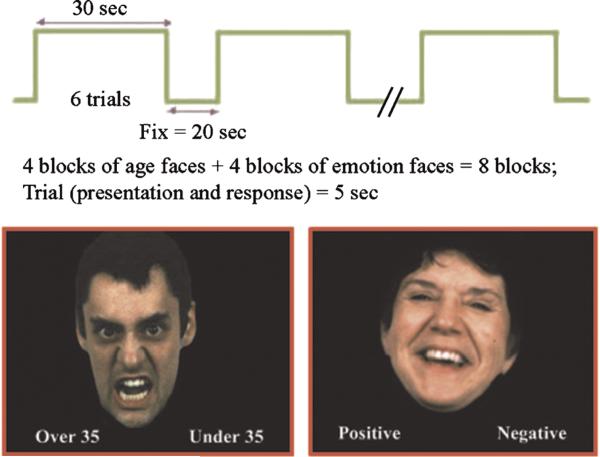
Equal numbers of controls (HC) and unmedicated patients with euthymia and PBD were matched for age, sex, race, socioeconomic status, and IQ (n = 10 per group; mean age 14.2 years [SD 2.0 years]). The task consisted of a "directed" emotion processing condition where subjects judged whether emotion in facial expression was positive or negative and an "incidental" condition where subjects judged whether faces expressing similar affect were older or younger than 35 years.
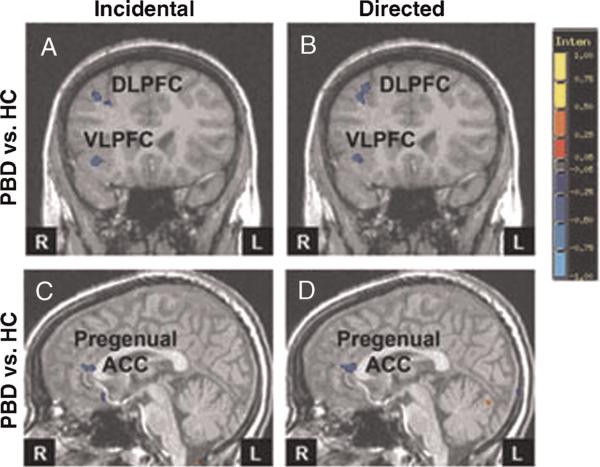
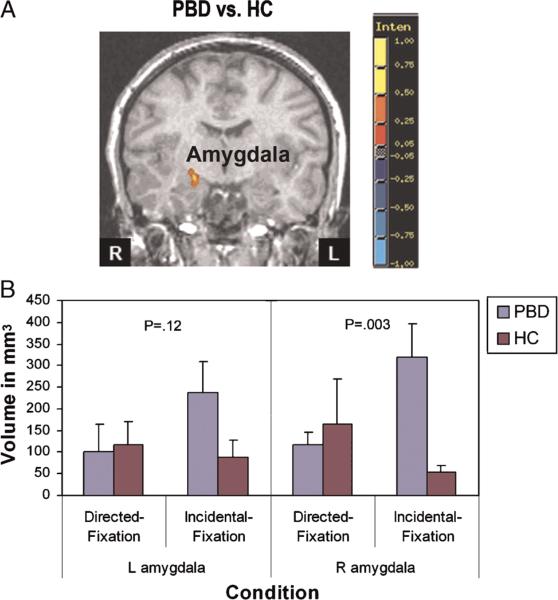
Relative to the directed condition, the incidental condition elicited greater activation in the right amygdala and the right insula, the left middle frontal gyrus, and the left posterior cingulate cortex in patients with PBD, in contrast to the HC that showed greater activation in the right superior frontal gyrus. In both incidental and directed conditions, relative to visual fixation, patients with PBD showed less activation in the right prefrontal cortex (superior, middle, and inferior frontal gyri) and the pregenual anterior cingulate cortex and greater activation in the posterior visual and face-processing regions (i.e., right precuneus/cuneus, fusiform gyrus).
Increased amygdala activation observed in patients with PBD elicited by incidental emotional processing relative to directed emotional processing may indicate more intense automatic emotional reactivity. Furthermore, the right prefrontal systems that are believed to modulate affect seem to be less engaged in patients with PBD regardless of whether the emotion processing is incidental or directed, which may signify reduced top-down control of emotional reactivity in PBD.
运用功能神经影像学探究小儿双相情感障碍(PBD)中情绪加工和情绪反应紊乱背后的情感回路功能障碍。
选取数量相等的对照组(HC)以及处于心境正常状态且未接受药物治疗的PBD患者,按照年龄、性别、种族、社会经济地位和智商进行匹配(每组n = 10;平均年龄14.2岁[标准差2.0岁])。该任务包括一种“定向”情绪加工条件,即受试者判断面部表情中的情绪是积极还是消极,以及一种“附带”条件,即受试者判断表达相似情感的面孔年龄是否大于或小于35岁。
相对于定向条件,在附带条件下,PBD患者右侧杏仁核、右侧脑岛、左侧额中回和左侧后扣带回皮质的激活程度更高,而HC组则是右侧额上回的激活程度更高。在附带条件和定向条件下,相对于视觉注视,PBD患者右侧前额叶皮质(额上回、额中回和额下回)和膝前扣带回皮质的激活程度较低,而后侧视觉和面部加工区域(即右侧楔前叶/楔叶、梭状回)的激活程度较高。
相对于定向情绪加工,PBD患者在附带情绪加工时观察到的杏仁核激活增加可能表明更强烈的自动情绪反应。此外,无论情绪加工是附带的还是定向的,PBD患者中被认为调节情感的右侧前额叶系统似乎参与度较低,这可能意味着PBD中对情绪反应的自上而下控制减弱。