Jiwa Moyez, Deas Kathleen, Ross Jackie, Shaw Tim, Wilcox Helen, Spilsbury Katrina
Western Australian Centre for Cancer and Palliative Care, Curtin Health Innovation Research Institute, Curtin University of Technology, Perth, Western Australia, Australia.
BMC Med Res Methodol. 2009 Feb 28;9:13. doi: 10.1186/1471-2288-9-13.
In this study we explored the challenges to establishing a community of practice (CoP) to address standards in general practice. We focused on the issue of improving referral letters which are the main form of communication between general practitioners (GPs) and specialists. There is evidence to suggest that the information relayed to specialists at the time of referral could be improved.
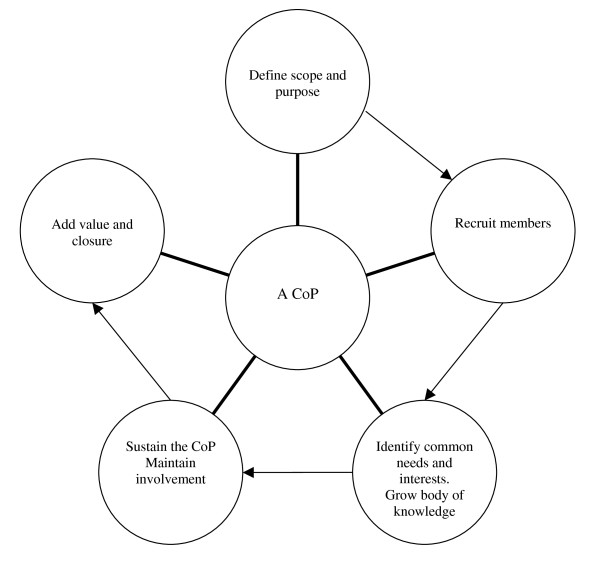
We aimed to develop a community of practice consisting of GPs in Western Australia to improve the quality of referral letters to six specialty clinics. Three phases included: establishing the CoP, monitoring the progress of the CoP and sustaining and managing the CoP. The CoP's activity centred on referral letters to each of six selected specialties. A local measure for the quality of the referral letters was developed from a survey of participants about specific items of history and weighted for their perceived importance in the referral letter. Referral letters by participants written before and after the benchmarking exercise were scored for quality based on the standards set by the CoP. Feedback to participants regarding the 'quality' of their individual referrals was provided by a nominated member of the CoP, including a comparison of before and after scores.
15 GPs were recruited. Only five GPs submitted referral letters both before and after benchmarking. The five GPs that participated in both study phases submitted a total of 102 referral letters (53 before and 49 after). There was a 26 point (95% CI 11-41) improvement in the average scores of the second set of letters after taking clustering by speciality into account, indicating the quality of referral letters improved substantially after feedback.
There are many challenges to forming a CoP to focus on improving a specific issue in general practice. However we were able to demonstrate that those practitioners who participated in all aspects of the project substantially improved the quality of their referral letters. For recruitment it was important to work with a champion for the project from within the practice. The project took several months to complete therefore some GPs became disengaged. Some were very disappointed by their performance when compared to colleagues. This reaction may be an important motivation to change, however it needs to be sensitively handled if participants are not to become disillusioned or disheartened.
在本研究中,我们探讨了建立实践社区(CoP)以解决全科医疗标准问题所面临的挑战。我们重点关注改善转诊信这一全科医生(GP)与专科医生之间主要沟通形式的问题。有证据表明,转诊时传达给专科医生的信息可以得到改善。
我们旨在建立一个由西澳大利亚州的全科医生组成的实践社区,以提高转诊至六个专科诊所的转诊信质量。三个阶段包括:建立实践社区、监测实践社区的进展以及维持和管理实践社区。实践社区的活动以针对六个选定专科中每个专科的转诊信为中心。通过对参与者关于病史特定项目的调查,并根据他们在转诊信中感知到的重要性进行加权,制定了一种衡量转诊信质量的本地方法。根据实践社区设定的标准,对参与者在基准测试练习前后撰写的转诊信进行质量评分。实践社区的一名指定成员向参与者提供关于其个人转诊“质量”的反馈,包括前后分数的比较。
招募了15名全科医生。只有5名全科医生在基准测试前后都提交了转诊信。参与两个研究阶段的这5名全科医生共提交了102封转诊信(之前53封,之后49封)。在考虑按专科进行聚类后,第二组信件的平均分数提高了26分(95%可信区间11 - 41),表明反馈后转诊信的质量有了显著提高。
组建一个专注于改善全科医疗中特定问题的实践社区面临诸多挑战。然而,我们能够证明,参与项目各个方面的从业者大幅提高了他们转诊信的质量。在招募方面,与诊所内部的项目支持者合作很重要。该项目耗时数月完成,因此一些全科医生不再参与。与同事相比,一些人对自己的表现非常失望。这种反应可能是改变的重要动力,然而,如果不让参与者感到幻灭或沮丧,就需要谨慎处理。