Centre for Clinical Governance Research, Australian Institute of Health Innovation, University of New South Wales, Sydney, NSW 2052, Australia.
Implement Sci. 2011 May 23;6:49. doi: 10.1186/1748-5908-6-49.
Healthcare organisations seeking to manage knowledge and improve organisational performance are increasingly investing in communities of practice (CoPs). Such investments are being made in the absence of empirical evidence demonstrating the impact of CoPs in improving the delivery of healthcare. A realist evaluation is proposed to address this knowledge gap. Underpinned by the principle that outcomes are determined by the context in which an intervention is implemented, a realist evaluation is well suited to understand the role of CoPs in improving healthcare practice. By applying a realist approach, this study will explore the following questions: What outcomes do CoPs achieve in healthcare? Do these outcomes translate into improved practice in healthcare? What are the contexts and mechanisms by which CoPs improve healthcare?
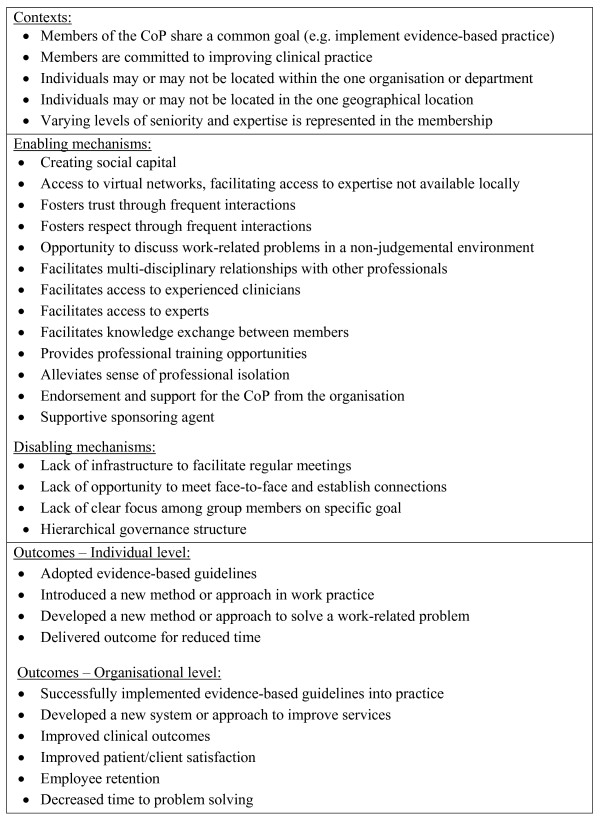
The realist evaluation will be conducted by developing, testing, and refining theories on how, why, and when CoPs improve healthcare practice. When collecting data, context will be defined as the setting in which the CoP operates; mechanisms will be the factors and resources that the community offers to influence a change in behaviour or action; and outcomes will be defined as a change in behaviour or work practice that occurs as a result of accessing resources provided by the CoP.
Realist evaluation is being used increasingly to study social interventions where context plays an important role in determining outcomes. This study further enhances the value of realist evaluations by incorporating a social network analysis component to quantify the structural context associated with CoPs. By identifying key mechanisms and contexts that optimise the effectiveness of CoPs, this study will contribute to creating a framework that will guide future establishment and evaluation of CoPs in healthcare.
寻求管理知识和提高组织绩效的医疗保健组织越来越多地投资于实践社区(CoP)。在缺乏实证证据表明 CoP 对改善医疗保健服务有影响的情况下,做出了这种投资。提出了一种现实主义评估来解决这一知识差距。基于干预实施背景决定结果的原则,现实主义评估非常适合理解 CoP 在改善医疗实践中的作用。通过应用现实主义方法,本研究将探讨以下问题:CoP 在医疗保健方面实现了哪些成果?这些成果是否转化为医疗保健实践的改进?CoP 通过哪些机制来改善医疗保健?
现实主义评估将通过开发、测试和完善关于 CoP 如何、为何以及何时改善医疗保健实践的理论来进行。在收集数据时,背景将被定义为 CoP 运作的环境;机制将是社区提供的影响行为或行动变化的因素和资源;结果将被定义为由于访问 CoP 提供的资源而导致的行为或工作实践的变化。
现实主义评估越来越多地用于研究社会干预,其中背景在确定结果方面起着重要作用。本研究通过纳入社会网络分析组件来量化与 CoP 相关的结构背景,进一步增强了现实主义评估的价值。通过确定优化 CoP 有效性的关键机制和背景,本研究将有助于创建一个框架,指导未来医疗保健领域 CoP 的建立和评估。