Vuong Mai Tuyet, Lundberg Sigrid, Gunnarsson Iva, Wramner Lars, Seddighzadeh Maria, Hahn-Zoric Mirjana, Fernström Anders, Hanson Lars A, Do Lieu Thi, Jacobson Stefan H, Padyukov Leonid
Department of Medicine, Danderyd Hospital, Karolinska Institutet, Stockholm, Sweden.
Nephrol Dial Transplant. 2009 Oct;24(10):3061-7. doi: 10.1093/ndt/gfp079. Epub 2009 Mar 3.
There is growing evidence of genetic risk for susceptibility to IgA nephropathy. Among several candidate genes related to immunological regulation in renal tissue, TGFB1 is known to be a contributor to proliferation and the development of fibrosis.
We analysed several SNPs in a region of this gene using 212 DNA samples from biopsy-proven IgA nephropathy patients, 146 men and 66 women and 477 healthy age-matched controls (321 men and 156 women) from the same population in Sweden.
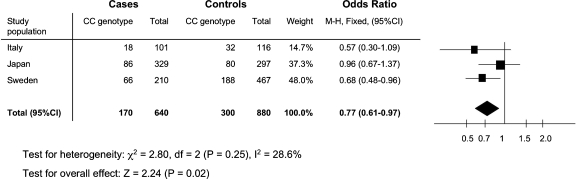
Frequencies of four out of five selected SNPs (rs6957, rs2241715, rs1800471, rs1982073 and rs1800469) were found to significantly differ between male patients and male controls in a co-dominant model (corrected P <or= 0.05) and of two SNPs (rs1982073 and rs1800469) in the allelic model (P <or= 0.05 in 100,000 permutation test). Haplotype analysis for five selected SNPs revealed a significant association of TGGCG with protective effect (P = 0.0012, empirical P = 0.006, 100,000 permutations) and of CTGTA with susceptibility effect (P = 0.0018, empirical P = 0.008, 100,000 permutations). In our study, no association with TGFB1 variations was found when comparing female patients and female controls. No association was found for TGFB1 markers with disease progression for selected individuals from the patient's group. In addition, meta-analysis performed for SNP rs1982073 for combined patients and controls from our study together with published data from two independent studies showed a significant association.
Our experimental data together with the meta-analysis suggest TGFB1 as an important candidate gene for further biological studies of IgA nephropathy and as a possible target for therapy. Our data also indicate a possibility of a gender effect in the genetic background of IgA nephropathy.
越来越多的证据表明IgA肾病易感性存在遗传风险。在与肾组织免疫调节相关的几个候选基因中,已知转化生长因子β1(TGFB1)是增殖和纤维化发展的一个促成因素。
我们使用来自瑞典同一人群中经活检证实的IgA肾病患者的212份DNA样本(146名男性和66名女性)以及477名年龄匹配的健康对照(321名男性和156名女性),分析了该基因一个区域内的几个单核苷酸多态性(SNP)。
在共显性模型中,发现五个选定SNP中的四个(rs6957、rs2241715、rs1800471、rs1982073和rs1800469)在男性患者和男性对照之间的频率有显著差异(校正P≤0.05),在等位基因模型中,两个SNP(rs1982073和rs1800469)有显著差异(在100,000次置换检验中P≤0.05)。对五个选定SNP的单倍型分析显示,TGGCG具有显著的保护作用(P = 0.0012,经验性P = 0.006,100,000次置换),CTGTA具有易感性作用(P = 0.0018,经验性P = 0.008,100,000次置换)。在我们的研究中,比较女性患者和女性对照时,未发现与TGFB1变异有关联。对于患者组中选定个体,未发现TGFB1标记物与疾病进展有关联。此外,对我们研究中的患者和对照以及两项独立研究的已发表数据进行的SNP rs1982073的荟萃分析显示存在显著关联。
我们的实验数据以及荟萃分析表明,TGFB1是IgA肾病进一步生物学研究的重要候选基因,也是一个可能的治疗靶点。我们的数据还表明,在IgA肾病的遗传背景中可能存在性别效应。