Gillespie Joseph J, Ammerman Nicole C, Dreher-Lesnick Sheila M, Rahman M Sayeedur, Worley Micah J, Setubal Joao C, Sobral Bruno S, Azad Abdu F
Virginia Bioinformatics Institute at Virginia Tech, Blacksburg, Virginia, United States of America.
PLoS One. 2009;4(3):e4833. doi: 10.1371/journal.pone.0004833. Epub 2009 Mar 12.
Bacterial type IV secretion systems (T4SSs) comprise a diverse transporter family functioning in conjugation, competence, and effector molecule (DNA and/or protein) translocation. Thirteen genome sequences from Rickettsia, obligate intracellular symbionts/pathogens of a wide range of eukaryotes, have revealed a reduced T4SS relative to the Agrobacterium tumefaciens archetype (vir). However, the Rickettsia T4SS has not been functionally characterized for its role in symbiosis/virulence, and none of its substrates are known.
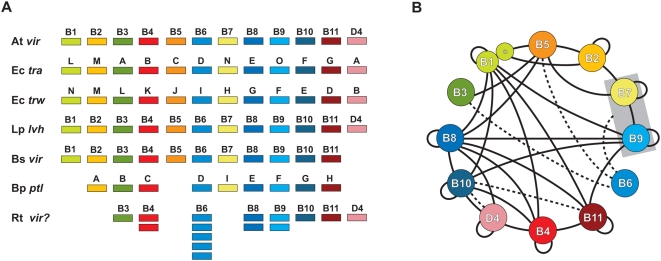
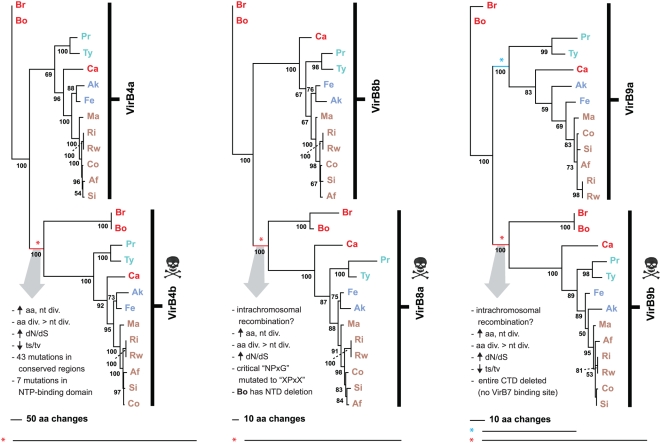
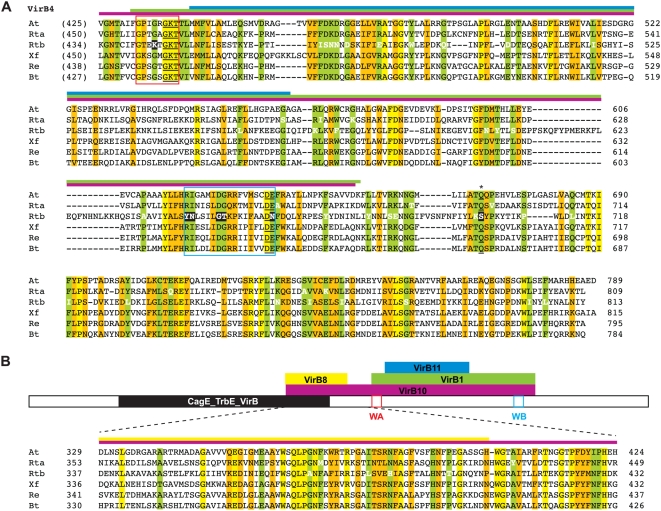
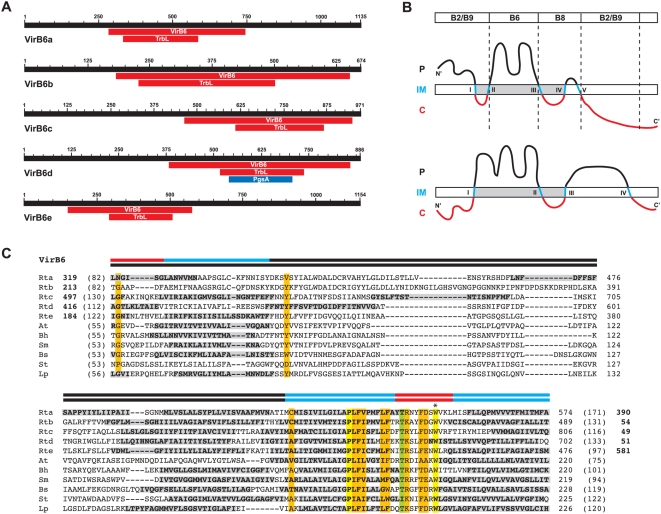
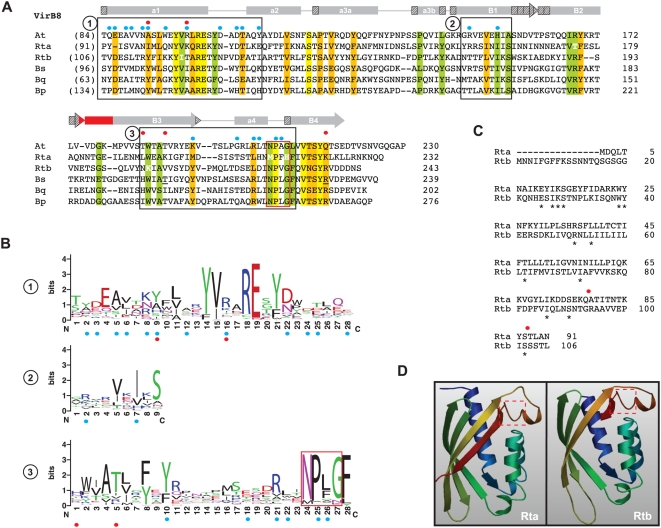
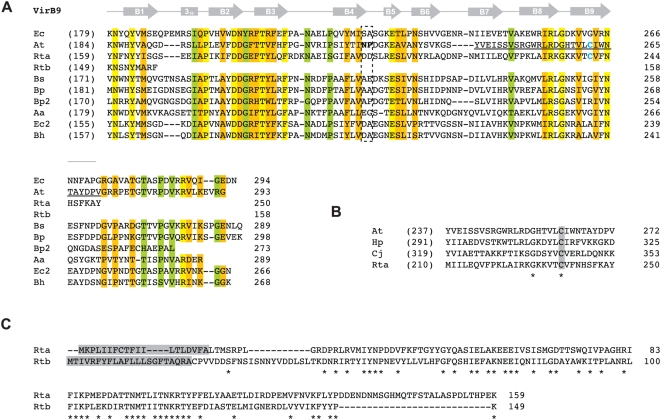
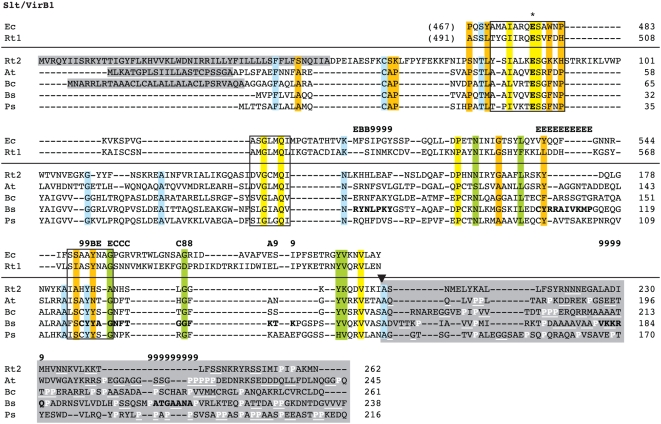
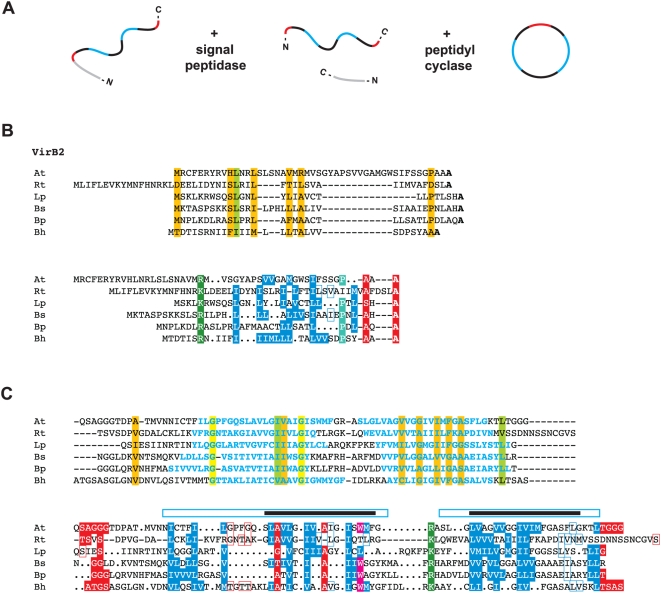
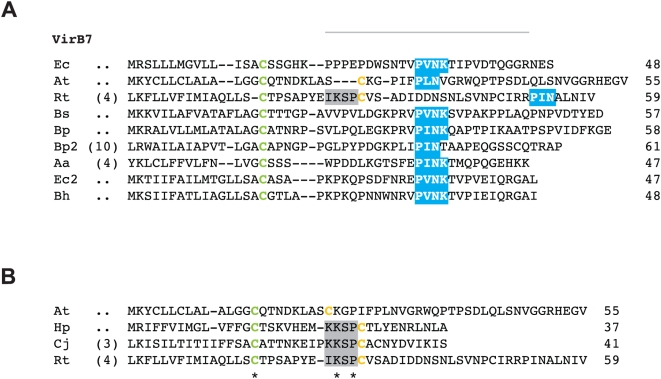
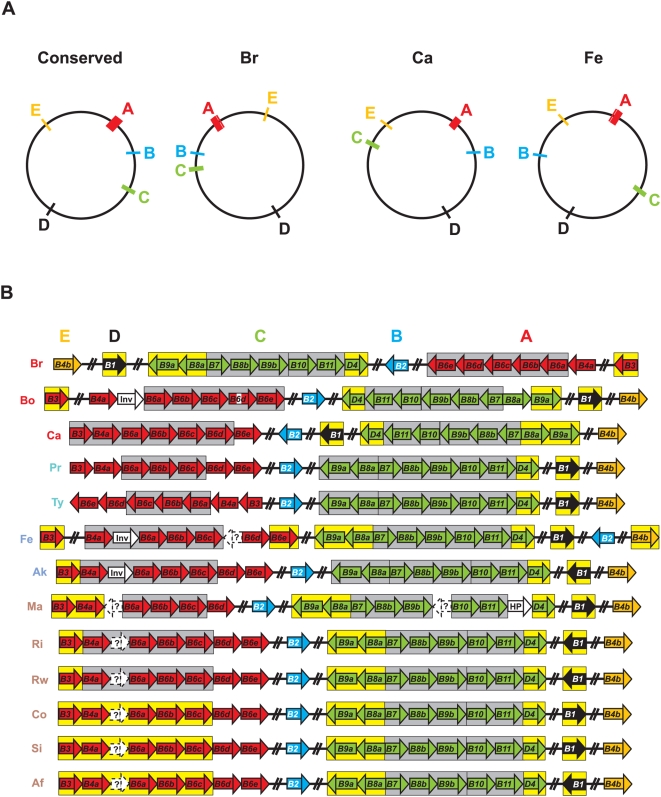
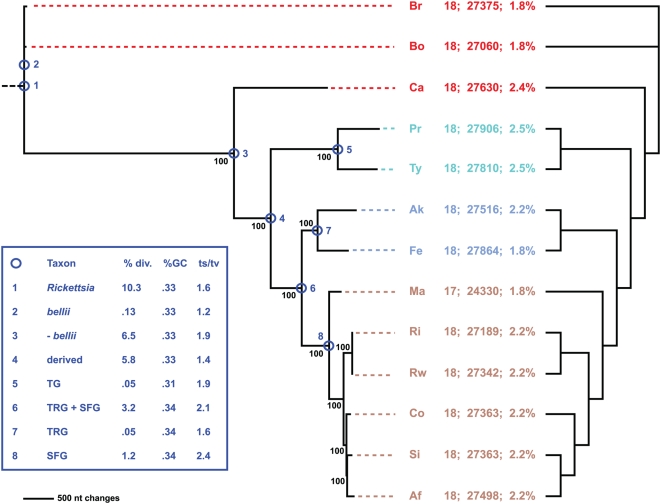
Superimposition of T4SS structural/functional information over previously identified Rickettsia components implicate a functional Rickettsia T4SS. virB4, virB8 and virB9 are duplicated, yet only one copy of each has the conserved features of similar genes in other T4SSs. An extraordinarily duplicated VirB6 gene encodes five hydrophobic proteins conserved only in a short region known to be involved in DNA transfer in A. tumefaciens. virB1, virB2 and virB7 are newly identified, revealing a Rickettsia T4SS lacking only virB5 relative to the vir archetype. Phylogeny estimation suggests vertical inheritance of all components, despite gene rearrangements into an archipelago of five islets. Similarities of Rickettsia VirB7/VirB9 to ComB7/ComB9 proteins of epsilon-proteobacteria, as well as phylogenetic affinities to the Legionella lvh T4SS, imply the Rickettsiales ancestor acquired a vir-like locus from distantly related bacteria, perhaps while residing in a protozoan host. Modern modifications of these systems likely reflect diversification with various eukaryotic host cells.
We present the rvh (Rickettsiales vir homolog) T4SS, an evolutionary conserved transporter with an unknown role in rickettsial biology. This work lays the foundation for future laboratory characterization of this system, and also identifies the Legionella lvh T4SS as a suitable genetic model.
细菌IV型分泌系统(T4SSs)是一个多样的转运蛋白家族,在接合作用、感受态以及效应分子(DNA和/或蛋白质)转运过程中发挥作用。立克次氏体是广泛存在于各种真核生物中的专性细胞内共生菌/病原体,其13个基因组序列显示,与根癌农杆菌原型(vir)相比,立克次氏体的T4SS有所简化。然而,立克次氏体T4SS在共生/毒力方面的作用尚未得到功能表征,其底物也均不为人知。
将T4SS结构/功能信息叠加到先前鉴定的立克次氏体组分上,表明立克次氏体T4SS具有功能。virB4、virB8和virB9存在重复,但每个基因只有一个拷贝具有其他T4SS中相似基因的保守特征。一个异常重复的VirB6基因编码5种疏水蛋白,这些蛋白仅在根癌农杆菌中已知参与DNA转移的一个短区域内保守。virB1、virB2和virB7是新鉴定出来的,这表明相对于vir原型,立克次氏体T4SS仅缺少virB5。系统发育估计表明,尽管基因重排形成了五个小岛状的群岛结构,但所有组分都是垂直遗传的。立克次氏体VirB7/VirB9与ε-变形菌门的ComB7/ComB9蛋白的相似性,以及与嗜肺军团菌lvh T4SS的系统发育亲缘关系,意味着立克次氏体目祖先从远缘细菌中获得了一个类似vir的基因座,这可能发生在其寄生于原生动物宿主期间。这些系统的现代修饰可能反映了与各种真核宿主细胞的多样化过程。
我们提出了rvh(立克次氏体目vir同源物)T4SS,这是一种在立克次氏体生物学中作用未知的进化保守转运蛋白。这项工作为该系统未来的实验室表征奠定了基础,同时也将嗜肺军团菌lvh T4SS确定为一个合适的遗传模型。