Rossignol Daniel A, Rossignol Lanier W, Smith Scott, Schneider Cindy, Logerquist Sally, Usman Anju, Neubrander Jim, Madren Eric M, Hintz Gregg, Grushkin Barry, Mumper Elizabeth A
International Child Development Resource Center, Melbourne, FL, USA.
BMC Pediatr. 2009 Mar 13;9:21. doi: 10.1186/1471-2431-9-21.
Several uncontrolled studies of hyperbaric treatment in children with autism have reported clinical improvements; however, this treatment has not been evaluated to date with a controlled study. We performed a multicenter, randomized, double-blind, controlled trial to assess the efficacy of hyperbaric treatment in children with autism.
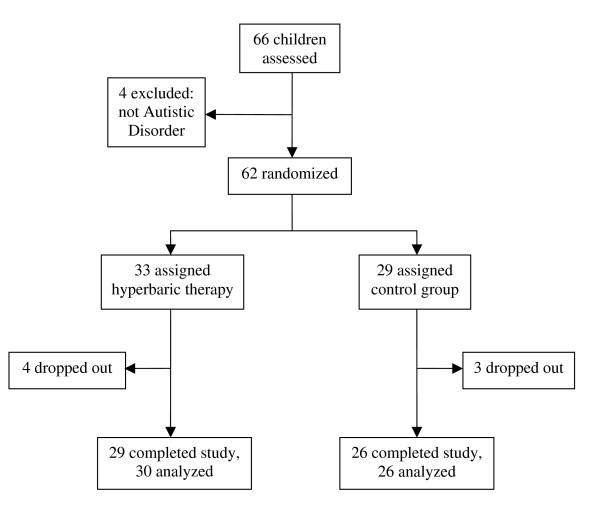
62 children with autism recruited from 6 centers, ages 2-7 years (mean 4.92 +/- 1.21), were randomly assigned to 40 hourly treatments of either hyperbaric treatment at 1.3 atmosphere (atm) and 24% oxygen ("treatment group", n = 33) or slightly pressurized room air at 1.03 atm and 21% oxygen ("control group", n = 29). Outcome measures included Clinical Global Impression (CGI) scale, Aberrant Behavior Checklist (ABC), and Autism Treatment Evaluation Checklist (ATEC).
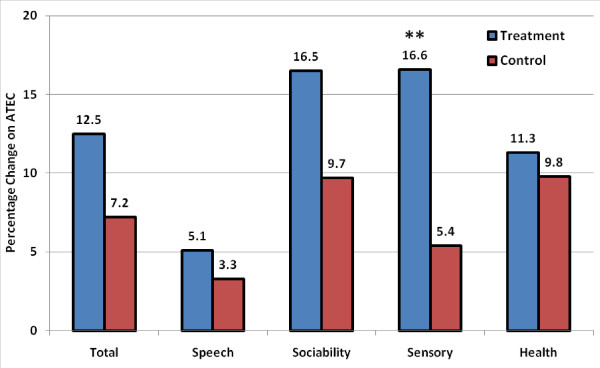
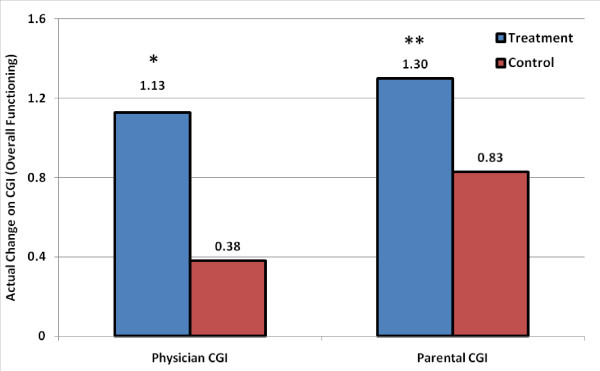
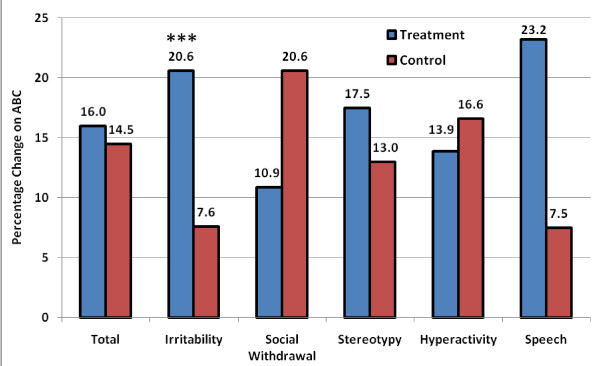
After 40 sessions, mean physician CGI scores significantly improved in the treatment group compared to controls in overall functioning (p = 0.0008), receptive language (p < 0.0001), social interaction (p = 0.0473), and eye contact (p = 0.0102); 9/30 children (30%) in the treatment group were rated as "very much improved" or "much improved" compared to 2/26 (8%) of controls (p = 0.0471); 24/30 (80%) in the treatment group improved compared to 10/26 (38%) of controls (p = 0.0024). Mean parental CGI scores significantly improved in the treatment group compared to controls in overall functioning (p = 0.0336), receptive language (p = 0.0168), and eye contact (p = 0.0322). On the ABC, significant improvements were observed in the treatment group in total score, irritability, stereotypy, hyperactivity, and speech (p < 0.03 for each), but not in the control group. In the treatment group compared to the control group, mean changes on the ABC total score and subscales were similar except a greater number of children improved in irritability (p = 0.0311). On the ATEC, sensory/cognitive awareness significantly improved (p = 0.0367) in the treatment group compared to the control group. Post-hoc analysis indicated that children over age 5 and children with lower initial autism severity had the most robust improvements. Hyperbaric treatment was safe and well-tolerated.
Children with autism who received hyperbaric treatment at 1.3 atm and 24% oxygen for 40 hourly sessions had significant improvements in overall functioning, receptive language, social interaction, eye contact, and sensory/cognitive awareness compared to children who received slightly pressurized room air.
clinicaltrials.gov NCT00335790.
多项针对自闭症儿童高压治疗的非对照研究报告了临床改善情况;然而,迄今为止,该治疗方法尚未通过对照研究进行评估。我们开展了一项多中心、随机、双盲、对照试验,以评估高压治疗对自闭症儿童的疗效。
从6个中心招募了62名年龄在2至7岁(平均4.92±1.21岁)的自闭症儿童,随机分配接受40次每小时一次的治疗,其中一组接受1.3个大气压(atm)和24%氧气的高压治疗(“治疗组”,n = 33),另一组接受1.03 atm和21%氧气的微压室内空气治疗(“对照组”,n = 29)。结局指标包括临床总体印象(CGI)量表、异常行为检查表(ABC)和自闭症治疗评估检查表(ATEC)。
40次治疗后,与对照组相比,治疗组医生CGI量表在总体功能(p = 0.0008)、接受性语言(p < 0.0001)、社交互动(p = 0.0473)和眼神接触(p = 0.0102)方面的平均得分显著改善;治疗组30名儿童中有9名(30%)被评为“非常明显改善”或“明显改善”,而对照组26名儿童中有2名(8%)(p = 0.0471);治疗组30名儿童中有24名(80%)有所改善,而对照组26名儿童中有10名(38%)(p = 0.0024)。与对照组相比,治疗组家长CGI量表在总体功能(p = 0.0336)、接受性语言(p = 0.0168)和眼神接触(p = 0.0322)方面的平均得分显著改善。在ABC量表上,治疗组在总分、易激惹、刻板行为、多动和言语方面有显著改善(每项p < 0.03),而对照组无改善。与对照组相比,治疗组ABC总分和各子量表的平均变化相似,但易激惹方面改善的儿童数量更多(p = 0.0311)。在ATEC量表上,与对照组相比,治疗组的感觉/认知意识有显著改善(p = 0.0367)。事后分析表明,5岁以上儿童和初始自闭症严重程度较低的儿童改善最为显著。高压治疗安全且耐受性良好。
与接受微压室内空气治疗的儿童相比,接受1.3 atm和24%氧气的高压治疗40次每小时一次的自闭症儿童在总体功能、接受性语言、社交互动、眼神接触和感觉/认知意识方面有显著改善。
clinicaltrials.gov NCT00335790