Celnik Pablo, Paik Nam-Jong, Vandermeeren Yves, Dimyan Michael, Cohen Leonardo G
Human Cortical Physiology and Stroke Neurorehabilitation Section, National Institute of Neurological Disorders and Stroke, National Institutes of Health, Bethesda, MD, USA.
Stroke. 2009 May;40(5):1764-71. doi: 10.1161/STROKEAHA.108.540500. Epub 2009 Mar 12.
Recent work demonstrated that application of peripheral nerve and cortical stimulation independently can induce modest improvements in motor performance in patients with stroke. The purpose of this study was to test the hypothesis that combining peripheral nerve stimulation (PNS) to the paretic hand with anodal direct current stimulation (tDCS) to the ipsilesional primary motor cortex (M1) would facilitate beneficial effects of motor training more than each intervention alone or sham (tDCS(Sham) and PNS(Sham)).
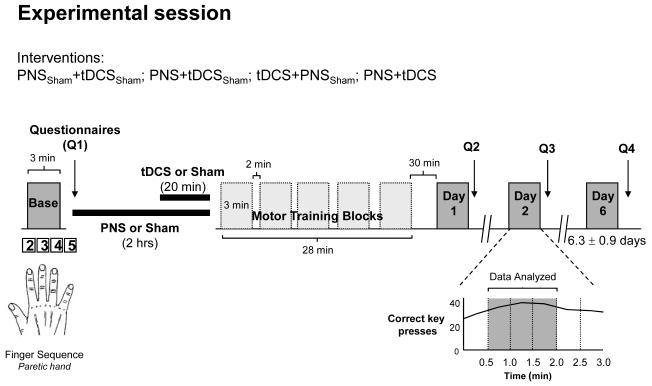
Nine chronic stroke patients completed a blinded crossover designed study. In separate sessions, we investigated the effects of single applications of PNS+tDCS, PNS+tDCS(Sham), tDCS+PNS(Sham), and PNS(Sham)+tDCS(Sham) before motor training on the ability to perform finger motor sequences with the paretic hand.
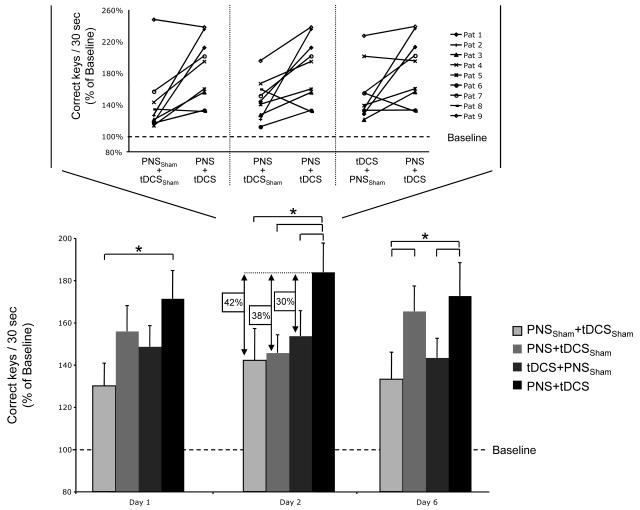
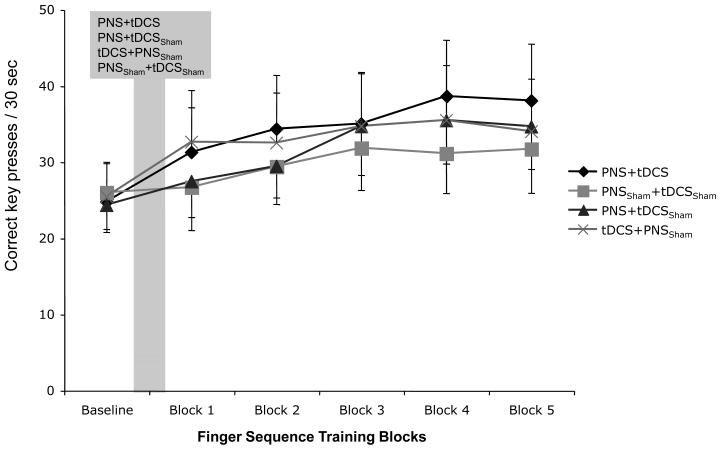
PNS+tDCS resulted in a 41.3% improvement in the number of correct key presses relative to PNS(Sham)+tDCS(Sham), 15.4% relative to PNS+tDCS(Sham), and 22.7% relative to tDCS+PNS(Sham). These performance differences were maintained 1 and 6 days after the end of the training.
These results indicate that combining PNS with tDCS can facilitate the beneficial effects of training on motor performance beyond levels reached with each intervention alone, a finding of relevance for the neurorehabilitation of motor impairments after stroke.
近期研究表明,单独应用外周神经刺激和皮质刺激能够使中风患者的运动表现得到适度改善。本研究的目的是验证以下假设:将患侧手部的外周神经刺激(PNS)与患侧初级运动皮层(M1)的阳极直流电刺激(tDCS)相结合,相比于单独的每种干预措施或假刺激(tDCS(假刺激)和PNS(假刺激)),能更有效地促进运动训练的有益效果。
9名慢性中风患者完成了一项双盲交叉设计研究。在不同的时间段,我们研究了在运动训练前单独应用PNS+tDCS、PNS+tDCS(假刺激)、tDCS+PNS(假刺激)以及PNS(假刺激)+tDCS(假刺激)对患侧手执行手指运动序列能力的影响。
与PNS(假刺激)+tDCS(假刺激)相比,PNS+tDCS使正确按键次数提高了41.3%;与PNS+tDCS(假刺激)相比提高了15.4%;与tDCS+PNS(假刺激)相比提高了22.7%。这些表现差异在训练结束后的第1天和第6天依然存在。
这些结果表明,将PNS与tDCS相结合能够促进训练对运动表现的有益效果,且效果优于单独的每种干预措施,这一发现对中风后运动障碍的神经康复具有重要意义。