de Freitas Zanona Aristela, Romeiro da Silva Andressa Claudia, Baltar do Rego Maciel Adriana, Shirahige Gomes do Nascimento Livia, Bezerra da Silva Amanda, Piscitelli Daniele, Monte-Silva Katia
Applied Neuroscience Laboratory, Department of Physical Therapy, Universidade Federal de Pernambuco, Recife, Pernambuco, Brazil.
Occupational Therapy Department and Post-Graduate Program in Applied Health Sciences, Universidade Federal de Sergipe, São Cristóvão, Brazil.
Front Neurosci. 2023 Jan 25;16:985754. doi: 10.3389/fnins.2022.985754. eCollection 2022.
The ability to produce coordinated movement is dependent on dynamic interactions through transcallosal fibers between the two cerebral hemispheres of the brain. Although typically unilateral, stroke induces changes in functional and effective connectivity across hemispheres, which are related to sensorimotor impairment and stroke recovery. Previous studies have focused almost exclusively on interhemispheric interactions in the primary motor cortex (M1).
To identify the presence of interhemispheric asymmetry (ASY) of somatosensory cortex (S1) excitability and to investigate whether S1 repetitive transcranial magnetic stimulation (rTMS) combined with sensory stimulation (SS) changes excitability in S1 and M1, as well as S1 ASY, in individuals with subacute stroke.
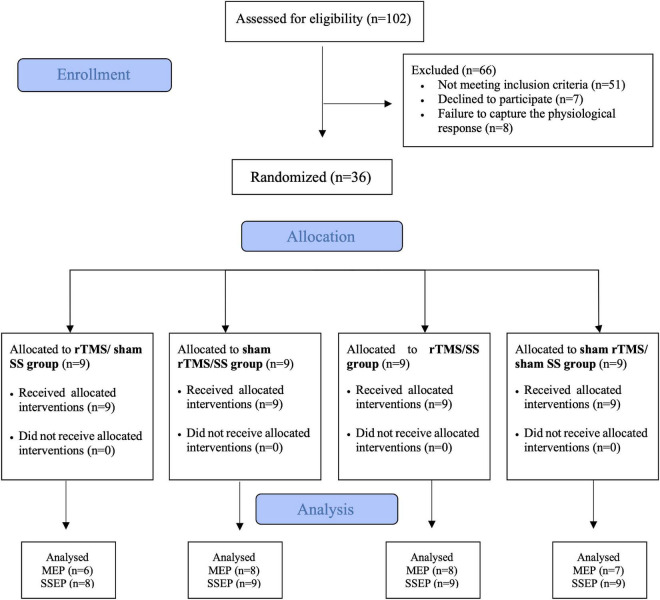
A randomized clinical trial. Participants with a single episode of stroke, in the subacute phase, between 35 and 75 years old, were allocated, randomly and equally balanced, to four groups: rTMS/sham SS, sham rTMS/SS, rTMS/SS, and sham rTMS/Sham SS. Participants underwent 10 sessions of S1 rTMS of the lesioned hemisphere (10 Hz, 1,500 pulses) followed by SS. SS was applied to the paretic upper limb (UL) (active SS) or non-paretic UL (sham SS). TMS-induced motor evoked potentials (MEPs) of the paretic UL and somatosensory evoked potential (SSEP) of both ULs assessed M1 and S1 cortical excitability, respectively. The S1 ASY index was measured before and after intervention. Evaluator, participants and the statistician were blinded.
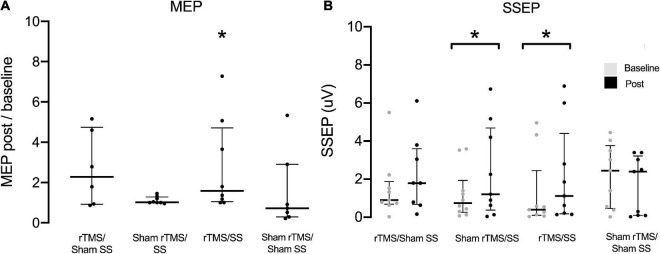
Thirty-six participants divided equally into groups (nine participants per group). Seven patients were excluded from MEP analysis because of failure to produce consistent MEP. One participant was excluded in the SSEP analysis because no SSEP was detected. All somatosensory stimulation groups had decreased S1 ASY except for the sham rTMS/Sham SS group. When compared with baseline, M1 excitability increased only in the rTMS/SS group.
S1 rTMS and SS alone or in combination changed S1 excitability and decreased ASY, but it was only their combination that increased M1 excitability.
clinicaltrials.gov, identifier (NCT03329807).
产生协调运动的能力依赖于大脑两个半球之间通过胼胝体纤维进行的动态相互作用。虽然中风通常是单侧性的,但它会引起半球间功能和有效连接的变化,这与感觉运动障碍和中风恢复有关。以往的研究几乎完全集中在初级运动皮层(M1)的半球间相互作用上。
确定体感皮层(S1)兴奋性的半球间不对称(ASY)的存在,并研究S1重复经颅磁刺激(rTMS)联合感觉刺激(SS)是否会改变亚急性中风患者S1和M1的兴奋性以及S1 ASY。
一项随机临床试验。将35至75岁的亚急性期单次中风患者随机且均衡地分为四组:rTMS/假SS、假rTMS/SS、rTMS/SS和假rTMS/假SS。参与者对患侧半球进行10次S1 rTMS(10 Hz,1500个脉冲),随后进行SS。SS应用于瘫痪上肢(UL)(主动SS)或非瘫痪UL(假SS)。TMS诱发的瘫痪UL的运动诱发电位(MEP)和双侧UL的体感诱发电位(SSEP)分别评估M1和S1皮层兴奋性。在干预前后测量S1 ASY指数。评估者、参与者和统计学家均处于盲态。
36名参与者平均分为四组(每组9名参与者)。7名患者因未能产生一致的MEP而被排除在MEP分析之外。1名参与者因未检测到SSEP而被排除在SSEP分析之外。除假rTMS/假SS组外,所有感觉刺激组的S1 ASY均降低。与基线相比,仅rTMS/SS组的M1兴奋性增加。
单独或联合使用S1 rTMS和SS可改变S1兴奋性并降低ASY,但只有它们联合使用才能增加M1兴奋性。
clinicaltrials.gov,标识符(NCT03329807)。