Gilbert Clément, Maxfield David G, Goodman Steven M, Feschotte Cédric
Department of Biology, University of Texas at Arlington, Arlington, TX, USA.
PLoS Genet. 2009 Mar;5(3):e1000425. doi: 10.1371/journal.pgen.1000425. Epub 2009 Mar 20.
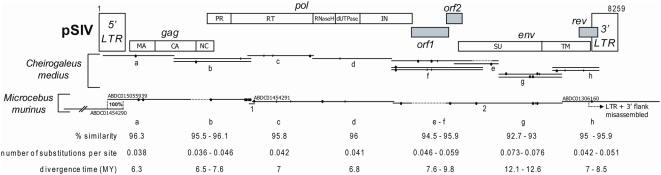
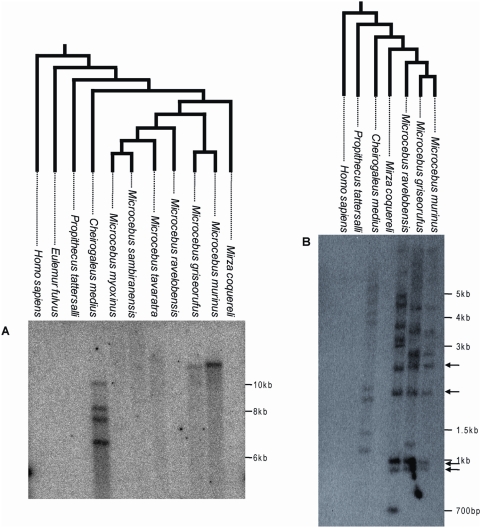
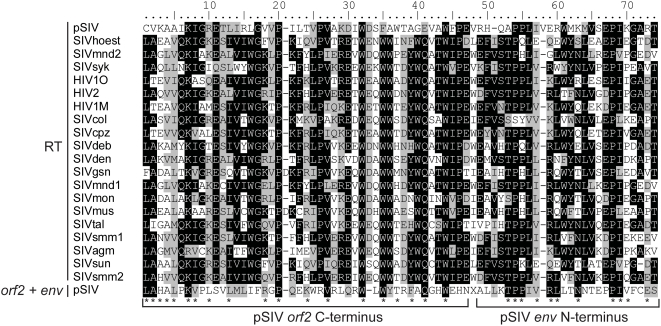
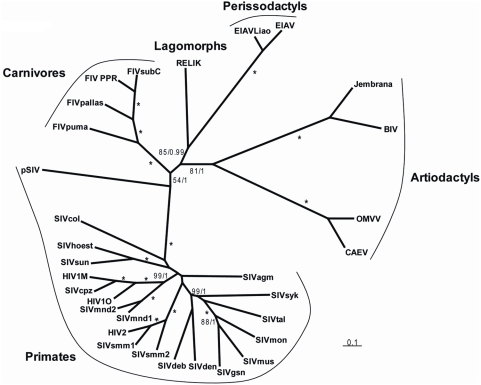
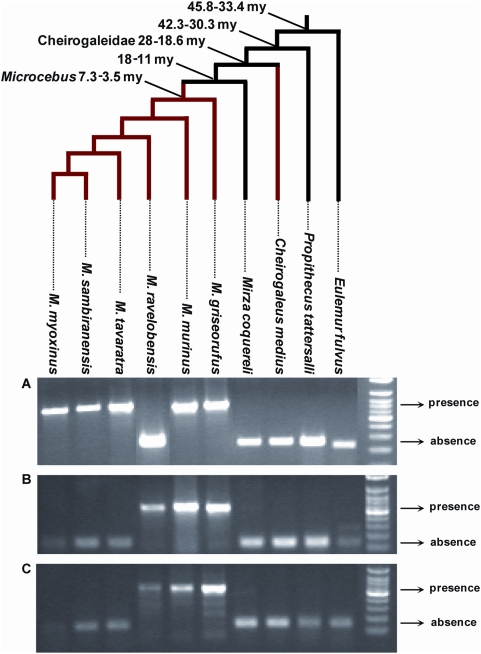
Retroviruses normally infect the somatic cells of their host and are transmitted horizontally, i.e., in an exogenous way. Occasionally, however, some retroviruses can also infect and integrate into the genome of germ cells, which may allow for their vertical inheritance and fixation in a given species; a process known as endogenization. Lentiviruses, a group of mammalian retroviruses that includes HIV, are known to infect primates, ruminants, horses, and cats. Unlike many other retroviruses, these viruses have not been demonstrably successful at germline infiltration. Here, we report on the discovery of endogenous lentiviral insertions in seven species of Malagasy lemurs from two different genera -- Cheirogaleus and Microcebus. Combining molecular clock analyses and cross-species screening of orthologous insertions, we show that the presence of this endogenous lentivirus in six species of Microcebus is the result of one endogenization event that occurred about 4.2 million years ago. In addition, we demonstrate that this lentivirus independently infiltrated the germline of Cheirogaleus and that the two endogenization events occurred quasi-simultaneously. Using multiple proviral copies, we derive and characterize an apparently full length and intact consensus for this lentivirus. These results provide evidence that lentiviruses have repeatedly infiltrated the germline of prosimian species and that primates have been exposed to lentiviruses for a much longer time than what can be inferred based on sequence comparison of circulating lentiviruses. The study sets the stage for an unprecedented opportunity to reconstruct an ancestral primate lentivirus and thereby advance our knowledge of host-virus interactions.
逆转录病毒通常感染宿主的体细胞,并以水平方式传播,即以外源性方式传播。然而,偶尔也有一些逆转录病毒能够感染并整合到生殖细胞的基因组中,这可能使其在特定物种中垂直遗传并固定下来;这个过程称为内源性化。慢病毒是包括HIV在内的一组哺乳动物逆转录病毒,已知可感染灵长类动物、反刍动物、马和猫。与许多其他逆转录病毒不同,这些病毒在种系渗透方面并未取得明显成功。在此,我们报告在来自两个不同属——倭狐猴属和小鼠狐猴属的七种马达加斯加狐猴中发现了内源性慢病毒插入。结合分子钟分析和直系同源插入的跨物种筛选,我们表明六种小鼠狐猴中这种内源性慢病毒的存在是大约420万年前发生的一次内源性化事件的结果。此外,我们证明这种慢病毒独立地渗透到倭狐猴属的种系中,并且这两次内源性化事件几乎同时发生。利用多个前病毒拷贝,我们推导并表征了这种慢病毒的一个明显全长且完整的共有序列。这些结果提供了证据,表明慢病毒多次渗透到原猴亚目物种的种系中,并且灵长类动物接触慢病毒的时间比根据循环慢病毒的序列比较所推断的时间长得多。这项研究为重建一种原始灵长类慢病毒并从而推进我们对宿主-病毒相互作用的认识创造了前所未有的机会。