Boileau C, Clark S, Bignami-Van Assche S, Poulin M, Reniers G, Watkins S C, Kohler H P, Heymann S J
Cartagene, Montreal, Quebec, Canada.
Sex Transm Infect. 2009 Apr;85 Suppl 1(Suppl_1):i27-33. doi: 10.1136/sti.2008.033969.
To explore how sexual and marital trajectories are associated with HIV infection among ever-married women in rural Malawi.
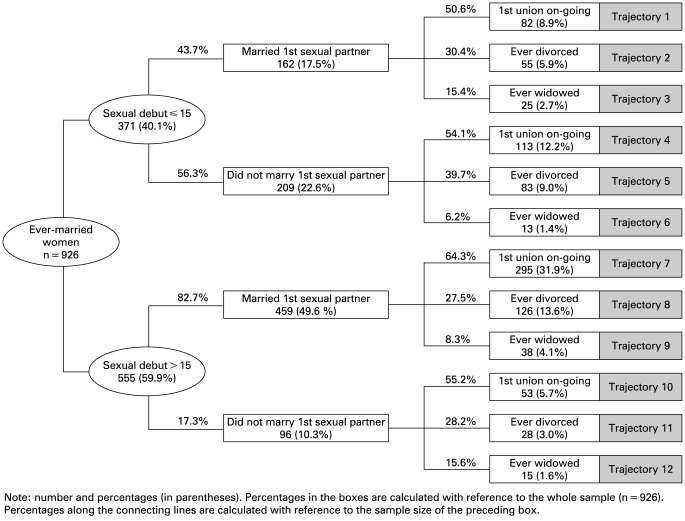
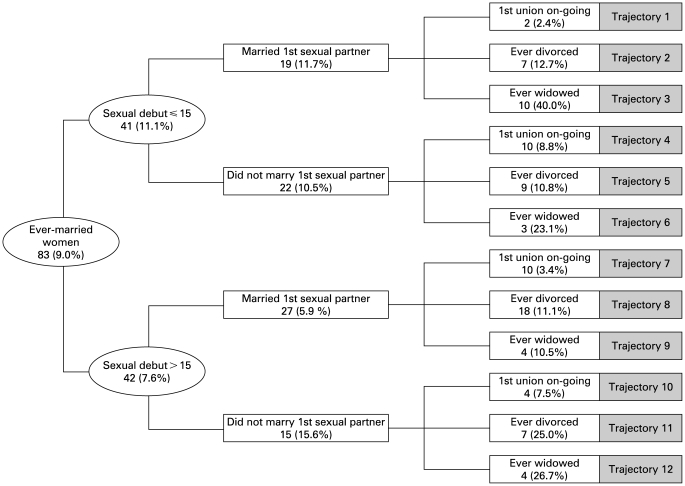
Retrospective survey data and HIV biomarker data for 926 ever-married women interviewed in the Malawi Diffusion and Ideational Change Project were used. The associations between HIV infection and four key life course transitions considered individually (age at sexual debut, premarital sexual activity, entry into marriage and marital disruption by divorce or death) were examined. These transitions were then sequenced to construct trajectories that represent the variety of patterns in the data. The association between different trajectories and HIV prevalence was examined, controlling for potentially confounding factors such as age and region.
Although each life course transition taken in isolation may be associated with HIV infection, their combined effect appeared to be conditional on the sequence in which they occurred. Although early sexual debut, not marrying one's first sexual partner and having a disrupted marriage each increased the likelihood of HIV infection, their risk was not additive. Women who both delayed sexual debut and did not marry their first partner are, once married, more likely to experience marital disruption and to be HIV-positive. Women who marry their first partner but who have sex at a young age, however, are also at considerable risk.
These findings identify the potential of a life course perspective for understanding why some women become infected with HIV and others do not, as well as the differentials in HIV prevalence that originate from the sequence of sexual and marital transitions in one's life. The analysis suggests, however, the need for further data collection to permit a better examination of the mechanisms that account for variations in life course trajectories and thus in lifetime probabilities of HIV infection.
探讨在马拉维农村地区,曾经结婚的女性的性与婚姻轨迹如何与艾滋病毒感染相关联。
使用了在马拉维传播与观念转变项目中接受访谈的926名曾经结婚女性的回顾性调查数据和艾滋病毒生物标志物数据。研究了艾滋病毒感染与单独考虑的四个关键人生历程转变(首次性行为年龄、婚前性行为、步入婚姻以及因离婚或死亡导致的婚姻破裂)之间的关联。然后对这些转变进行排序,以构建代表数据中各种模式的轨迹。在控制年龄和地区等潜在混杂因素的情况下,研究了不同轨迹与艾滋病毒流行率之间的关联。
虽然单独来看,每个人生历程转变都可能与艾滋病毒感染相关,但它们的综合影响似乎取决于发生的顺序。虽然过早开始性行为、没有与第一个性伴侣结婚以及婚姻破裂都会增加感染艾滋病毒的可能性,但它们的风险并非相加的。既推迟首次性行为又没有与第一个伴侣结婚的女性,一旦结婚,更有可能经历婚姻破裂并感染艾滋病毒。然而,与第一个伴侣结婚但过早发生性行为的女性也面临相当大的风险。
这些发现确定了从人生历程角度理解为何有些女性感染艾滋病毒而有些女性未感染的潜力,以及因一个人一生中性与婚姻转变顺序不同而导致的艾滋病毒流行率差异。然而,分析表明需要进一步收集数据,以便更好地研究解释人生历程轨迹变化以及艾滋病毒感染终生概率变化的机制。