Grant Monica J, Soler-Hampejsek Erica
Assistant Professor, Department of Sociology, 8128 William H. Sewell Social Science Building, 1180 Observatory Drive, University of Wisconsin, Madison, WI 53703..
Stud Fam Plann. 2014 Sep;45(3):315-37. doi: 10.1111/j.1728-4465.2014.00394.x.
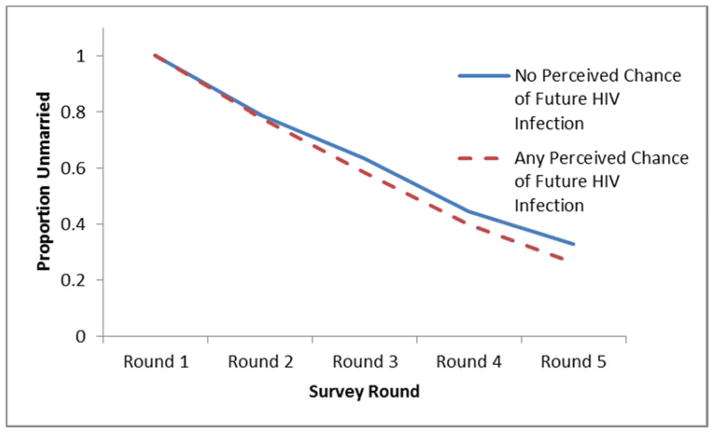
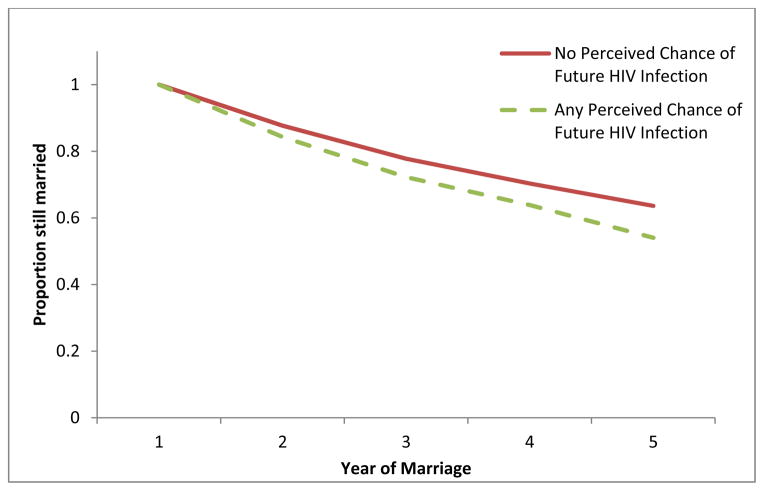
Little is known about whether the timing of marriage is used as a strategy to avoid HIV infection among young people in sub-Saharan Africa. Analyzing five rounds of longitudinal data from the Malawi Schooling and Adolescent Survey, we do not find support for the hypothesis that young women's perceived chances of future HIV infection are associated with the transition to marriage, but we do find evidence that young married women who see themselves as at risk of future infection have a greater likelihood of divorcing than do women who perceive no chance of future infection. We also use individual-level fixed-effects regressions to examine how the transition to marriage affects respondents' expectations of future HIV infection. Respondents are consistently more likely to perceive any chance of future HIV infection in the years following marriage than in the years preceding it. Our findings suggest that young women revise their risk perceptions based on their marital experiences and that divorce may serve as a protective strategy for young married women concerned about their chance of future HIV infection.
关于在撒哈拉以南非洲地区,结婚时间是否被用作年轻人避免感染艾滋病毒的一种策略,人们知之甚少。通过分析马拉维教育与青少年调查的五轮纵向数据,我们并未找到证据支持以下假设:年轻女性对未来感染艾滋病毒可能性的认知与结婚转变有关,但我们确实发现,那些认为自己未来有感染风险的年轻已婚女性,比那些认为未来没有感染可能性的女性更有可能离婚。我们还使用个体层面的固定效应回归分析,来研究结婚转变如何影响受访者对未来感染艾滋病毒的预期。受访者在婚后几年比婚前几年更有可能认为自己未来有感染艾滋病毒的可能性。我们的研究结果表明,年轻女性会根据自己的婚姻经历调整对风险的认知,对于担心未来感染艾滋病毒的年轻已婚女性来说,离婚可能是一种保护策略。