Centro de Estudios en Salud, Universidad del Valle de Guatemala, Guatemala City, Guatemala.
PLoS Negl Trop Dis. 2009;3(3):e404. doi: 10.1371/journal.pntd.0000404. Epub 2009 Mar 31.
Elimination of onchocerciasis (river blindness) through mass administration of ivermectin in the six countries in Latin America where it is endemic is considered feasible due to the relatively small size and geographic isolation of endemic foci. We evaluated whether transmission of onchocerciasis has been interrupted in the endemic focus of Escuintla-Guatemala in Guatemala, based on World Health Organization criteria for the certification of elimination of onchocerciasis.
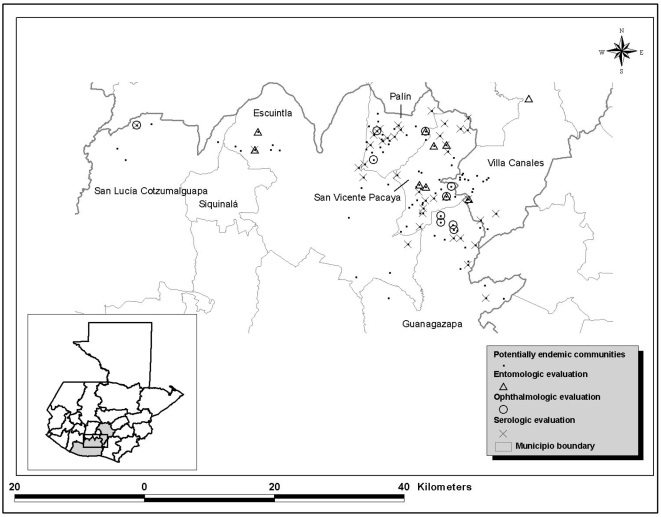
METHODOLOGY/PRINCIPAL FINDINGS: We conducted evaluations of ocular morbidity and past exposure to Onchocerca volvulus in the human population, while potential vectors (Simulium ochraceum) were captured and tested for O. volvulus DNA; all of the evaluations were carried out in potentially endemic communities (PEC; those with a history of actual or suspected transmission or those currently under semiannual mass treatment with ivermectin) within the focus. The prevalence of microfilariae in the anterior segment of the eye in 329 individuals (> or =7 years old, resident in the PEC for at least 5 years) was 0% (one-sided 95% confidence interval [CI] 0-0.9%). The prevalence of antibodies to a recombinant O. volvulus antigen (Ov-16) in 6,432 school children (aged 6 to 12 years old) was 0% (one-sided 95% IC 0-0.05%). Out of a total of 14,099 S. ochraceum tested for O. volvulus DNA, none was positive (95% CI 0-0.01%). The seasonal transmission potential was, therefore, 0 infective stage larvae per person per season.
CONCLUSIONS/SIGNIFICANCE: Based on these evaluations, transmission of onchocerciasis in the Escuintla-Guatemala focus has been successfully interrupted. Although this is the second onchocerciasis focus in Latin America to have demonstrated interruption of transmission, it is the first focus with a well-documented history of intense transmission to have eliminated O. volvulus.
在拉丁美洲六个流行盘尾丝虫病(河盲症)的国家,通过大规模使用伊维菌素进行治疗,消除该病被认为是可行的,这是因为流行区的范围相对较小且地理位置较为孤立。我们根据世界卫生组织消除盘尾丝虫病的认证标准,评估了在危地马拉埃斯昆特拉-危地马拉的流行区是否已经阻断了盘尾丝虫病的传播。
方法/主要发现:我们对人群的眼部发病率和既往感染旋盘尾丝虫的情况进行了评估,同时对潜在的传播媒介(棕斑幽蚊)进行了捕获和盘尾丝虫 DNA 检测;所有评估均在流行区(PEC;有实际或疑似传播史或目前每半年接受伊维菌素大规模治疗的社区)的潜在流行社区(PEC;有实际或疑似传播史或目前每半年接受伊维菌素大规模治疗的社区)进行。在 329 名(年龄≥7 岁,居住在 PEC 至少 5 年)眼前段的微丝蚴流行率为 0%(单侧 95%置信区间 [CI] 0-0.9%)。6432 名 6 至 12 岁的学童中,抗重组旋盘尾丝虫抗原(Ov-16)抗体的流行率为 0%(单侧 95%CI 0-0.05%)。总共检测了 14099 只棕斑幽蚊的盘尾丝虫 DNA,均为阴性(95%CI 0-0.01%)。因此,季节性传播潜力为每人每季节 0 条感染性幼虫。
结论/意义:根据这些评估,埃斯昆特拉-危地马拉流行区的盘尾丝虫病传播已被成功阻断。尽管这是拉丁美洲第二个证明已阻断传播的盘尾丝虫病流行区,但它是第一个有大量记录表明传播强度很高的流行区,已经消除了旋盘尾丝虫。